


A tycoon who became China’s richest man by building an electronics and home appliance empire was jailed yesterday for 14 years for bribery and insider trading, capping a spectacular fall from grace.
Observers said Huang Guangyu (黃光裕), a high school dropout once known as the “Price Butcher” for the low prices at his massive GOME chain of stores, had been held up as an example of unscrupulous corporate greed and corruption.
A Beijing court ordered Huang, in his 40s, to pay a fine of 600 million yuan (US$88 million), and authorities seized another 200 million yuan in assets as part of his conviction, state Xinhua news agency reported.
A court official said he could not immediately confirm the decision.
Huang was named China’s richest man in 2004, 2005 and 2008 by the Hurun Report magazine. In October 2008, his estimated net worth was US$6.3 billion.
A month later, he was detained and placed under investigation. He resigned as GOME director and chairman in January of last year. Huang was held for more than a year without charge, and was then tried last month in a Beijing court.
The court found him guilty of bribing or ordering others to bribe five government officials with 4.56 million yuan in cash and properties from 2006 to 2008, Xinhua said.
The bribes were offered in exchange for “improper benefits” for Huang’s GOME Electrical Appliances and his Beijing Pengrun Real Estate Development, it said previously.
Gome and Pengrun were fined 5 million yuan and 1.2 million yuan respectively for their involvement in the scandal.
Huang was also convicted of insider trading of shares in the Shenzhen-listed Beijing Centergate Technologies, in which he was the majority shareholder. He allegedly earned more than 300 million yuan in illegal profits.
He was further found to have engaged in “illegal business dealings.”
The court said it had shown “leniency” even though Huang’s crimes were “extremely serious” because he had admitted his guilt and cooperated with investigators, Xinhua said.
Before his arrest, Huang was revered in the media as a model entrepreneur, once dubbed the “Sam Walton of China” after the founder of Wal-Mart, who rose from nothing by shrewdly capitalizing on China’s decades of economic reforms.
After dropping out of school, he started building his fortune in his teens, running a roadside stall in Beijing where he sold radios and gadgets purchased from factories near his hometown in south China’s Guangdong Province.
GOME is now China’s largest electronics and appliance chain with more than 1,200 stores in more than 200 cities.
“It certainly can serve as a warning,” Shanghai-based financial analyst Yan Tan, who writes columns for several publications, said when asked about the verdict. “His case was closely watched by the public and it involves collusion with high-level officials.”
Wu Shaozhi, a Beijing-based lawyer specializing in cases involving financial crimes, said he suspected the court had handed down a “heavy” jail term because of Huang’s alleged connections in the upper echelons of power.
Two top police officials, including a former deputy minister of public security, have been detained on suspicion of bribery in connection with the case, reports have said.
Huang has also been linked to the sacked former mayor of Shenzhen, Xu Zongheng (許宗衡).
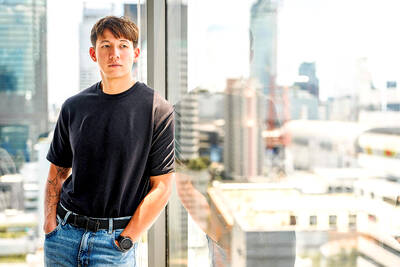
SPEAKING OUT: After Siranudh Scott’s allegations surfaced, celebrities and public figures took to social media to share their own experiences of sexual misconduct and abuse A high-profile alleged sexual abuse case within a wealthy Thai beer brewing family has prompted a wave of painful accounts from survivors of unconnected abuse in the conservative nation. Siranudh Scott, a member of the billionaire Thai family that founded the ubiquitous Singha beer brand, posted an emotional video this month accusing his elder brother Sunit of repeatedly abusing him when he was a teenager. Sunit, who is in his 30s, later denied the allegations in a video posted online, but Singha parent Boonrawd dismissed him from his executive role with the company on Tuesday last week. “I felt I needed to speak

A Hong Kong astronaut is to join a Chinese space mission for the first time as part of a three-person crew launching today, as Beijing edges closer to its goal of landing people on the moon. The Tiangong space station — crewed by teams of three astronauts that are typically rotated every six months — is the crown jewel of China’s space program, boosted by billions in state investment in a bid to catch up with the US and Russia. The Shenzhou-23 mission is to blast off at 11:08pm from the Jiuquan Satellite Launch Center in northwestern China, carrying three astronauts to
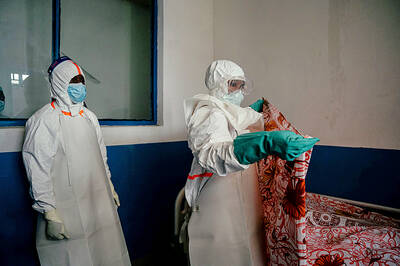
UPGRADED ALERT: The risk inside DR Congo is now considered ‘very high,’ while neighboring countries face a ‘high’ threat as the outbreak continues, the WHO said Ebola is spreading faster than responders can track it in eastern Congo, where health workers managed to follow up with barely one in five identified contacts in a single day. Authorities in the Democratic Republic of the Congo (DR Congo) reported 83 confirmed infections, 746 suspected cases and 1,603 identified contacts as of Thursday, but health workers were able to follow up on only 342 contacts that day — about 21 percent of the total under monitoring — data released by the DR Congo Ministry of Public Health on Friday showed. The figures suggest the response is falling behind the outbreak itself,

SEEKING ORDER: Rodrigo Paz said that ‘anyone who wants to destroy the nation will have to deal with this president and the full force of the constitution’ Bolivian President Rodrigo Paz on Wednesday said that the nation was at a “breaking point” after nearly a month of protests that have caused shortages of food, fuel and medicine. Paz, who took office six months ago amid the worst economic crisis there in four decades, is battling a groundswell of fury over his policies. The political capital, La Paz, has been besieged by low-income workers and members of the indigenous majority calling for his resignation. “The country needs order and is reaching breaking point,” the 58-year-old said at a public event in La Paz, renewing his appeal for dialogue. On Tuesday, the Bolivian


 RSS
RSS