


Japan’s native people, the Ainu, once hunted bears and fished for salmon in the wild forests of the country’s far north, but today they are an ethnic minority fighting for their cultural survival.
Like Aboriginals elsewhere, the Ainu suffered through an era of forced assimilation that took a heavy toll on their customs, language and way of life, leaving them a disadvantaged minority in modern Japan.
As the group keeps struggling to redress past wrongs and revive its rapidly fading traditions, its community leaders say they hope for support from Japan’s new center-left government, which took power in mid-September.
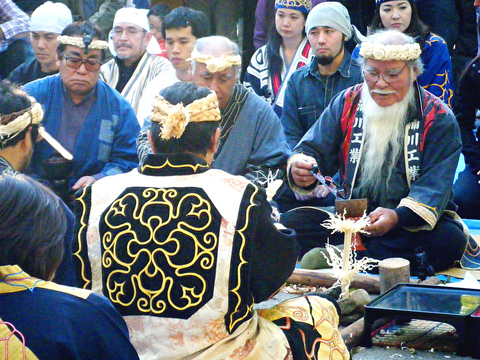
PHOTO: AFP
The electoral seat of Prime Minister Yukio Hatoyama is on Hokkaido island, part of the ancient homeland of the Ainu, which once stretched from northern Honshu island to the Kuril and Sakhalin islands now ruled by Russia.
Hatoyama, in a recent parliamentary address, said he wants a society free of discrimination and prejudice, and hopes to promote cultural diversity, including by “respecting the history and culture of the Ainu people.”
His Democratic Party of Japan has promised a kinder, gentler society after more than half a century of almost unbroken conservative rule, and the prime minister often speaks of his vision of a society shaped by “fraternity.”
The Ainu hope the new spirit of brotherhood will also apply to them as they continue to struggle with higher incidences of unemployment and poverty than the rest of Japan, and lower levels of health and education.
“After a long, negative period, I believe that great possibilities are opening up now that, in the political world, the Democratic Party of Japan is about to launch a new era,” Haruzo Urakawa, a former chairman of the Tokyo Ainu Association, wrote in a letter to Hatoyama.
The new prime minister, days after his Aug. 30 election win, met Tadashi Kato, chairman of the Ainu Association of Hokkaido, who urged the incoming government to establish a new Ainu law and boost measures to support his people.
The Ainu were only recognized in June last year as Japan’s Aborigines, in a resolution passed months before Japan hosted a summit of world leaders, the G8 conference, on Hokkaido.
Japan signed up in 2007 to the UN Declaration on the Right of Indigenous Peoples, but still lacks a national law to formally recognize the Ainu.
“At the moment, the most urgent issue for us is the establishment, in concrete terms, of specific legislation at the national level,” Kato said.
Although the content of such a law has not taken shape yet, Ainu have in the past called for greater self-determination, control over natural resources, school texts in their native language and a formal apology for past wrongs.
Most of Japan’s people, Kato said, have a lot to learn about the Ainu, whose number has been estimated at 70,000, but is uncertain because many have integrated with mainstream society and some have hidden their cultural roots.
Some anthropologists believe the Ainu once lived across Japan’s four major islands, but were pushed northward by later waves of migration from mainland Asia.
Fairer-skinned and more hirsute than most Japanese, the Ainu traditionally observed an animist faith with a belief that God exists in every creation — trees, hills, lakes, rivers and animals, particularly bears.
Ainu men kept full beards, while women adorned themselves with facial tattoos which they acquired before they reached the age of marriage. Ainu clothes were robes spun from tree bark and decorated with geometric designs.
Ethnic Japanese gradually settled Hokkaido and in 1899 enacted the Hokkaido Former Aborigines Protection Act, under which the Ainu were forced to give up their land, language and traditions, and shift from hunting to farming.
The act was repealed only in 1997 and replaced by legislation calling for “respect for the dignity of the Ainu people.”
That law, however, stopped short of recognizing the Ainu as Aborigines or, as some activists have demanded, setting up autonomous areas along the lines of Native American reservations in the US.

SPEAKING OUT: After Siranudh Scott’s allegations surfaced, celebrities and public figures took to social media to share their own experiences of sexual misconduct and abuse A high-profile alleged sexual abuse case within a wealthy Thai beer brewing family has prompted a wave of painful accounts from survivors of unconnected abuse in the conservative nation. Siranudh Scott, a member of the billionaire Thai family that founded the ubiquitous Singha beer brand, posted an emotional video this month accusing his elder brother Sunit of repeatedly abusing him when he was a teenager. Sunit, who is in his 30s, later denied the allegations in a video posted online, but Singha parent Boonrawd dismissed him from his executive role with the company on Tuesday last week. “I felt I needed to speak

A Hong Kong astronaut is to join a Chinese space mission for the first time as part of a three-person crew launching today, as Beijing edges closer to its goal of landing people on the moon. The Tiangong space station — crewed by teams of three astronauts that are typically rotated every six months — is the crown jewel of China’s space program, boosted by billions in state investment in a bid to catch up with the US and Russia. The Shenzhou-23 mission is to blast off at 11:08pm from the Jiuquan Satellite Launch Center in northwestern China, carrying three astronauts to

UPGRADED ALERT: The risk inside DR Congo is now considered ‘very high,’ while neighboring countries face a ‘high’ threat as the outbreak continues, the WHO said Ebola is spreading faster than responders can track it in eastern Congo, where health workers managed to follow up with barely one in five identified contacts in a single day. Authorities in the Democratic Republic of the Congo (DR Congo) reported 83 confirmed infections, 746 suspected cases and 1,603 identified contacts as of Thursday, but health workers were able to follow up on only 342 contacts that day — about 21 percent of the total under monitoring — data released by the DR Congo Ministry of Public Health on Friday showed. The figures suggest the response is falling behind the outbreak itself,

SEEKING ORDER: Rodrigo Paz said that ‘anyone who wants to destroy the nation will have to deal with this president and the full force of the constitution’ Bolivian President Rodrigo Paz on Wednesday said that the nation was at a “breaking point” after nearly a month of protests that have caused shortages of food, fuel and medicine. Paz, who took office six months ago amid the worst economic crisis there in four decades, is battling a groundswell of fury over his policies. The political capital, La Paz, has been besieged by low-income workers and members of the indigenous majority calling for his resignation. “The country needs order and is reaching breaking point,” the 58-year-old said at a public event in La Paz, renewing his appeal for dialogue. On Tuesday, the Bolivian


 RSS
RSS