


Germany’s most popular women’s magazine is banning professional models from its pages and replacing them with images of “real life” women instead.
In what is seen as the latest attempt to stamp out the “size zero” model, the editors of Brigitte said it would in future only use women with “normal figures.”
“From 2010 we will not work with professional models any more,” said Andreas Lebert, editor-in-chief, adding that he was “fed up” with retouching pictures of underweight models who bore no resemblance to ordinary women.
“For years we’ve had to use Photoshop to fatten the girls up,” he said. “Especially their thighs, and decolletage. But this is disturbing and perverse and what has it got to do with our real reader?”
He said the move was a response to complaints by readers who said they had no connection with the women depicted in fashion features and “no longer wanted to see protruding bones.”
“Today’s models weigh around 23 percent less than normal women,” Lebert said. “The whole model industry is anorexic.”
Brigitte, which is Germany’s best-selling women’s title with more than 700,000 copies, offers readers a familiar diet of fitness, lifestyle, recipes and sex, which tends to appeal to upwardly mobile younger career women.
Lebert said the magazine would call on German women to put themselves forward as models for fashion and makeup articles.
“We’re looking for women who have their own identity, whether it be the 18-year-old student, the company chairwoman, the musician, or the footballer,” he said, adding that he wanted a mix between prominent and completely unknown women and would look out for politicians and actresses interested in modelling.
Critics accused Brigitte of seeking a cost-cutting strategy at a time of declining magazine sales, and of dressing it up as a campaign issue to attract new readers, but Lebert insisted the “ordinary women” would be paid the same amounts that the magazine would otherwise pay modeling agencies.
No one has yet been signed up for the new initiative, but Lebert is thought to be scouting around. He will undoubtedly extend an invitation to Chancellor Angela Merkel. While her fashion sense has sometimes been questioned, she makes headlines each year with her eye-catching choices of ballgowns at the annual Wagner festival in Bayreuth, and she recently had a Barbie doll modeled after her.
Other figureheads might include arguably the most successful female tennis player of all time, Steffi Graf, or the country’s popular family minister, mother of seven, Ursula von der Leyen.
German commentators said that Brigitte’s move had clearly been inspired by British Vogue editor Alexandra Schulman’s recent appeal to major fashion houses to end the “size-zero” culture.
Two years ago Spain introduced a law banning models who were “too thin” from the catwalks.
Model agencies reacted with skepticism to the Brigitte plan.
Louisa von Minckwitz, owner of Louisa Models, said she understood the rage about underweight models but doubted that readers really wanted to buy a magazine to look at ordinary women.
“The fact is that women want to see clothes on beautiful, aesthetically pleasing people,” she said.

When a hiker fell from a 55m waterfall in wild New Zealand bush, rescuers were forced to evacuate the badly hurt woman without her dog, which could not be found. After strangers raised thousands of dollars for a search, border collie Molly was flown to safety by a helicopter pilot who was determined to reunite the pet and the owner. A week earlier, an emergency rescue helicopter found the woman with bruises and lacerations after a fall at a rocky spot at the waterfall on the South Island’s West Coast. She was airlifted on March 24, but they were forced to
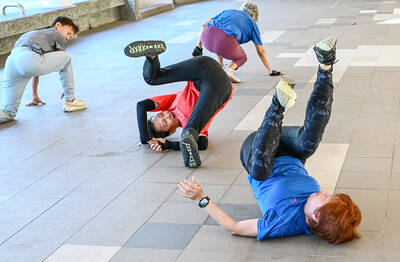
CONFIDENCE BOOSTER: ’After parkour ... you dare to do a lot of things that you think only young people can do,’ a 67-year-old parkour enthusiast said In a corner of suburban Singapore, Betty Boon vaults a guardrail, crawls underneath a slide, executes forward shoulder rolls and scales a steep slope, finishing the course to applause. “Good job,” the 69-year-old’s coach cheers. This is “geriatric parkour,” where about 20 retirees learned to tackle a series of relatively demanding exercises, building their agility and enjoying a sense of camaraderie. Boon, an upbeat grandmother, said learning parkour has aided her confidence and independence as she ages. “When you’re weak, you will be dependent on someone,” she said after sweating it out with her parkour classmates in suburban Toa Payoh,

HIGH HOPES: The power source is expected to have a future, as it is not dependent on the weather or light, and could be useful for places with large desalination facilities A Japanese water plant is harnessing the natural process of osmosis to generate renewable energy that could one day become a common power source. The possibility of generating power from osmosis — when water molecules pass from a less salty solution to a more salty one — has long been known. However, actually generating energy from that has proved more complicated, in part due the difficulty of designing the membrane through which the molecules pass. Engineers in Fukuoka, Japan, and their private partners think they might have cracked it, and have opened what is only the world’s second osmotic power plant. It generates

Chinese dissident artist Gao Zhen (高兟), famous for making provocative satirical sculptures of former Chinese leader Mao Zedong (毛澤東), was tried on Monday over accusations of “defaming national heroes and martyrs,” his wife and a rights group said. Gao, 69, who was detained in 2024 during a visit from the US, faces a maximum three-year prison sentence, said his wife, Zhao Yaliang (趙雅良), and Shane Yi, a researcher at the Chinese Human Rights Defenders group which operates outside the nation. The closed-door, one-day trial took place at Sanhe City People’s Court in Hebei Province neighboring the capital, Beijing, and ended without a


 RSS
RSS