


After more than 40 years, the former US army officer found guilty of organizing mass killings in the Vietnamese community of My Lai during the war has made a public apology.
“There is not a day that goes by that I do not feel remorse for what happened that day in My Lai,” former lieutenant William Calley told members of the Kiwanis Club of Greater Columbus, Georgia.
“I feel remorse for the Vietnamese who were killed, for their families, for the American soldiers involved and their families. I am very sorry,” he said.
Calley spoke on Wednesday, but because of a restricted audience, his remarks did not become known until now.
The killings that occurred on March 16, 1968, in the South Vietnamese hamlet of My Lai prompted widespread outrage around the world.
They are also credited with advancing the end of the Vietnam War because they significantly undermined US public support for the war effort.
MISSION
The massacre began when men of Charlie Company under the command of Lieutenant Calley opened fire on civilians during a “search and destroy” mission in My Lai and neighboring villages.
The targets of the killings were mainly old men, women and children — all unarmed — as most younger males of the community were working in the fields.
The exact toll of the massacre still remain in dispute. But US estimates suggest that between 347 and 504 unarmed citizens were massacred that day.
According to testimony presented during Calley’s trial, dozens of people were herded into a local irrigation ditch and killed with automatic weapons.
A large group of about 70 to 80 villagers, rounded up in the center of the village, were killed personally by Calley and other soldiers under his command.
Calley also shot two other large groups of civilians with a weapon taken from a soldier who had refused to obey his orders, it was revealed.
The massacre did not become public knowledge until November 1969, when independent investigative journalist Seymour Hersh broke the story after extensive conversations with Calley.
The lieutenant, the only American tried in connection with the massacre, was convicted and sentenced by a court-martial to life imprisonment. But he was freed after three years under house arrest when then-US president Richard Nixon intervened.
Although his presentation at the Kiwanis Club was brief, Calley took a few questions.
Asked if obeying an unlawful order was not itself an unlawful act, he said: “I believe that is true.”
“If you are asking why I did not stand up to them when I was given the orders, I will have to say that I was a second lieutenant getting orders from my commander and I followed them — foolishly, I guess,” he said.
Calley’s immediate commander at that time was Captain Ernest Medina, who was also tried in connection to the My Lai massacre.
But Medina was represented by famous defense attorney F. Lee Bailey and was acquitted of all charges in 1971.
Following his release from house arrest, Calley settled in Columbus, Georgia, where he worked at jewelry store that belonged to his father-in-law.
He now lives in Atlanta. He complained that some of the basic civil rights remained denied to him following his conviction.
“I still cannot vote,” he said.
SURVIVOR
A survivor of the massacre said yesterday he welcomed the public apology.
“It’s a question of the past and we accept his apologies, although they come too late,” Pham Thanh Cong, director of a small museum at My Lai, said by telephone.
“However, I prefer that he send his apologies to me in writing or by e-mail.”

When a hiker fell from a 55m waterfall in wild New Zealand bush, rescuers were forced to evacuate the badly hurt woman without her dog, which could not be found. After strangers raised thousands of dollars for a search, border collie Molly was flown to safety by a helicopter pilot who was determined to reunite the pet and the owner. A week earlier, an emergency rescue helicopter found the woman with bruises and lacerations after a fall at a rocky spot at the waterfall on the South Island’s West Coast. She was airlifted on March 24, but they were forced to
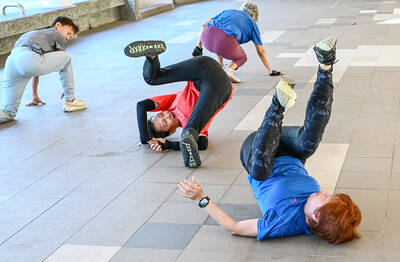
CONFIDENCE BOOSTER: ’After parkour ... you dare to do a lot of things that you think only young people can do,’ a 67-year-old parkour enthusiast said In a corner of suburban Singapore, Betty Boon vaults a guardrail, crawls underneath a slide, executes forward shoulder rolls and scales a steep slope, finishing the course to applause. “Good job,” the 69-year-old’s coach cheers. This is “geriatric parkour,” where about 20 retirees learned to tackle a series of relatively demanding exercises, building their agility and enjoying a sense of camaraderie. Boon, an upbeat grandmother, said learning parkour has aided her confidence and independence as she ages. “When you’re weak, you will be dependent on someone,” she said after sweating it out with her parkour classmates in suburban Toa Payoh,

HIGH HOPES: The power source is expected to have a future, as it is not dependent on the weather or light, and could be useful for places with large desalination facilities A Japanese water plant is harnessing the natural process of osmosis to generate renewable energy that could one day become a common power source. The possibility of generating power from osmosis — when water molecules pass from a less salty solution to a more salty one — has long been known. However, actually generating energy from that has proved more complicated, in part due the difficulty of designing the membrane through which the molecules pass. Engineers in Fukuoka, Japan, and their private partners think they might have cracked it, and have opened what is only the world’s second osmotic power plant. It generates

Chinese dissident artist Gao Zhen (高兟), famous for making provocative satirical sculptures of former Chinese leader Mao Zedong (毛澤東), was tried on Monday over accusations of “defaming national heroes and martyrs,” his wife and a rights group said. Gao, 69, who was detained in 2024 during a visit from the US, faces a maximum three-year prison sentence, said his wife, Zhao Yaliang (趙雅良), and Shane Yi, a researcher at the Chinese Human Rights Defenders group which operates outside the nation. The closed-door, one-day trial took place at Sanhe City People’s Court in Hebei Province neighboring the capital, Beijing, and ended without a


 RSS
RSS