


Takeo Doi, a psychoanalayst who wrote that the Japanese psyche thrived on a love-hungry dependence on authority figures, has died, his family said. He was 89.
Doi, who died in his Tokyo home on Sunday from illnesses related to old age, wrote the 1971 book, The Anatomy of Dependence, which introduced the idea of amae — a childlike desire for indulgence — as key to understanding the Japanese mind.
Doi’s work was a hit in Japan and has been widely studied abroad in translation. Ezra Vogel, social sciences professor emeritus at Harvard University, has praised Doi’s work as “the first book by a Japanese trained in psychiatry to have an impact on Western psychiatric thinking.”
Doi argued that amae, while also observed by other nationalities, was more pronounced and elaborate among Japanese, and was key in defining social relationships everywhere, including at the office, at schools and in marriages.
His work stemmed from what he called his “culture shock” when he went to study in the US in the 1950s and saw the difference between how Americans and Japanese act, including his patients. He was struck by how there was no precise way to translate ***amae into English, although the behavior was common in puppies and human babies.
“I set about using my idea that amae might be vitally important in understanding the Japanese mentality,” Doi wrote in his book. “I soon became convinced that it provided a clue to all kinds of things that had hitherto been obscure.”
Doi used amae as a starting point for explaining other common Japanese traits, such as self-effacement and the widespread perception of a duality between appearances and a hidden internal reality.
Doi taught at the International Christian University in Tokyo between 1980-1982, and he also counseled students and faculty members. Before that, he was a professor at his alma mater, the University of Tokyo’s Faculty of Medicine, from 1971 to 1980.
He was working as a special adviser to the PHP Research Institute up to his death, the private think-tank said.
Funeral services are for just the family, and details of a separate memorial service have yet to be decided, said Megumi Doi, his daughter. Doi is survived by his wife, two sons and two daughters, she said.

Through the noise of rushing papers and whirring belts at a print factory in Kyoto, two creators watch their photo essay come to life in broadsheet form — part of an effort to win new audiences in the age of artificial intelligence (AI). Despite the decline of the publishing industry, self-publication and handmade “zine” magazines are growing in popularity in Japan, reflecting the nation’s enduring love of paper in the digital era. While speaking to Agence France-Presse at the plant, his hands black with ink, one of the creators, Kazuma Obara, said: “I think [paper] is a medium that engages all five

‘CROSSING THE LINE’: China’s embassy in Seoul criticized US Forces Korea Commander General Xavier Brunson, asking if his ‘hostile’ remarks were authorized by Washington South Korea and the US are in talks over recent public remarks by the commander of US Forces Korea, Seoul’s presidential office said yesterday, after the comments drew sharp criticism from China. In a recent podcast interview, US Forces Korea Commander General Xavier Brunson described South Korea as “the dagger in the heart of Asia” from China’s east coast, prompting the Chinese embassy in Seoul to say that he had “truly crossed the line.” The interview came amid growing speculation that Washington might seek to expand the role of US Forces Korea in countering the growing regional influence of China, a key
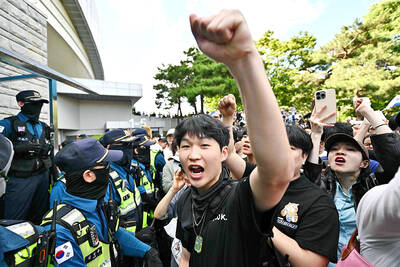
‘ABSURD MISTAKE’: The election commission said that there had been a failure to anticipate turnout after 14 polling stations ran short of ballot papers South Korean riot police yesterday cleared protesters from a Seoul polling station after a 35-hour blockade sparked by a shortage of ballot papers during local elections earlier this week. Wednesday’s election was the first nationwide vote since South Korean President Lee Jae-myung took office following the ouster of Yoon Suk-yeol over his short-lived martial law declaration. Lee’s ruling Democratic Party swept most races, but failed to flip the crucial Seoul mayoral seat. The South Korean National Election Commission apologized, blaming a failure to anticipate turnout after 14 polling stations in Seoul ran short of ballot papers. Some polling stations stayed open until 10pm to

Australian researchers have trained lab-grown brain cells on a silicon computer chip to play the 1990s shooter game Doom and said they are just scratching the surface of what the neurons could be capable of doing. It is the science-fiction work of biotech boffins at Cortical Labs, who researched and developed the technology that harnesses the workings of the brain’s networking system. Each so-called “biological computer” contains about 200,000 living human brain cells, grown from stem cells that were harvested from blood donations. Having mastered the simple computer game Pong, where a paddle is moved up and down to send a ball


 RSS
RSS