


Deep-sea explorers who found US$500 million in sunken treasure two years ago say they have discovered another prized shipwreck: A legendary British man-of-war that sank in the English Channel 264 years ago.
The wreckage of the HMS Victory, found below about 100m of water, may carry an even bigger jackpot. Research indicates the ship was carrying 4 tonnes of gold coins when it sank in storm, said Greg Stemm, cofounder of Odyssey Marine Exploration, ahead of a news conference scheduled for yesterday in London.
So far, two brass cannons have been recovered from the wreck, Stemm said. The Florida-based company said it is negotiating with the British government over collaborating on the project.
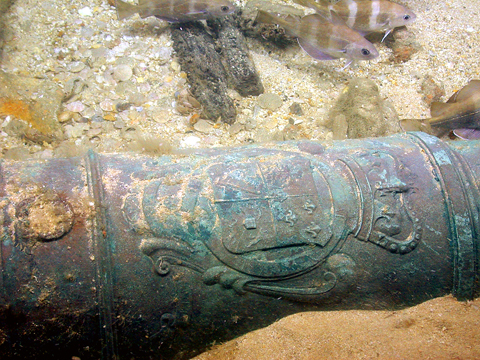
PHOTO: AP
“This is a big one, just because of the history,” Stemm said. “Very rarely do you solve an age-old mystery like this.”
Thirty-one brass cannons and other evidence on the wreck allowed definitive identification of the HMS Victory, 53m sailing ship that was separated from its fleet and sank in the English Channel on Oct. 4, 1744, with at least 900 men aboard, the company said. The ship was the largest and, with 110 brass cannons, the most heavily armed vessel of its day. It was the inspiration for the HMS Victory famously commanded by Admiral Horatio Nelson decades later.
Odyssey was searching for other valuable shipwrecks in the English Channel when it came across the Victory. Stemm wouldn’t say exactly where the ship was found though he said it wasn’t close to where it was expected.
“We found this more than 50 miles [80km] from where anybody would have thought it went down,” Stemm said.
US federal court records filed by Odyssey in Tampa seeking the exclusive salvage rights said the site is 40km to 65km from the English coast, outside of its territorial waters.
A British Ministry of Defence spokesman said on Sunday the government was aware of Odyssey’s claim to have found the Victory.
“Assuming the wreck is indeed that of a British warship, her remains are sovereign immune,” he said on condition of anonymity in keeping with government policy. “This means that no intrusive action may be taken without the express consent of the United Kingdom.”
He would not say whether the government had begun talks with Odyssey over the future of the find.
Newspapers of the day and other historical records analyzed by the company indicated that the Victory sank off the Channel Island of Alderney near Cherbourg, France. Pieces of the ship had washed up in various places, but its final resting place remained a mystery.
The HMS Victory was returning from Lisbon, Portugal, and was probably transporting 100,000 gold Portuguese coins for merchants, according to Odyssey’s research.
Odyssey, a publicly traded corporation, announced in May 2007 that it had raised 17 tonnes of silver coins from an Atlantic Ocean shipwreck. The company later said it believed the wreck to be the Spanish galleon Nuestra Senora de las Mercedes y las Animas, which sank off Portugal in 1804.
Shortly afterward, the Spanish government sued Odyssey in federal court in Tampa to claim the treasure, arguing that the shipwreck was never abandoned by Spain. The case is pending.
Some in the Spanish government have called the company 21st century pirates, and twice ships from Spain’s Civil Guard seized Odyssey ships off the Spanish coast. Both ships and their crews were released within a week.
The company’s relationship with the British government has been more cordial. Odyssey had already negotiated an agreement with British officials regarding the search for the HMS Sussex, which sank in the Mediterranean in 1694 with gold coins aboard.

When a hiker fell from a 55m waterfall in wild New Zealand bush, rescuers were forced to evacuate the badly hurt woman without her dog, which could not be found. After strangers raised thousands of dollars for a search, border collie Molly was flown to safety by a helicopter pilot who was determined to reunite the pet and the owner. A week earlier, an emergency rescue helicopter found the woman with bruises and lacerations after a fall at a rocky spot at the waterfall on the South Island’s West Coast. She was airlifted on March 24, but they were forced to

CONFIDENCE BOOSTER: ’After parkour ... you dare to do a lot of things that you think only young people can do,’ a 67-year-old parkour enthusiast said In a corner of suburban Singapore, Betty Boon vaults a guardrail, crawls underneath a slide, executes forward shoulder rolls and scales a steep slope, finishing the course to applause. “Good job,” the 69-year-old’s coach cheers. This is “geriatric parkour,” where about 20 retirees learned to tackle a series of relatively demanding exercises, building their agility and enjoying a sense of camaraderie. Boon, an upbeat grandmother, said learning parkour has aided her confidence and independence as she ages. “When you’re weak, you will be dependent on someone,” she said after sweating it out with her parkour classmates in suburban Toa Payoh,

HIGH HOPES: The power source is expected to have a future, as it is not dependent on the weather or light, and could be useful for places with large desalination facilities A Japanese water plant is harnessing the natural process of osmosis to generate renewable energy that could one day become a common power source. The possibility of generating power from osmosis — when water molecules pass from a less salty solution to a more salty one — has long been known. However, actually generating energy from that has proved more complicated, in part due the difficulty of designing the membrane through which the molecules pass. Engineers in Fukuoka, Japan, and their private partners think they might have cracked it, and have opened what is only the world’s second osmotic power plant. It generates

Chinese dissident artist Gao Zhen (高兟), famous for making provocative satirical sculptures of former Chinese leader Mao Zedong (毛澤東), was tried on Monday over accusations of “defaming national heroes and martyrs,” his wife and a rights group said. Gao, 69, who was detained in 2024 during a visit from the US, faces a maximum three-year prison sentence, said his wife, Zhao Yaliang (趙雅良), and Shane Yi, a researcher at the Chinese Human Rights Defenders group which operates outside the nation. The closed-door, one-day trial took place at Sanhe City People’s Court in Hebei Province neighboring the capital, Beijing, and ended without a


 RSS
RSS