


North Korea freed a Japanese businessman yesterday after holding him for more than five years on drug smuggling charges, Pyongyang state media reported.
Yoshiaki Sawada was detained in the communist nation in October 2003 after allegedly trying to bribe a North Korean into buying drugs from a third country and smuggling them into Japan, previous North Korean state media reports said.
Yesterday, Pyongyang’s Korean Central News Agency (KCNA) said Sawada left North Korea on the day “thanks to a humanitarian measure” by the regime, but did not say where he was headed.
KCNA claimed the North’s investigation found that a Japanese “plot breeding organization” used Sawada to back accusations that North Korea uses its Mangyongbong-92 ferry to smuggle drugs to Japan.
It said Sawada “admitted to his crime” as well as his links to the unspecified Japanese organization and apologized.
The North “treated him in a humanitarian manner and leniently dealt with his case, taking his wish to go back home and health condition and so on into consideration,” KCNA said.
The report did not say what made the North free Sawada now or if the country negotiated his release with Tokyo.
Relations between Tokyo and Pyongyang have been tense amid a row over the North’s 1970s and 1980s kidnapping of Japanese nationals.
Pyongyang acknowledged in 2002 that it abducted 13 Japanese and allowed five to return home, saying the remaining eight had died.
But Tokyo has demanded proof of their deaths and an investigation into other suspected kidnappings.
In related news, a South Korean fisherman kidnapped by North Korea in 1975 has finally escaped to China but has not yet been allowed to fly home, relatives and an activist said yesterday.
Family members appealed to Beijing to let Yoon Jong-soo, 68, return as soon as possible. He has been in protective custody at a South Korean consulate in northeast China for the past eight months, they said.
“We’ve been separated from each other for more than three decades and we still remain separated even after he escaped the North,” his brother Yoon Joo-ok told journalists.
Activist Choi Sung-yong said Yoon Jong-soo was one of several abductees who had fled the North with Choi’s help decades after being seized.
Others had been allowed to leave South Korean diplomatic missions and fly home within a month or so.
“It is quite unusual for China not to let him go, refusing to give him a green light for more than eight months,” Choi said.
He said he believed China was under strong diplomatic pressure from North Korea, which has proclaimed Yoon a wanted “traitor.”
Choi said Yoon’s wife and their 27-year-old daughter were caught trying to follow Yoon to China and were under house arrest.
Yoon and 32 other crew were captured when their fishing boat developed engine trouble. Four, including Yoon, have escaped over the past few years with Choi’s help.
By Seoul’s official count 494 South Koreans, mostly fishermen, were seized in the Cold War decades following the 1950-1953 Korean conflict. The South also says more than 500 prisoners of war were never sent home in 1953.
North Korea denies holding any South Koreans against their will, even though some have managed to escape.
Choi lost his own fisherman father to North Korean kidnappers more than 40 years ago and campaigns to rescue other victims.
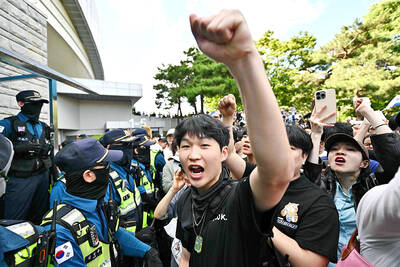
‘ABSURD MISTAKE’: The election commission said that there had been a failure to anticipate turnout after 14 polling stations ran short of ballot papers South Korean riot police yesterday cleared protesters from a Seoul polling station after a 35-hour blockade sparked by a shortage of ballot papers during local elections earlier this week. Wednesday’s election was the first nationwide vote since South Korean President Lee Jae-myung took office following the ouster of Yoon Suk-yeol over his short-lived martial law declaration. Lee’s ruling Democratic Party swept most races, but failed to flip the crucial Seoul mayoral seat. The South Korean National Election Commission apologized, blaming a failure to anticipate turnout after 14 polling stations in Seoul ran short of ballot papers. Some polling stations stayed open until 10pm to

France experienced its hottest spring on record, the French weather service said on Tuesday, after an exceptional early heat wave that also broke highs for the season in England and Wales. Meteo-France said the average nationwide temperature over March to May was 13.8°C — about 1.7°C above the norm, and surpassing records set in 2011 and 2020. “The warmest spring since records began in 1900,” it said in a bulletin. All three months were warmer than average, but the onset of an “unprecedented heatwave” late last month pushed the mercury to highs typically seen at the height of the summer. “Our country had never

A Sherpa guide was found crawling to base camp on Mount Everest a week after he went missing and was reunited with his family, who had given up hope he would return. Dawa Sherpa was last seen on Friday last week descending the mountain, but he did not reach base camp even though his client did. The pair were among the last climbers on the mountain as the climbing season came to an end and the route was dismantled. Dawa was located by a cleaning crew on Thursday morning as he was crawling down the snowy slopes around the Khumbu Icefall, just above
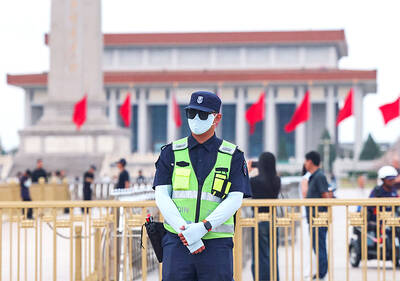
Chinese authorities are snuffing out any remembrance of the deadly 1989 military crackdown on student-led pro-democracy protests in Tiananmen Square, which happened 37 years ago yesterday, in a further tightening of a years-long campaign to erase what happened from public memory. Police told relatives of the victims they would not be allowed to visit a cemetery in Beijing on the anniversary of the crackdown, a person with knowledge of the matter said. Relatives of the victims visited the cemetery on the anniversary for more than 30 years to read memorial statements with police keeping watch, Amnesty International said. Hundreds of people,


 RSS
RSS