


Top negotiators prepared to turn to fresh proposals yesterday in a bid to nail a new global trade free trade pact despite growing discord and warnings that years of painstaking negotiations could unravel at the last minute.
Squabbles among emerging economies threatened to shatter fragile gains in the quest for an agreement, as top negotiators slogged on into a second week of talks.
Delegates said much remained unresolved after a meeting late on Sunday that sought to cement a tentative breakthrough on farming and industrial products.
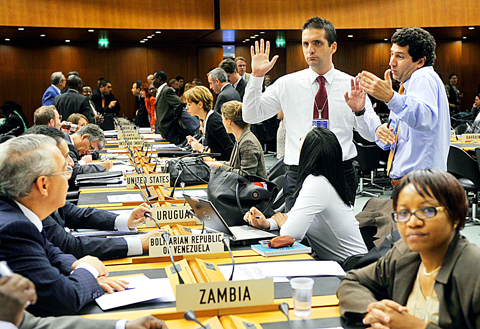
PHOTO: AFP
US Trade Representative Susan Schwab accused emerging economies of delaying an agreement.
“We had a path on Friday for a successful outcome on Friday night. It wasn’t perfect, but it was delicately balanced and had a strong endorsement,” she told reporters after the talks.
“Unfortunately a few emerging markets have decided that somehow they want to re-balance it in favor of one or another issue,” she said. “That was a very delicate balance that was struck. You pull one thread, it threatens to unravel.”
As if to prove her point, key African and Caribbean banana producers threatened on Sunday to torpedo any deal if the EU and Latin American states went ahead with a plan to cut EU banana import tariffs.
“We will block the [WTO] negotiations if our latest counter-proposal is not accepted,” said Cameroon Trade Minister Luc Magloire Mbarga Atangana, the spokesman for the African, Caribbean and Pacific (ACP) trade grouping.
His comment referred to the ACP’s bid to amend an agreement by the EU to lower banana import tariffs for certain Latin American states, which ACP countries fear will harm the competitiveness of their banana industries.
Ministers from more than 35 key trading nations were due to consult all 153 members of the WTO at a full meeting yesterday.
The WTO’s chief negotiators on agriculture and industrial goods — respectively ambassadors Crawford Falconer of New Zealand and Don Stephenson of Canada — were also set to issue new texts that would hopefully serve as the basis for any final agreement, delegates said.
New Zealand Trade Minister Phil Goff said on Sunday that there was “no great animosity,” but conceded that many differences remain.
Optimism had grown after a perceived breakthrough on Friday in deadlocked talks on farming and industrial products, followed by further encouraging signs from key players after discussions on the services sector.
But as negotiators began picking through the finer details on Sunday, a split opened up among emerging nations, underlining the vast differences in their interests.
India stuck to its hard line of protecting its small-scale farmers, claiming that it had rallied 100 countries to its cause, but other developing economies said they opposed India’s stance on the issue.
Commerce Minister Kamal Nath told reporters Sunday night’s meeting was “constructive,” but said there was still disagreement on the persistent sore points of agricultural import tariffs and sector-specific proposals for industrial goods.
Nath told reporters that “100 countries” had signed a paper backing India’s concerns on the so-called special safeguard mechanism (SSM) which would allow developing countries to raise farm tariffs if imports surge.
But an African diplomat said: “Who are these 100 countries? They [India] are thriving on a pack of lies.”
Other developing countries that oppose India’s stance include Latin American economies such as Paraguay and Uruguay, where much of their farm exports go to developing states.
“We are not ready to accept a solution that will impose a different balance of rights and obligations than the one we agreed upon in the Uruguay Round” of talks in 1994, said Uruguay’s ambassador to the WTO, Guillermo Valles Galmes.
Meanwhile, Asian export giant China annoyed other developing countries as it insisted on protecting its rice, cotton and sugar producers, another diplomat said.
“China is becoming a major problem. It is going back on a lot of its promises,” said the diplomat on condition of anonymity, adding that the Asian exporter said it would not lower its tariffs on these three products.

When a hiker fell from a 55m waterfall in wild New Zealand bush, rescuers were forced to evacuate the badly hurt woman without her dog, which could not be found. After strangers raised thousands of dollars for a search, border collie Molly was flown to safety by a helicopter pilot who was determined to reunite the pet and the owner. A week earlier, an emergency rescue helicopter found the woman with bruises and lacerations after a fall at a rocky spot at the waterfall on the South Island’s West Coast. She was airlifted on March 24, but they were forced to

CONFIDENCE BOOSTER: ’After parkour ... you dare to do a lot of things that you think only young people can do,’ a 67-year-old parkour enthusiast said In a corner of suburban Singapore, Betty Boon vaults a guardrail, crawls underneath a slide, executes forward shoulder rolls and scales a steep slope, finishing the course to applause. “Good job,” the 69-year-old’s coach cheers. This is “geriatric parkour,” where about 20 retirees learned to tackle a series of relatively demanding exercises, building their agility and enjoying a sense of camaraderie. Boon, an upbeat grandmother, said learning parkour has aided her confidence and independence as she ages. “When you’re weak, you will be dependent on someone,” she said after sweating it out with her parkour classmates in suburban Toa Payoh,
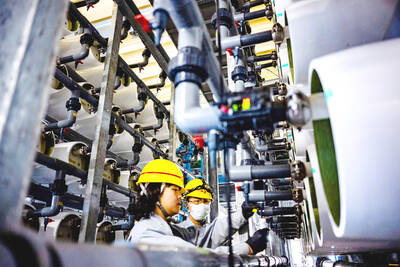
HIGH HOPES: The power source is expected to have a future, as it is not dependent on the weather or light, and could be useful for places with large desalination facilities A Japanese water plant is harnessing the natural process of osmosis to generate renewable energy that could one day become a common power source. The possibility of generating power from osmosis — when water molecules pass from a less salty solution to a more salty one — has long been known. However, actually generating energy from that has proved more complicated, in part due the difficulty of designing the membrane through which the molecules pass. Engineers in Fukuoka, Japan, and their private partners think they might have cracked it, and have opened what is only the world’s second osmotic power plant. It generates
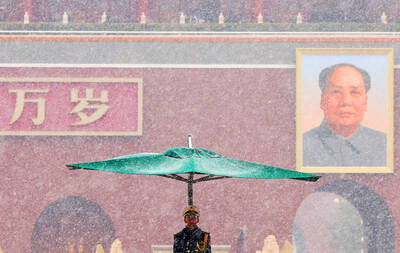
Chinese dissident artist Gao Zhen (高兟), famous for making provocative satirical sculptures of former Chinese leader Mao Zedong (毛澤東), was tried on Monday over accusations of “defaming national heroes and martyrs,” his wife and a rights group said. Gao, 69, who was detained in 2024 during a visit from the US, faces a maximum three-year prison sentence, said his wife, Zhao Yaliang (趙雅良), and Shane Yi, a researcher at the Chinese Human Rights Defenders group which operates outside the nation. The closed-door, one-day trial took place at Sanhe City People’s Court in Hebei Province neighboring the capital, Beijing, and ended without a


 RSS
RSS