


Russian Prime Minister Vladimir Putin on Thursday called on Europeans to strengthen economic cooperation with Russia, but adding that he was powerless to rein in soaring oil prices.
Putin was speaking to journalists in Paris after talks with French Prime Minister Francois Fillon at the start of a two-day visit — his first outside Russia since stepping down as head of state.
The special treatment in the French capital accorded to Putin, who was president for eight years, underscored the view in Paris that he remains a predominant player in Russian affairs.
Replying to questions, Putin — who met French President Nicolas Sarkozy later on Thursday — said concern over human rights abuses in Russia was exaggerated, suggesting that the topic was being exploited to pressure Moscow.
Noting that France takes over the rotating presidency of the EU from July 1, Putin said: “We hope this will enable us to advance negotiations on a strategic partnership.”
EU member states on Monday approved the launch of negotiations with Moscow on a new partnership and cooperation agreement, putting an end to two years of acrimony over the issue.
Putin invited Europeans to invest in Russia, including its energy sector, citing the signature of the French oil giant Total in February of an accord to participate in a major oil project in the Barents Sea.
He said he regretted the amount of emphasis placed on primary materials in EU-Russian trade and urged development of high technology projects in the space, aeronautical and automotive industries.
Fillon, speaking to journalists along with Putin, said France was “open to Russian projects,” but stressed the need for a legal framework to develop such cooperation, a lack which the projected EU-Russian partnership aims to overcome.
“Energy security in Europe depends on calm relations with Russia,” he said, referring to concern in western Europe that Russia might try to exploit its gas and oil supplies to western Europe for political purposes.

DISASTER: The Bangladesh Meteorological Department recorded a magnitude 5.7 and tremors reached as far as Kolkata, India, more than 300km away from the epicenter A powerful earthquake struck Bangladesh yesterday outside the crowded capital, Dhaka, killing at least five people and injuring about a hundred, the government said. The magnitude 5.5 quake struck at 10:38am near Narsingdi, Bangladesh, about 33km from Dhaka, the US Geological Survey (USGS) said. The earthquake sparked fear and chaos with many in the Muslim-majority nation of 170 million people at home on their day off. AFP reporters in Dhaka said they saw people weeping in the streets while others appeared shocked. Bangladesh Interim Leader Muhammad Yunus expressed his “deep shock and sorrow over the news of casualties in various districts.” At least five people,

ON THE LAM: The Brazilian Supreme Court said that the former president tried to burn his ankle monitor off as part of an attempt to orchestrate his escape from Brazil Former Brazilian president Jair Bolsonaro — under house arrest while he appeals a conviction for a foiled coup attempt — was taken into custody on Saturday after the Brazilian Supreme Court deemed him a high flight risk. The court said the far-right firebrand — who was sentenced to 27 years in prison over a scheme to stop Brazilian President Luiz Inacio Lula da Silva from taking office after the 2022 elections — had attempted to disable his ankle monitor to flee. Supreme Court judge Alexandre de Moraes said Bolsonaro’s detention was a preventive measure as final appeals play out. In a video made
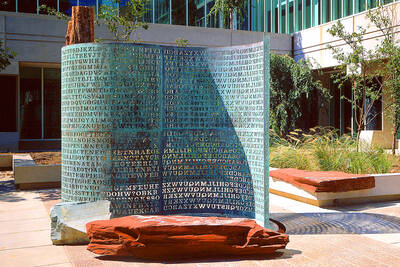
It is one of the world’s most famous unsolved codes whose answer could sell for a fortune — but two US friends say they have already found the secret hidden by Kryptos. The S-shaped copper sculpture has baffled cryptography enthusiasts since its 1990 installation on the grounds of the CIA headquarters in Virginia, with three of its four messages deciphered so far. Yet K4, the final passage, has kept codebreakers scratching their heads. Sculptor Jim Sanborn, 80, has been so overwhelmed by guesses that he started charging US$50 for each response. Sanborn in August announced he would auction the 97-character solution to K4
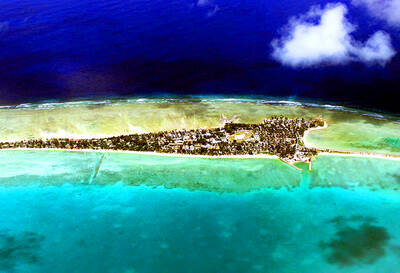
SHOW OF FORCE: The US has held nine multilateral drills near Guam in the past four months, which Australia said was important to deter coercion in the region Five Chinese research vessels, including ships used for space and missile tracking and underwater mapping, were active in the northwest Pacific last month, as the US stepped up military exercises, data compiled by a Guam-based group shows. Rapid militarization in the northern Pacific gets insufficient attention, the Pacific Center for Island Security said, adding that it makes island populations a potential target in any great-power conflict. “If you look at the number of US and bilateral and multilateral exercises, there is a lot of activity,” Leland Bettis, the director of the group that seeks to flag regional security risks, said in an


 RSS
RSS