


When residents of this poor, Cambodian village need something built, they call on the Lightmans.
The Jewish-American family’s latest gift: a mosque.
“We never had such a beautiful mosque in our village,” said 81-year-old Leb Sen, a toothless, village elder with a wrinkled face. “The young people said to me that I am very lucky to live long enough to see one now.”
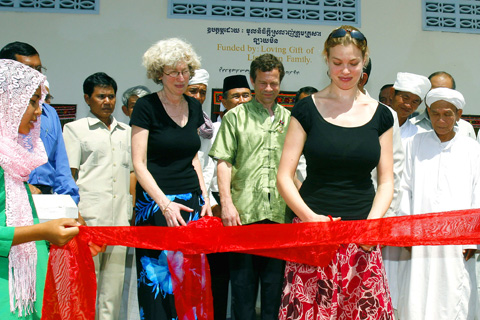
PHOTO: AP
Flashing a broad grin, Leb Sen brought his palms together and bowed repeatedly in gratitude toward his American donors — Alan Lightman; his wife, Jean Greenblatt Lightman and their daughter, Elyse.
Alan Lightman, a 59-year-old humanities professor at the Massachusetts Institute of Technology, said building the mosque was not part of his family’s original plan to improve education in the village, about 70km northwest of the capital, Phnom Penh.
“It’s too much to comprehend. We never imagined that we would build a mosque in a remote village in Cambodia,” said Lightman, author of the best-selling novel Einstein’s Dreams.
“It was so strange for us to be there … halfway across the planet, and it’s a religion that’s far from our religion,” he said.
The Lightmans first learned about the village in 2003, when a friend introduced them to various rural education projects. Two years later, the Harpswell Foundation, an organization founded by Lightman to help children and young women in developing countries, built a four-room concrete school, the village’s first.
Some of the 600 villagers came to Lightman in 2006 asking him to fund a new health center, a popular choice among the women, and a mosque, which the men favored. He told the villagers they would have to choose one. In the male-dominated community, it was a mosque.
“The men have won again, but the mosque is also very important for preserving our culture and tradition,” said 50-year-old Sit Khong, one of the five women in the village who were part of a committee to pick the project. “We will never find enough money to build it ourselves anyway.”
The mosque, with the gold-colored inscription “Funded by Loving Gift of Lightman Family” above the front door, opened on May 9. It can accommodate about 200 people and replaces a tiny building on wood stilts that held only 30 worshippers.
The villagers follow Imam-San, a small Islamic sect that incorporates Buddhism, Hinduism and animism. The Imam-San makes up about 3 percent of Cambodia’s 700,000 Muslims, who themselves represent only 5 percent of Cambodia’s 14 million people, the US State Department annual report on religious freedom said.
Besides mixing in elements of other religions, Imam-San followers pray only once a week, not the traditional five times a day.
“In the view of the real teaching of Islam, they are not pure,” said Tin Faizine, a 24-year-old Muslim student who was interpreting for the Lightmans.
Elyse Lightman, who is writing a book about Imam-San culture and traditions, said she was happy to help a community that is not fully embraced by either mainstream Muslims or Buddhists, Cambodia’s majority religious group.
“You can see why Muslims don’t consider them to be their own,” she said. “And then Buddhists say, ‘Well, you pray to Allah.’ So, they’re caught in the middle.”
She said the Imam-San, like the Jews, have faced persecution over the centuries, most recently when the Khmer Rouge seized power and abolished all religion.
“I think there is part of me that felt some sort of kinship in this,” she said.
About 500 followers of Imam-San from around the country came to this village of wooden houses and mango trees to celebrate the opening of the new mosque.
Sem Ahmad, 57, said he wanted the Lightman family to help build a mosque in his village in Battambang Province.
But Lightman said this would be his “first and last” mosque, because “I don’t think I have the resources or the time to build more mosques.”

It began as a satirical online project. Now millions of young people in India are flocking to it as an outlet for their frustration. A parody political party called the Cockroach Janta Party, with the insect as its symbol, has exploded across India’s social media by turning absurdist humor into protest. Memes and short videos mocking corruption, joblessness and political dysfunction have flooded social media sites, where millions of users are embracing the cockroach — known for its ability to survive harsh conditions — as a tongue-in-cheek symbol of endurance. The online movement’s rise has been unusually rapid. The Cockroach Janta Party (CJP)

SPEAKING OUT: After Siranudh Scott’s allegations surfaced, celebrities and public figures took to social media to share their own experiences of sexual misconduct and abuse A high-profile alleged sexual abuse case within a wealthy Thai beer brewing family has prompted a wave of painful accounts from survivors of unconnected abuse in the conservative nation. Siranudh Scott, a member of the billionaire Thai family that founded the ubiquitous Singha beer brand, posted an emotional video this month accusing his elder brother Sunit of repeatedly abusing him when he was a teenager. Sunit, who is in his 30s, later denied the allegations in a video posted online, but Singha parent Boonrawd dismissed him from his executive role with the company on Tuesday last week. “I felt I needed to speak

A Hong Kong astronaut is to join a Chinese space mission for the first time as part of a three-person crew launching today, as Beijing edges closer to its goal of landing people on the moon. The Tiangong space station — crewed by teams of three astronauts that are typically rotated every six months — is the crown jewel of China’s space program, boosted by billions in state investment in a bid to catch up with the US and Russia. The Shenzhou-23 mission is to blast off at 11:08pm from the Jiuquan Satellite Launch Center in northwestern China, carrying three astronauts to
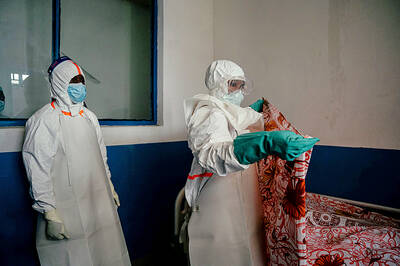
UPGRADED ALERT: The risk inside DR Congo is now considered ‘very high,’ while neighboring countries face a ‘high’ threat as the outbreak continues, the WHO said Ebola is spreading faster than responders can track it in eastern Congo, where health workers managed to follow up with barely one in five identified contacts in a single day. Authorities in the Democratic Republic of the Congo (DR Congo) reported 83 confirmed infections, 746 suspected cases and 1,603 identified contacts as of Thursday, but health workers were able to follow up on only 342 contacts that day — about 21 percent of the total under monitoring — data released by the DR Congo Ministry of Public Health on Friday showed. The figures suggest the response is falling behind the outbreak itself,


 RSS
RSS