


Long-hidden items and documents related to the 1963 assassination of president John F. Kennedy were revealed for the first time on Monday, after spending nearly two decades locked inside a courthouse safe.
Dallas County District Attorney (DA) Craig Watkins presented the articles at a US Presidents' Day holiday news conference while standing next to brown and white file boxes stacked in a pyramid.
The items include a purported transcript between Kennedy assassin Lee Harvey Oswald and Oswald's killer, nightclub owner Jack Ruby; a leather gun holster that held the weapon Ruby used to shoot Oswald; brass knuckles found on Ruby when he was arrested; and a movie contract signed by then-Dallas District Attorney Henry Wade.
Watkins said investigators told him about the contents of the blue, two-door safe shortly after he took office last year.
"And every DA up until the new administration decided that they wanted to keep it secret," he said. But he decided "this information was too important to keep secret."
One of the most intriguing items was the typed transcript of an alleged conversation between Oswald and Ruby. The transcript -- which has not been examined by experts and has already been called farfetched by some -- includes talk of killing the president at the behest of the Mafia.
"Now we don't know if this is an actual conversation or not," Watkins said. "But what we do know is that as a result of this find, it will open up the debate as to whether there was a conspiracy to assassinate the president."
Ruby killed Oswald on Nov. 24, 1963, two days after Oswald was arrested in the assassination of president Kennedy. Ruby was convicted and sentenced to death the following year.
Ruby won an appeal of his conviction but died of cancer before he was retried.
The two-page transcript resembles one published by the Warren Commission, which investigated Kennedy's assassination and determined Oswald was the lone gunman.
In the report, the FBI concluded that the transcript of an alleged conversation between Oswald and Ruby was fake, and that it had been "re-created" for authorities by a now-deceased Dallas attorney who claimed he recognized Oswald in a newspaper photo as the man he saw talking to Ruby.
The transcript unveiled on Monday is dated Oct. 4, 1963, and allegedly happened at the Carousel Club, a Dallas nightclub. It begins with a discussion of how the "boys in Chicago" want to "get rid of" US attorney general Robert Kennedy, JFK's brother.
"There is a way to get rid of him without killing him," Oswald says.
"How's that?" Ruby responds.
"I can shoot his brother," Oswald says.
After a discussion of the logistics of shooting the president, Ruby says the money for the operation's coming from the Mafia.
"Are you with the Mafia?" Oswald asked.
"You're asking too many questions," Ruby responds.
Later, Ruby gives a lengthy warning that Oswald must not get caught or say anything, noting that "if you do talk, then the boys will make me follow you, wherever you go, and kill you."
The Dallas Morning News first reported the transcript and other details of the find in an exclusive story published on Sunday.
Gary Mack, curator of the Sixth Floor Museum near where the president was shot, thinks the document displayed on Monday could be one of many scripts written for films about the assassination.
"My best guess is somebody found that transcript, reworked it for the movies and Henry Wade wound up with a copy," Mack said.
A 1967 movie production deal signed by Wade, who prosecuted Ruby, was in the safe. It's unclear why the film was never produced, Watkins said.
The contents of the safe were likely Wade's personal files on the Kennedy assassination, which researchers have long-known Wade kept. When he left office in the 1980s, Wade thought the files were taken to his home but they apparently weren't, Mack said.
Staff from the DA's office were nearly finished scanning the scores of typed and handwritten papers and cataloging the items. Recordings and films kept in the safe had not yet been examined. Once the task is completed, Watkins said his office plans to turn over the articles to an organization that will continue making them public.
"We're looking forward to the opportunity to talk with the district attorney ... We would love to have these records," Mack said. "We believe very strongly that these records need to stay here in Dallas."
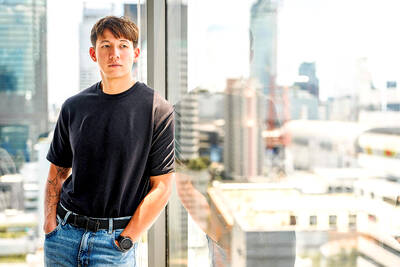
SPEAKING OUT: After Siranudh Scott’s allegations surfaced, celebrities and public figures took to social media to share their own experiences of sexual misconduct and abuse A high-profile alleged sexual abuse case within a wealthy Thai beer brewing family has prompted a wave of painful accounts from survivors of unconnected abuse in the conservative nation. Siranudh Scott, a member of the billionaire Thai family that founded the ubiquitous Singha beer brand, posted an emotional video this month accusing his elder brother Sunit of repeatedly abusing him when he was a teenager. Sunit, who is in his 30s, later denied the allegations in a video posted online, but Singha parent Boonrawd dismissed him from his executive role with the company on Tuesday last week. “I felt I needed to speak

SEEKING ORDER: Rodrigo Paz said that ‘anyone who wants to destroy the nation will have to deal with this president and the full force of the constitution’ Bolivian President Rodrigo Paz on Wednesday said that the nation was at a “breaking point” after nearly a month of protests that have caused shortages of food, fuel and medicine. Paz, who took office six months ago amid the worst economic crisis there in four decades, is battling a groundswell of fury over his policies. The political capital, La Paz, has been besieged by low-income workers and members of the indigenous majority calling for his resignation. “The country needs order and is reaching breaking point,” the 58-year-old said at a public event in La Paz, renewing his appeal for dialogue. On Tuesday, the Bolivian
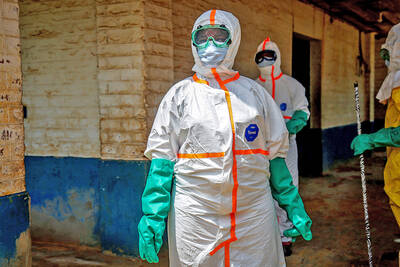
COMMUNITY CONFLICT: Concerns about disease spread from corpses has run up against friends and families’ desire to bury their dead as infection spreads in the area Angry residents of a town at the epicenter of the Ebola outbreak in the Democratic Republic of the Congo (DR Congo) attacked and burned a tent that was part of a health center where people are being treated for the virus, the staff there said Saturday. It was the second such attack in the region in a week. No one was hurt in the attack, according to reports but as patients ran out to escape the fire, 18 people with suspected Ebola infections fled the facility and are unaccounted for, a hospital director said. Angry residents arrived at the clinic in the
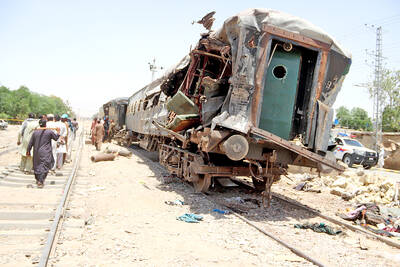
INSURGENT ACTION: A local independence movement in Balochistan, alleged by Pakistan’s government to be backed by India, claimed responsibility for the strike A suicide bomber detonated an vehicle-borne IED near a railway as a passenger train passed through the southwestern Pakistani city of Quetta yesterday, killing at least 23 people and wounding over 70, officials said. The explosion caused two of the train cars to overturn and catch fire, according to footage shared online. The attack happened in an area where security forces are usually stationed, badly damaging several nearby buildings and smashing more than a dozen vehicles parked along the road, according to witnesses and images circulating on social media. Doctors at local hospitals said they had received the wounded, with 20 in critical


 RSS
RSS