


Tunnels run beneath Chinatown: brick-walled passages that were once home to people and activities that could not be mentioned aboveground.
Rick Lew knows, because he walked the passages as a child, entering through a trapdoor in his grandfather's liquor store.
"There was a nightlife you couldn't see from the streets," he said.
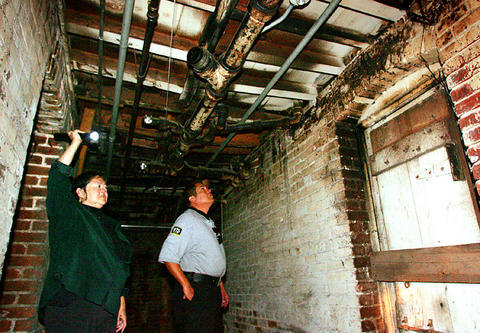
PHOTO: AP
But to many others, the lace-work of tunnels sprawling under the city was just another tall tale from Fresno's days as a Western railroad town and a hub of gambling and prostitution.
Now, a group of archeologists is using ground-penetrating radar to find evidence of the secret passages, which are believed to branch out from long-abandoned basements littered with cobwebs and filth.
The project, funded by the city and headed by a group working to preserve Chinatown, will take data gathered via radar and compare the findings to the memories of those who recall the neighborhood's heyday, said Kathy Omachi, vice president of Chinatown Revitalization. That will help archeologists decide where to dig trenches and look for the passages, researchers said.
The approximately six blocks just west of the railroad tracks that make up the historic Chinatown were Fresno's birthplace, said Karana Hattersley-Drayton, the city's historic preservation officer. Unlike the better-known Chinese enclaves of San Francisco and New York, there's little left of it today -- at least on the surface.
But fire insurance maps from the 1880s show a densely populated area, a stark contrast from the wide-open ranch and farm country all around. It was home to the Chinese laborers who laid Fresno's foundations, and to successive layers of immigrants -- Japanese, Armenians, Mexicans, Portuguese, Basques and others -- who were kept separate from the growing white population by the iron boundary of the train tracks.
The area long housed family-run stores, temples, churches, Chinese and Japanese schools. But it was also host to illicit activities kept out of the "good side of town" -- gambling, drinking during Prohibition, and prostitution.
Omachi's father, who was from a Japanese immigrant family, was born here in 1913 "between a bar and a house of ill repute," she said.
Many establishments had basements, some of them interconnected. Of those that can still be seen today, some end in bricked-off walls that longtime residents say hide tunnel entrances.
As late as the 1950s, when Lew was a boy, Chinatown was still thriving -- both its respectable establishments and as its shadier side.
He remembers visiting the underground world with his father, passing though a dark basement before descending into a lit tunnel with an arched roof and enough space for two people to pass by each other. There were people there he recognized from the neighborhood. And then there were the glamorous women whose images remain seared in his memory.
"They were off to the side, in bright satin dresses, one red, one blue," said Lew, speculating that they were probably prostitutes. "I later asked my father about it. He said it was something we don't mention."
Jon Brady, lead archeologist on the project, said the tunnels may have been built to provide cool underground storage in a region known for sweltering summer heat. But they later proved handy for other purposes, even escape when necessary.
"These groups that lived on the fringe could have resorted to them to protect themselves, communicate away from public view, who knows what else," Brady said.
Local lore holds, though it still hasn't been proved by research, that a tunnel one time extended beyond the railroad tracks into the traditionally white part of town, possibly allowing "respectable" citizens access to the illicit charms of Chinatown.
"Some say that was blown up during Prohibition," said Hattersley-Drayton, who got a lot of calls from longtime residents once the project got started. "I'm hearing that from a lot of people, but we just don't know yet."
In the 1950s and 1960s, many of Chinatown's buildings were torn down to make way for new development or freeways, and much of the history was buried, Lew said.
"Many of the older residents packed up and left, and it started getting rough," Lew said. He now lives far from Chinatown, but remains surrounded by artifacts from the days his family was an important part of the neighborhood: tall, elaborately decorated vases, paintings and sculptures handed down by his grandfather, and the old manual cash register that rang up purchases at the liquor store.
Today, Fresno's Chinatown is largely abandoned, peopled by the homeless, with many of its facades boarded up. It's a part of the region's history that's been largely forgotten.
As downtown develops it's critical "to look at where we were," said Patti Miller, spokeswoman for the city.
Someday, Hattersley-Drayton hopes, Chinatown and its excavated tunnels might be developed for heritage tourism, bringing some income to the now-impoverished area.
"This is a first step, and it's about approaching parts of community history that are not in books," Brady said. "Parts that are literally below the surface, but that deserve to be told."
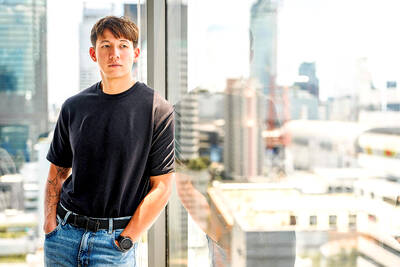
SPEAKING OUT: After Siranudh Scott’s allegations surfaced, celebrities and public figures took to social media to share their own experiences of sexual misconduct and abuse A high-profile alleged sexual abuse case within a wealthy Thai beer brewing family has prompted a wave of painful accounts from survivors of unconnected abuse in the conservative nation. Siranudh Scott, a member of the billionaire Thai family that founded the ubiquitous Singha beer brand, posted an emotional video this month accusing his elder brother Sunit of repeatedly abusing him when he was a teenager. Sunit, who is in his 30s, later denied the allegations in a video posted online, but Singha parent Boonrawd dismissed him from his executive role with the company on Tuesday last week. “I felt I needed to speak

A Hong Kong astronaut is to join a Chinese space mission for the first time as part of a three-person crew launching today, as Beijing edges closer to its goal of landing people on the moon. The Tiangong space station — crewed by teams of three astronauts that are typically rotated every six months — is the crown jewel of China’s space program, boosted by billions in state investment in a bid to catch up with the US and Russia. The Shenzhou-23 mission is to blast off at 11:08pm from the Jiuquan Satellite Launch Center in northwestern China, carrying three astronauts to
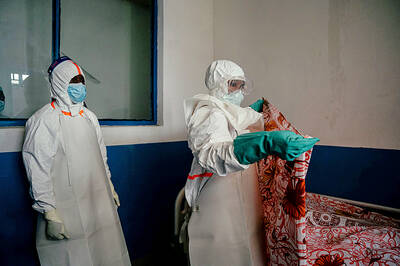
UPGRADED ALERT: The risk inside DR Congo is now considered ‘very high,’ while neighboring countries face a ‘high’ threat as the outbreak continues, the WHO said Ebola is spreading faster than responders can track it in eastern Congo, where health workers managed to follow up with barely one in five identified contacts in a single day. Authorities in the Democratic Republic of the Congo (DR Congo) reported 83 confirmed infections, 746 suspected cases and 1,603 identified contacts as of Thursday, but health workers were able to follow up on only 342 contacts that day — about 21 percent of the total under monitoring — data released by the DR Congo Ministry of Public Health on Friday showed. The figures suggest the response is falling behind the outbreak itself,

SEEKING ORDER: Rodrigo Paz said that ‘anyone who wants to destroy the nation will have to deal with this president and the full force of the constitution’ Bolivian President Rodrigo Paz on Wednesday said that the nation was at a “breaking point” after nearly a month of protests that have caused shortages of food, fuel and medicine. Paz, who took office six months ago amid the worst economic crisis there in four decades, is battling a groundswell of fury over his policies. The political capital, La Paz, has been besieged by low-income workers and members of the indigenous majority calling for his resignation. “The country needs order and is reaching breaking point,” the 58-year-old said at a public event in La Paz, renewing his appeal for dialogue. On Tuesday, the Bolivian


 RSS
RSS