


Yemen's president said on Tuesday that security authorities knew al-Qaeda was plotting attacks in the impoverished country, after a suicide car bomber killed seven Spanish tourists and two local drivers.
"Yemeni security authorities had information that al-Qaeda elements were preparing to carry out terrorist attacks," President Ali Abdullah Saleh told reporters a day after the massive blast at an ancient temple site.
They "boosted security measures around oil facilities and government institutions, but the Balqis temple was not taken into account" as a potential target, he said.
A suicide bomber rammed a car packed with explosives into the Spanish tourists' convoy as they were wrapping up a tour of the temple in Marib, 170km east of the capital Sanaa.
The temple dates back 3,000 years, to the time of the biblical Queen of Sheba. The site has become a major tourist attraction since its significance was discovered in 1988, despite the threat of kidnapping by local tribesmen.
The bombing was the worst attack against Westerners in the Arabian peninsula country since al-Qaeda extremists struck the USS Cole off the southern port of Aden in 2000, killing 17 US sailors.
Spain's Onda Cero radio quoted survivor Maria Begona Larrabeiti as saying the experience was "an absolute nightmare."
"I saw the first car burning. In the second, people were in a bad state and, in mine, people were screaming," she said.
In addition to the nine people killed on Monday, six Spanish tourists, two Yemeni drivers and four police guards escorting the tourists were wounded.
No group has claimed responsibility.
"Preliminary information suggests the perpetrator of the attack was an Arab national," Saleh said without elaborating.
A security source said the bombing was apparently masterminded by al-Qaeda militants still on the run after escaping from a Sanaa prison in February last year.
At least three of the 23 al-Qaeda suspects who tunnelled out of jail remain at large after the others gave themselves up or were arrested or killed.
One of those still at large is Jamal Ahmad al-Badawi, convicted and sentenced to death for the Cole blast and featured on the US list of most-wanted terrorists with a US$5 million bounty on his head.
"Security agencies have upgraded their readiness to 100 percent to track down the elements involved in this criminal and irresponsible act," Saleh said.
Authorities are also hunting the escaped al-Qaeda militants, who number "three to four," he said.

It began as a satirical online project. Now millions of young people in India are flocking to it as an outlet for their frustration. A parody political party called the Cockroach Janta Party, with the insect as its symbol, has exploded across India’s social media by turning absurdist humor into protest. Memes and short videos mocking corruption, joblessness and political dysfunction have flooded social media sites, where millions of users are embracing the cockroach — known for its ability to survive harsh conditions — as a tongue-in-cheek symbol of endurance. The online movement’s rise has been unusually rapid. The Cockroach Janta Party (CJP)
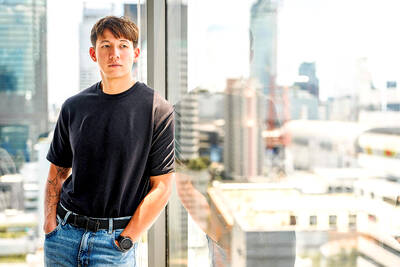
SPEAKING OUT: After Siranudh Scott’s allegations surfaced, celebrities and public figures took to social media to share their own experiences of sexual misconduct and abuse A high-profile alleged sexual abuse case within a wealthy Thai beer brewing family has prompted a wave of painful accounts from survivors of unconnected abuse in the conservative nation. Siranudh Scott, a member of the billionaire Thai family that founded the ubiquitous Singha beer brand, posted an emotional video this month accusing his elder brother Sunit of repeatedly abusing him when he was a teenager. Sunit, who is in his 30s, later denied the allegations in a video posted online, but Singha parent Boonrawd dismissed him from his executive role with the company on Tuesday last week. “I felt I needed to speak

A Hong Kong astronaut is to join a Chinese space mission for the first time as part of a three-person crew launching today, as Beijing edges closer to its goal of landing people on the moon. The Tiangong space station — crewed by teams of three astronauts that are typically rotated every six months — is the crown jewel of China’s space program, boosted by billions in state investment in a bid to catch up with the US and Russia. The Shenzhou-23 mission is to blast off at 11:08pm from the Jiuquan Satellite Launch Center in northwestern China, carrying three astronauts to
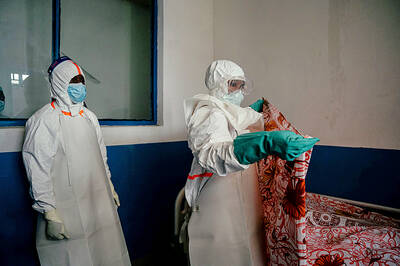
UPGRADED ALERT: The risk inside DR Congo is now considered ‘very high,’ while neighboring countries face a ‘high’ threat as the outbreak continues, the WHO said Ebola is spreading faster than responders can track it in eastern Congo, where health workers managed to follow up with barely one in five identified contacts in a single day. Authorities in the Democratic Republic of the Congo (DR Congo) reported 83 confirmed infections, 746 suspected cases and 1,603 identified contacts as of Thursday, but health workers were able to follow up on only 342 contacts that day — about 21 percent of the total under monitoring — data released by the DR Congo Ministry of Public Health on Friday showed. The figures suggest the response is falling behind the outbreak itself,


 RSS
RSS