


The "Red Crystal" is scheduled to make its debut today as an additional emblem that can be used to protect relief workers in combat where the Red Cross or Red Crescent meets hostility. But it is unlikely to be widely displayed in the near future.
The emblem was designed as part of complicated, long-running negotiations to include Israel in the Red Cross movement without giving the red shield used by Magen David Adom -- similar to the star on the Israeli flag -- the same status as the cross and crescent, which have been used by medics on the battlefield for more than a century.
Some countries feared that adding the red star of David to the list of protective emblems would open the door to proliferation of such symbols and undermine the recognition that any emblem had to protect humanitarian workers.
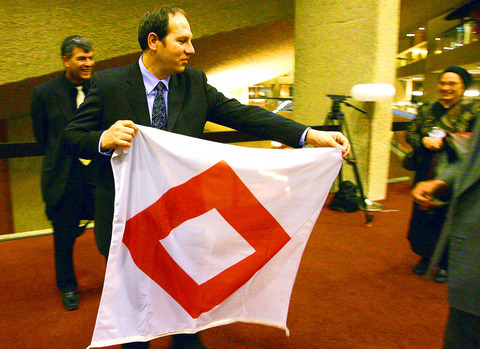
PHOTO: AP
But Red Cross officials on Friday conceded it would take time before the crystal, a red square frame standing on one corner, will be known widely enough for medics to work under it on the battlefield without fear of being targeted by one side or the other.
"We have no indication at the moment that anybody is going to start using it" immediately, said Antonella Notari, chief spokeswoman of the International Committee of the Red Cross.
"It's legally now a protective emblem, but there's a lot of work to be done for it to be in reality and concretely a protective emblem because it needs to be known in the field and respected," she said.
The treaty authorizing the new symbol is entering into force six months after Switzerland and Norway became the first two countries to ratify the accord aimed at including Israel's Magen David Adom society in the Red Cross movement. So far, 84 countries have signed the treaty and nine have ratified it.
"We are pleased they created especially for us a new symbol that will be accepted the world over," said Noam Yifrach, chairman of the executive committee of Magen David Adom. The Israeli organization puts the red Star of David inside the crystal's frame.
Any national society in the international Red Cross movement will be able to use the crystal if it wants. Military medics for any country also will be able to display it instead of the cross or crescent. In combat, the crystal is supposed to stand alone, but for fundraising and identification purposes at home a society such as the Israeli organization could put its own emblem inside the frame.
Israel, which became a member of the Red Cross last June after a meeting of the movement cleared the way for the new symbol, will still be able to use the star on ambulances inside Israel.
The simple red cross on a white background -- the reversal of colors of the Swiss flag -- was adopted as the emblem of the movement when it was founded in 1863 by Swiss humanitarians trying to care for battlefield casualties who otherwise would have been left to suffer.
But the symbol unintentionally reminded Muslims of the Christian crusaders, and they began using a red crescent in the 19th century.
When Israel's society bid for membership in 1949, it objected to using both the cross and the crescent, but the Red Cross movement refused to admit the Israeli star.

An American scientist convicted of lying to US authorities about payments from China while he was at Harvard University has rebuilt his research lab in Shenzhen, China, to pursue technology the Chinese government has identified as a national priority: embedding electronics into the human brain. Charles Lieber, 67, is among the world’s leading researchers in brain-computer interfaces. The technology has shown promise in treating conditions such as amyotrophic lateral sclerosis and restoring movement in paralyzed people. It also has potential military applications: Scientists at the Chinese People’s Liberation Army have investigated brain interfaces as a way to engineer super soldiers by boosting
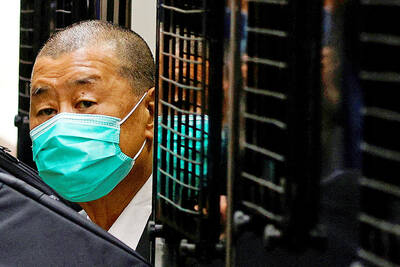
Jailed media entrepreneur Jimmy Lai (黎智英) has been awarded Deutsche Welle’s (DW) freedom of speech award for his contribution to Hong Kong’s pro-democracy movement. The German public broadcaster on Thursday said Lai would be presented in absentia with the 12th iteration of the award on June 23 at the DW Global Media Forum in Bonn. Deutsche Welle director-general Barbara Massing praised the 78-year-old founder of the now-shuttered news outlet Apple Daily for standing “unwaveringly for press freedom in Hong Kong at great personal risk.” “With Apple Daily, he gave journalists a platform for free reporting and a voice to the democracy movement in

PHILIPPINE COMMITTEE: The head of the committee that made the decision said: ‘If there is nothing to hide, there is no reason to hide, there is no reason to obstruct’ A Philippine congressional committee on Wednesday ruled that there was “probable cause” to impeach Philippine Vice President Sara Duterte after hearing allegations of unexplained wealth, misuse of state funds and threats to have the president assassinated. The unanimous decision of the 53-member committee in the Philippine House of Representatives sends the two impeachment complaints to deliberations and voting by the entire lower chamber, which has more than 300 lawmakers. The complaints centered on Duterte’s alleged illegal use and mishandling of intelligence funds from the vice president’s office, and from her time as education secretary under Philippine President Ferdinand Marcos Jr. Duterte and the

Burmese President Min Aung Hlaing yesterday cut all prisoners’ sentences by one-sixth, a blanket measure that a source close to deposed leader Aung San Suu Kyi said would further shorten her detention. Aung San Suu Kyi has been sequestered since a 2021 military coup, but the senior member of her dissolved National League for Democracy (NLD) party said that while her term had been reduced, her remaining sentence is still unclear. “We also don’t know exactly how many years she has left,” the source told reporters, speaking on condition of anonymity for security reasons. The military toppled Aung San Suu Kyi’s elected government


 RSS
RSS