


Like all Shiites, Afghanistan's Hazaras are waiting for the reappearance of the Mahdi, but those in the Bamiyan Valley are also hoping for the return of the ancient giant Buddhas torn down in 2001 by the Taliban government in a fit of iconoclastic rage.
At the foot of a cliff where the niches once inhabited by the statues are testimony to their once-towering grandeur, international teams gathered by the UN to repair the Buddhist relics are preparing to break camp for winter.
Where the larger Buddha once stood at 55m, workers under German supervision collect fragments, while an Italian team is at the site not far away of the 38m Buddha considered to have a more feminine face.
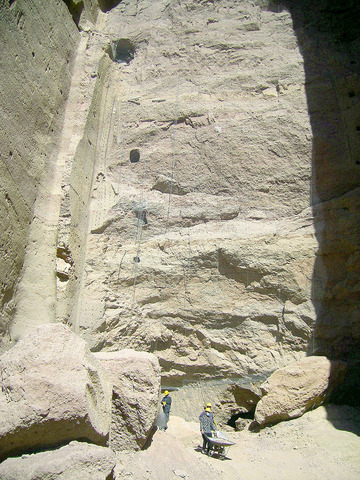
PHOTO: AFP
Between these two teams, Japanese experts are working on preserving what is left of murals adorning the walls of a network of caves, while Italian mountaineers are suspended from ropes slung over the smaller Buddha as they plug faults in the rock, embed steel anchors and install movement sensors.
"Bombs have created many fissures and it's very dangerous because it's very unstable," Italian engineer Gedeone Tonoli said.
The task was begun two years ago and is due to be completed before the year's work wraps up on Nov. 15, he said.
"After that temperatures fall below zero Celsius and we have problems with the machines," he said.
Because of the size and density of the statues, their destroyers deployed an enormous amount of explosives, some of which failed to detonate at the time and now present a daily hazard -- along with landmines left over from decades of war -- for the repair teams.
"Unfortunately we discover a lot of unexploded devices," said German architect Georgios Toubekis from the International Council on Monuments and Sites.
"Just recently we had two bombs of 250kg. One of them had to be exploded behind this field -- it took one week to pull it out carefully because it was heavily damaged. The other one luckily was more easy to take away," he said.
Because of this danger, no heavy machinery is allowed inside the larger niche and everything is done by hand, Toubekis said.
"The progress was very slow this year because of all these bomb findings," he said, describing the work as still in an emergency phase.
In front of the caves, Japanese specialists take down their scaffolding and seal the caves to protect the paintings, 80 percent of which were destroyed during the war, from animals that may stray inside.
"We can't stay in the caves -- it's very freezing, very cold," Yoko Taniguchi said.
That the murals were created with water-soluble paint further complicates preservation work, she said, because they are so easily damaged by the weather.
Bamiyan, some 200km northwest of Kabul, stands in a deep green and lush valley stretching 100km through central Afghanistan, on the former Silk Road that once linked China with Central Asia and beyond. It was a center of Buddhist scholarship and worship between the second and ninth centuries, before the coming of Islam.
In February 2001 Mullah Omar, head of the Taliban government then ruling Afghanistan, ordered the destruction of the Buddhas as idolatrous symbols.
The order for the destruction of the massive sandstone structures -- until then the largest standing Buddhist statues in the world -- led to an international outcry and calls for them to be spared for their historical significance if nothing else. But in vain.
Now, the people of Bamiyan are firm in their belief that the Buddhas must be restored to raise the status of the valley and attract tourists -- and income.
"If it is not possible for both of them, at least one of them can be rebuilt," provincial governor Habiba Surobi said.
But the international experts say the local people would be naive to expect the relics to ever be returned to their original state.
"Everybody is asking when the Buddhas will be reconstructed," Toubekis said, but adds: "At this moment there is no decision it is going towards this direction."
The main reason, he said, is that the statues are "much more fragmented than everybody thought. Nobody at the moment is behind putting it together like a puzzle, because I think it is not possible."
There is however the possibility of employing the archeological process of anastylosis by which ruined monuments are reassembled from old fragments and, when necessary, new materials.
But Toubekis believes that if the Bamiyan Buddhas were rebuilt in this manner they could lose their world heritage status and their value as tourism drawcards could be diminished.

A plan by Switzerland’s right-wing People’s Party to cap the population at 10 million has the backing of almost half the country, according to a poll before an expected vote next year. The party, which has long campaigned against immigration, argues that too-fast population growth is overwhelming housing, transport and public services. The level of support comes despite the government urging voters to reject it, warning that strict curbs would damage the economy and prosperity, as Swiss companies depend on foreign workers. The poll by newspaper group Tamedia/20 Minuten and released yesterday showed that 48 percent of the population plan to vote

PARLIAMENT CHAOS: Police forcibly removed Brazilian Deputy Glauber Braga after he called the legislation part of a ‘coup offensive’ and occupied the speaker’s chair Brazil’s lower house of Congress early yesterday approved a bill that could slash former Brazilian president Jair Bolsonaro’s prison sentence for plotting a coup, after efforts by a lawmaker to disrupt the proceedings sparked chaos in parliament. Bolsonaro has been serving a 27-year term since last month after his conviction for a scheme to stop Brazilian President Luiz Inacio Lula da Silva from taking office after the 2022 election. Lawmakers had been discussing a bill that would significantly reduce sentences for several crimes, including attempting a coup d’etat — opening up the prospect that Bolsonaro, 70, could have his sentence cut to

A powerful magnitude 7.6 earthquake shook Japan’s northeast region late on Monday, prompting tsunami warnings and orders for residents to evacuate. A tsunami as high as three metres (10 feet) could hit Japan’s northeastern coast after an earthquake with an estimated magnitude of 7.6 occurred offshore at 11:15 p.m. (1415 GMT), the Japan Meteorological Agency (JMA) said. Tsunami warnings were issued for the prefectures of Hokkaido, Aomori and Iwate, and a tsunami of 40cm had been observed at Aomori’s Mutsu Ogawara and Hokkaido’s Urakawa ports before midnight, JMA said. The epicentre of the quake was 80 km (50 miles) off the coast of
RELAXED: After talks on Ukraine and trade, the French president met with students while his wife visited pandas, after the pair parted ways with their Chinese counterparts French President Emmanuel Macron concluded his fourth state visit to China yesterday in Chengdu, striking a more relaxed note after tough discussions on Ukraine and trade with Chinese President Xi Jinping (習近平) a day earlier. Far from the imposing Great Hall of the People in Beijing where the two leaders held talks, Xi and China’s first lady, Peng Liyuan (彭麗媛), showed Macron and his wife Brigitte around the centuries-old Dujiangyan Dam, a World Heritage Site set against the mountainous landscape of Sichuan Province. Macron was told through an interpreter about the ancient irrigation system, which dates back to the third century


 RSS
RSS