


A vast chunk of Europe's most ill-famed mountain is threatening to break loose and crash down in the next few days, a geologist monitoring the situation said on Friday.
Hans-Rudolf Keusen said that 2 million cubic meters of the Eiger in the Bernese Alps, Switzerland -- twice the volume of the Empire State Building -- was rapidly working its way loose.
He said the mountain appeared to have cracked open as an indirect result of global warming.
There was no danger to people in the area.
"There aren't any houses underneath, so no one is going to end up getting a rock on the head," Keusen said.
But he added that the debris could settle on glaciers, blocking the outflow and affecting water supplies to neighboring towns.
It was not yet clear whether the part of the mountain at risk would fall all at once or by stages.
Keusen began monitoring the mountain, which has claimed the lives of many climbers, at the end of last month after spotting a long crack on the east face.
Measurements taken by instruments located on Baregg, on the other side of a valley from the Eiger, initially showed the fissure was opening up at a rate of 5cm a day.
But yesterday he said: "The crack is now widening at 75cm a day. That is very fast compared with fissures we have seen developing on other mountains. I think it is possible the rockfall could take place in the next few days."
It is natural for the Alps to erode. But evidence has grown in recent years that they are crumbling at a faster rate than normal. In 2004, three lumps of the Dolomites in northern Italy came loose.
The biggest chunk -- 75m high -- fell more than 300m to block a hikers' trail.
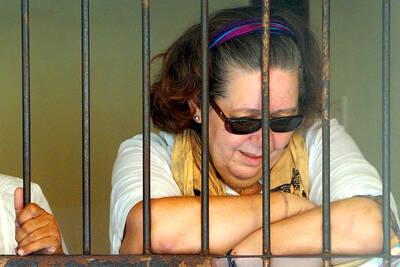
Indonesia was to sign an agreement to repatriate two British nationals, including a grandmother languishing on death row for drug-related crimes, an Indonesian government source said yesterday. “The practical arrangement will be signed today. The transfer will be done immediately after the technical side of the transfer is agreed,” the source said, identifying Lindsay Sandiford and 35-year-old Shahab Shahabadi as the people being transferred. Sandiford, a grandmother, was sentenced to death on the island of Bali in 2013 after she was convicted of trafficking drugs. Customs officers found cocaine worth an estimated US$2.14 million hidden in a false bottom in Sandiford’s suitcase when
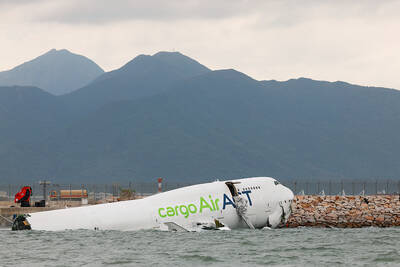
CAUSE UNKNOWN: Weather and runway conditions were suitable for flight operations at the time of the accident, and no distress signal was sent, authorities said A cargo aircraft skidded off the runway into the sea at Hong Kong International Airport early yesterday, killing two ground crew in a patrol car, in one of the worst accidents in the airport’s 27-year history. The incident occurred at about 3:50am, when the plane is suspected to have lost control upon landing, veering off the runway and crashing through a fence, the Airport Authority Hong Kong said. The jet hit a security patrol car on the perimeter road outside the runway zone, which then fell into the water, it said in a statement. The four crew members on the plane, which
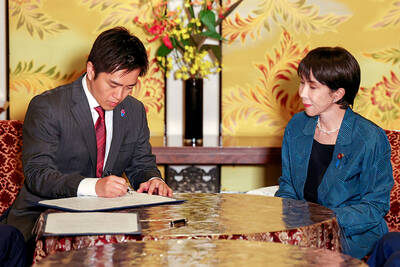
Japan’s ruling Liberal Democratic Party (LDP) and its junior partner yesterday signed a coalition deal, paving the way for Sanae Takaichi to become the nation’s first female prime minister. The 11th-hour agreement with the Japan Innovation Party (JIP) came just a day before the lower house was due to vote on Takaichi’s appointment as the fifth prime minister in as many years. If she wins, she will take office the same day. “I’m very much looking forward to working with you on efforts to make Japan’s economy stronger, and to reshape Japan as a country that can be responsible for future generations,”
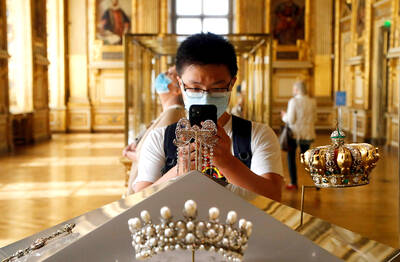
SEVEN-MINUTE HEIST: The masked thieves stole nine pieces of 19th-century jewelry, including a crown, which they dropped and damaged as they made their escape The hunt was on yesterday for the band of thieves who stole eight priceless royal pieces of jewelry from the Louvre Museum in the heart of Paris in broad daylight. Officials said a team of 60 investigators was working on the theory that the raid was planned and executed by an organized crime group. The heist reignited a row over a lack of security in France’s museums, with French Minister of Justice yesterday admitting to security flaws in protecting the Louvre. “What is certain is that we have failed, since people were able to park a furniture hoist in the middle of


 RSS
RSS