


Handsome and well-mannered, the crown prince of Bhutan has become the talk of Thailand.
Women have swooned over the bachelor prince's shiny, neatly combed hair and easy smile. Front pages have featured him as "Prince Charming," and a poll named him the most popular of all 25 royals who visited Thailand this month to celebrate King Bhumibol Adulyadej's 60th anniversary on the throne.
Now, a small scandal -- involving one woman in particular -- has spiced things up.
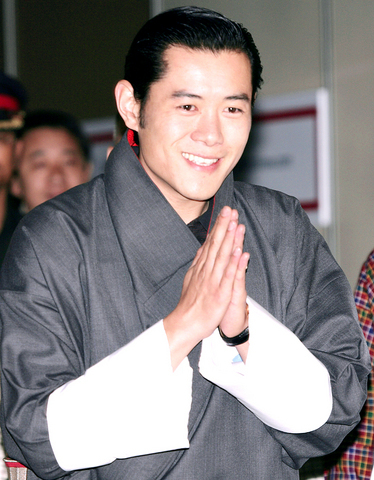
PHOTO: AP
Among the many pictures of Crown Prince Jigme Khesar Namgyel Wangchuck that circulated around Thai Internet sites after his visit is one that has sparked an uproar.
It shows the 26-year-old prince staring into the camera, leaned in close to a smiling mystery woman. He looks relaxed, with his chin resting on the head of the woman, who is wearing a halter top and dangling earrings.
The picture has trees in the background, leading some to speculate it was taken in his Himalayan kingdom, and it suggests a close relationship -- which is precisely the problem.
In Thailand, a royal's private life is not for public consumption.
Thai media never intrudes on the personal life of the country's royals, who are respected with a genuine reverence. Much of the country is honoring 78-year-old King Bhumibol during this celebratory year by wearing yellow shirts every Monday, the color that symbolizes the day of the week he was born.
Out of respect for the Bhutanese prince, police this week called for a halt to the online distribution of the photo and are searching for the culprit who initially posted it. Questions have arisen over whether the picture was doctored, which police say would carry criminal charges.
Police have asked the Bhutanese Embassy, which declined comment, to help determine its authenticity.
Thai authorities say it's their job to protect Jigme, who returned to his Himalayan kingdom more than a week ago after visiting a Thai beach resort following the king's June 9-12 celebrations.
"This may violate the prince's reputation. It requires thorough and careful examination," said police Major General Prachin Waree of the national police force's cyber crimes unit.
One Thai-language newspaper splashed the image across the top of its front page on Tuesday, but apparently sought to deflect criticism with an accompanying banner headline that denounced the picture as "very inappropriate."
Online chat rooms are abuzz with criticism over the photograph's circulation, speculation that it's a fake and general disgust over the prospect of offending the Oxford-educated prince, who became a media darling during his trip to Thailand.
Much talk was generated by widely publicized images of the prince giving a "wai" -- the Thai greeting of palms pressed together with a head bow -- during his outings in Thailand. A sign of humility and respect, it showed his "charm and easy manners," the Nation newspaper reported.
As a result of all the attention, tourism from Thailand to Bhutan is projected to increase this year, said Somyos Limthongkam, vice president of the Thai Travel Agents Association.
"Ever since Prince Jigme's visit, TV, radio and newspapers have been talking nonstop about Bhutan," he said. "Many people are interested in traveling to the country -- and they're mostly women."
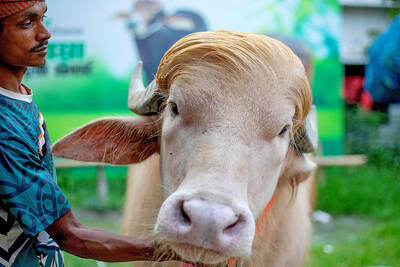
Crowds in Bangladesh are flocking to snap photographs with an unlikely social media star — an albino buffalo with flowing blond hair nicknamed “Donald Trump” that is due to be sacrificed within days. Owner Zia Uddin Mridha, 38, said his brother named the 700kg bull over its flowing helmet of hair resembling the signature look of the US president. “My younger brother picked this name because of the buffalo’s extraordinary hair,” he said at his farm in Narayanganj, just outside the capital, Dhaka. Mridha said that a constant stream of curious visitors — social media fans, onlookers and children — have come throughout

It began as a satirical online project. Now millions of young people in India are flocking to it as an outlet for their frustration. A parody political party called the Cockroach Janta Party, with the insect as its symbol, has exploded across India’s social media by turning absurdist humor into protest. Memes and short videos mocking corruption, joblessness and political dysfunction have flooded social media sites, where millions of users are embracing the cockroach — known for its ability to survive harsh conditions — as a tongue-in-cheek symbol of endurance. The online movement’s rise has been unusually rapid. The Cockroach Janta Party (CJP)
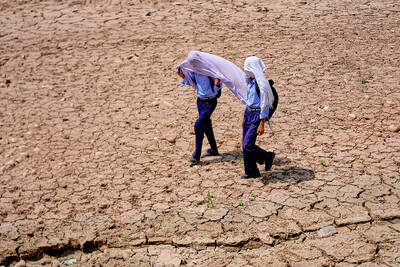
HOTTER: While Indians are accustomed to summer heat, climate change has caused northwestern India to warm faster than other parts of the country, an academic said Roads and markets have emptied during afternoons and some farmers have switched to nighttime work to avoid scorching temperatures as a heat wave grips large parts of India. The India Meteorological Department forecast maximum temperatures for yesterday of about 45°C in the capital, New Delhi, where authorities have opened temporary “cooling zones” to help people cope. The weather department warned that conditions would likely persist across several northern regions in the coming days, with temperatures staying well above seasonal averages. Authorities urged people to stay indoors during the hottest hours and take precautions against heat-related illnesses. India declares a heat wave whenever maximum temperatures

BIGGER ROLE: Beijing has said it maintains an impartial stance on the war in Ukraine, but by training Russian troops, China is far more involved than previously known China’s armed forces secretly trained about 200 Russian military personnel in China late last year, and some have since returned to fight in Ukraine, according to three European intelligence agencies and documents seen by Reuters. While China and Russia have held a number of joint military exercises since Moscow’s full-scale invasion of Ukraine in 2022, Beijing has repeatedly said that it is neutral in the conflict and presents itself as a peace mediator. The covert training sessions, which predominantly focused on the use of drones, were outlined in a dual-language Russian-Chinese agreement signed by senior Russian and Chinese officers in Beijing on


 RSS
RSS