


A British judge has sentenced radical Muslim cleric Abu Hamza al-Masri to seven years in prison for promoting the slaying of non-Muslims as a "religious duty" when he led a London mosque seen as the spiritual haven for two al-Qaeda-linked terrorists.
Judge Anthony Hughes told the former imam of the Finsbury Park mosque on Tuesday that his speeches had endangered people around the world. The mosque -- described by the head of London's Metropolitan Police anti-terrorism unit Peter Clarke as a "honeypot for extremists" -- was attended by both Sept. 11 plotter Zacarias Moussaoui and "shoe bomber" Richard Reid.
Moussaoui pleaded guilty last year to plotting with al-Qaeda to fly planes into US buildings, he faces trial in the US on terrorism conspiracy charges. Reid was convicted of attempting to blow up an American Airlines flight in 2001 with a shoe bomb.
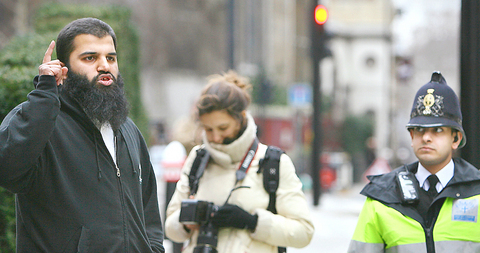
PHOTO: AFP
"You helped to create an atmosphere in which to kill has become regarded by some as not only a legitimate course but as a moral and religious duty in pursuit of perceived justice," the judge told al-Masri.
The one-eyed, hook-handed preacher sat impassively in the wood-paneled dock as the foreman of the jury read out guilty verdicts on 11 out of 15 counts, including incitement to murder, fomenting racial hatred, possessing a terrorist document and possessing abusive recordings. He had faced a maximum of life in prison.
Hughes sentenced al-Masri to seven years on the most serious charges of soliciting murder, and allowed him to serve his sentences on the other charges concurrently.
"I am quite satisfied that you are and were a person whose views created a real danger to the lives of innocent people in different parts of the world," he said.
The cleric's attorneys said he planned to appeal. Defense lawyer Muddassar Arani said al-Masri believed he was "a prisoner of faith, and this is a slow martyrdom for him."
A supporter in the public gallery shouted "God Bless You Sheik Hamza" as the cleric was led out of the courtroom. Others shouted to him in Arabic.
Authorities in Britain and the US claim al-Masri was at the center of a web of terrorist activity from the 1990s until police raided the Finsbury Park mosque in 2003.
He has been charged in the US on an 11-count indictment with trying to establish a terrorist training camp in Oregon, conspiring to take hostages in Yemen and facilitating terror training in Afghanistan.
Under British law, the domestic charges took precedence over the extradition case, but al-Masri could now be sent to the US for prosecution there if US authorities request it.
In Washington, US Justice Department spokesman Bryan Sierra said the US "stands ready to resume the extradition proceedings against Abu Hamza when British law allows."
In his trial at London's Central Criminal Court, al-Masri, whose real name is Mustafa Kamel Mustafa, faced charges of soliciting the murder of others, "namely a person or persons who did not believe in the Islamic faith; using threatening or abusive language designed to stir racial hatred; possessing threatening or abusive recordings; and possessing a document likely to be useful in terrorism -- the Encyclopedia of the Afghani Jihad."
The cleric, who claims to have lost his eye and both hands in Afghanistan during the Soviet occupation, became a high-profile radical and a hate figure for British tabloids, who called him "Hooky" and "Dr. Hook."
After he was expelled from the mosque by administrators in 2003, he led Friday prayers on the street outside until his 2004 arrest on a US extradition warrant. He has been detained in the high-security Belmarsh prison ever since.
During the trial, al-Masri took the stand and denied any involvement in violence.

‘CROSSING THE LINE’: China’s embassy in Seoul criticized US Forces Korea Commander General Xavier Brunson, asking if his ‘hostile’ remarks were authorized by Washington South Korea and the US are in talks over recent public remarks by the commander of US Forces Korea, Seoul’s presidential office said yesterday, after the comments drew sharp criticism from China. In a recent podcast interview, US Forces Korea Commander General Xavier Brunson described South Korea as “the dagger in the heart of Asia” from China’s east coast, prompting the Chinese embassy in Seoul to say that he had “truly crossed the line.” The interview came amid growing speculation that Washington might seek to expand the role of US Forces Korea in countering the growing regional influence of China, a key

Through the noise of rushing papers and whirring belts at a print factory in Kyoto, two creators watch their photo essay come to life in broadsheet form — part of an effort to win new audiences in the age of artificial intelligence (AI). Despite the decline of the publishing industry, self-publication and handmade “zine” magazines are growing in popularity in Japan, reflecting the nation’s enduring love of paper in the digital era. While speaking to Agence France-Presse at the plant, his hands black with ink, one of the creators, Kazuma Obara, said: “I think [paper] is a medium that engages all five

Australian researchers have trained lab-grown brain cells on a silicon computer chip to play the 1990s shooter game Doom and said they are just scratching the surface of what the neurons could be capable of doing. It is the science-fiction work of biotech boffins at Cortical Labs, who researched and developed the technology that harnesses the workings of the brain’s networking system. Each so-called “biological computer” contains about 200,000 living human brain cells, grown from stem cells that were harvested from blood donations. Having mastered the simple computer game Pong, where a paddle is moved up and down to send a ball

France experienced its hottest spring on record, the French weather service said on Tuesday, after an exceptional early heat wave that also broke highs for the season in England and Wales. Meteo-France said the average nationwide temperature over March to May was 13.8°C — about 1.7°C above the norm, and surpassing records set in 2011 and 2020. “The warmest spring since records began in 1900,” it said in a bulletin. All three months were warmer than average, but the onset of an “unprecedented heatwave” late last month pushed the mercury to highs typically seen at the height of the summer. “Our country had never


 RSS
RSS