


Japanese opposition parties and local officials yesterday criticized a new military agreement with the US, with one politician calling it "extremely dangerous."
The agreement on a major realignment of the alliance "is a radical change in security policies," said Seiji Mataichi, secretary-general of the Social Democratic Party of Japan.
"It has gone beyond the contents of the [1960] Japan-US Security Treaty. We cannot accept that," Mataichi said in a statement.
"The report, which authorizes Japan's support and commitment for military action by the United States, is extremely dangerous," he said.
On Saturday the two governments adopted an interim report designed to cut US forces in the Japanese island of Okinawa, deploy a powerful missile defense radar in Japan and bind their militaries more closely together.
Seiji Maehara, head of the Democratic Party of Japan, said in a television interview that the report would lift limits on Japan's military support for the US.
"If there is no explanation about how the government wants to make a change, [the limit] will be chipped away gradually," Maehara said. "The government must ask people if the government can go ahead with redefinition" of the treaty.
Under the 1960 treaty, Japan's support for the US military is limited to activities contributing to peace and stability in the "Far East."
The plan to realign US military forces in Japan also triggered plans for protest rallies and drew harsh opposition from local officials and citizens' groups, who say the burden of hosting the troops is just being shifted from one community to another.
"It's a mere shift of the problem," said Sekinari Nii, governor of Yamaguchi prefecture in western Japan. It has been designated as the next base of the US Carrier Air Wing currently stationed at the US Atsugi Air Base in Kanagawa, southwest of Tokyo.
"At present we are not willing to accept the plan," Nii told a news conference, saying the central government should notify local communities of the accord first.
Iwakuni's Mayor Katsusuke Ihara saying his city and others had not been included in the decision-making process.
"Japan and the US have made a unilateral decision, with no consultation whatsoever with local communities," Ihara said. "I urge the Japanese government to provide an explanation, open its ears to local opinion, and enter into talks."
"The US is simply playing a trick with numbers," said activist Takashi Kishimoto of the Okinawan Peace Movement Center, on plans to transfer about 7,000 Marines from Okinawa to the US Pacific island territory of Guam. "The actual functions of US bases in Okinawa, as well as risks to the local community, won't be reduced at all."
Okinawa prefecture's Governor Keiichi Inamine had earlier criticized plans to transfer the Futenma Marine Corps Air Station from one part of Okinawa's main island to reclaimed land off another part.
Inamine said he wanted to see US bases moved off Okinawa altogether.
Environmentalists have said the planned project, using a landfill to create a runway, would destroy part of a coral reef area that's home to the dugong, an endangered marine mammal.
US Defense Secretary Donald Rumsfeld has said the two countries would work together to reduce the impact of the US military on Japanese communities.
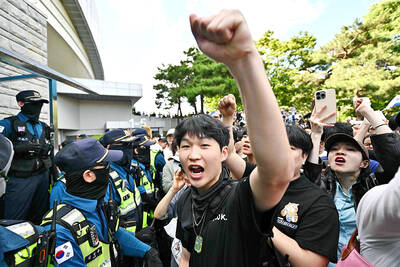
‘ABSURD MISTAKE’: The election commission said that there had been a failure to anticipate turnout after 14 polling stations ran short of ballot papers South Korean riot police yesterday cleared protesters from a Seoul polling station after a 35-hour blockade sparked by a shortage of ballot papers during local elections earlier this week. Wednesday’s election was the first nationwide vote since South Korean President Lee Jae-myung took office following the ouster of Yoon Suk-yeol over his short-lived martial law declaration. Lee’s ruling Democratic Party swept most races, but failed to flip the crucial Seoul mayoral seat. The South Korean National Election Commission apologized, blaming a failure to anticipate turnout after 14 polling stations in Seoul ran short of ballot papers. Some polling stations stayed open until 10pm to

France experienced its hottest spring on record, the French weather service said on Tuesday, after an exceptional early heat wave that also broke highs for the season in England and Wales. Meteo-France said the average nationwide temperature over March to May was 13.8°C — about 1.7°C above the norm, and surpassing records set in 2011 and 2020. “The warmest spring since records began in 1900,” it said in a bulletin. All three months were warmer than average, but the onset of an “unprecedented heatwave” late last month pushed the mercury to highs typically seen at the height of the summer. “Our country had never

A Sherpa guide was found crawling to base camp on Mount Everest a week after he went missing and was reunited with his family, who had given up hope he would return. Dawa Sherpa was last seen on Friday last week descending the mountain, but he did not reach base camp even though his client did. The pair were among the last climbers on the mountain as the climbing season came to an end and the route was dismantled. Dawa was located by a cleaning crew on Thursday morning as he was crawling down the snowy slopes around the Khumbu Icefall, just above
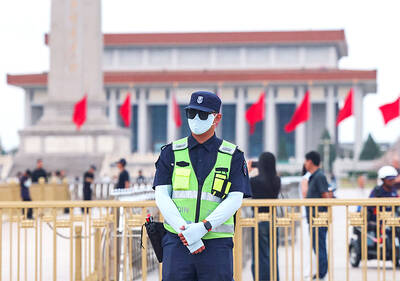
Chinese authorities are snuffing out any remembrance of the deadly 1989 military crackdown on student-led pro-democracy protests in Tiananmen Square, which happened 37 years ago yesterday, in a further tightening of a years-long campaign to erase what happened from public memory. Police told relatives of the victims they would not be allowed to visit a cemetery in Beijing on the anniversary of the crackdown, a person with knowledge of the matter said. Relatives of the victims visited the cemetery on the anniversary for more than 30 years to read memorial statements with police keeping watch, Amnesty International said. Hundreds of people,


 RSS
RSS