


Disney officials consulted Chinese feng shui experts before building Hong Kong Disneyland, making changes such as tilting the site of the park several degrees and setting up "no fire zones" in kitchens, a company spokeswoman said yesterday.
Feng shui is the Chinese belief that harmonious energy and therefore better fortune can be achieved by the correct positioning of furniture and other objects.
Other feng shui influences include the park's orientation to face water with mountains behind, Hong Kong Disneyland spokeswoman Esther Wong said.
The park's groundbreaking date and opening date of Sept. 12 were picked after conferring with feng shui specialists, she said.
`no fire zones'
Feng shui experts also designated "no fire zones" in the kitchens, to try to keep the five elements of metal, water, wood, fire and earth in balance.
Wong said US-based Walt Disney Co decided to observe feng shui because it wanted to defer to local customs.
"It's cultural considerations," Wong said, noting, "all the food and language in the park must follow the habits and tastes of our consumers and future guests."
Hong Kongers tend to be Westernized, but Hong Kong Disneyland is expected to draw droves of guests from neighboring mainland China.
backlash
However, Disney's cultural sensitivity drew a backlash recently. The park had planned to serve shark's fin soup, a Chinese delicacy, but dropped the dish after protests from environmentalists who expressed fears about the extinction of sharks.
Hong Kong Disneyland -- built on reclaimed land in the outlying Lantau island -- is a joint venture between The Walt Disney Co. and the Hong Kong government, but local taxpayers are footing most of the construction bill.
Critics have questioned whether the government got a good deal. Officials have said the park will boost employment and tourism.
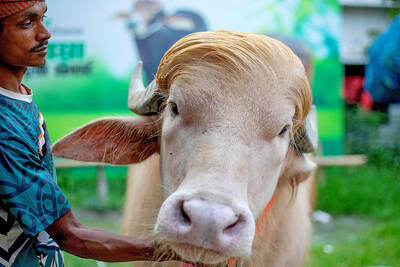
Crowds in Bangladesh are flocking to snap photographs with an unlikely social media star — an albino buffalo with flowing blond hair nicknamed “Donald Trump” that is due to be sacrificed within days. Owner Zia Uddin Mridha, 38, said his brother named the 700kg bull over its flowing helmet of hair resembling the signature look of the US president. “My younger brother picked this name because of the buffalo’s extraordinary hair,” he said at his farm in Narayanganj, just outside the capital, Dhaka. Mridha said that a constant stream of curious visitors — social media fans, onlookers and children — have come throughout

It began as a satirical online project. Now millions of young people in India are flocking to it as an outlet for their frustration. A parody political party called the Cockroach Janta Party, with the insect as its symbol, has exploded across India’s social media by turning absurdist humor into protest. Memes and short videos mocking corruption, joblessness and political dysfunction have flooded social media sites, where millions of users are embracing the cockroach — known for its ability to survive harsh conditions — as a tongue-in-cheek symbol of endurance. The online movement’s rise has been unusually rapid. The Cockroach Janta Party (CJP)

HOTTER: While Indians are accustomed to summer heat, climate change has caused northwestern India to warm faster than other parts of the country, an academic said Roads and markets have emptied during afternoons and some farmers have switched to nighttime work to avoid scorching temperatures as a heat wave grips large parts of India. The India Meteorological Department forecast maximum temperatures for yesterday of about 45°C in the capital, New Delhi, where authorities have opened temporary “cooling zones” to help people cope. The weather department warned that conditions would likely persist across several northern regions in the coming days, with temperatures staying well above seasonal averages. Authorities urged people to stay indoors during the hottest hours and take precautions against heat-related illnesses. India declares a heat wave whenever maximum temperatures

A Hong Kong astronaut is to join a Chinese space mission for the first time as part of a three-person crew launching today, as Beijing edges closer to its goal of landing people on the moon. The Tiangong space station — crewed by teams of three astronauts that are typically rotated every six months — is the crown jewel of China’s space program, boosted by billions in state investment in a bid to catch up with the US and Russia. The Shenzhou-23 mission is to blast off at 11:08pm from the Jiuquan Satellite Launch Center in northwestern China, carrying three astronauts to


 RSS
RSS