


A coup leader who seized power in a rebel war two years ago was vying for Central African Republic's presidency in a runoff election yesterday pitting him against a man representing the former ruling party he ousted.
Military strongman Francois Bozize faces former prime minister Martin Ziguele in a poll that many hope will bring an end to an era of army coups and revolts.
Bozize is favored to win, hoping victory at the ballot box will give him the legitimacy his government lacks.
Bozize led a rebel army that propelled him to the nation's top post in a hail of machine-gun and mortar fire in March 2003 -- when the rest of the world's attention was focused on the US invasion of Iraq.
In the March 13 first round, Bozize won about 43 percent of the vote, less than the simple majority needed for a victory.
Ziguele took 23 percent, while third place went to former military ruler Andre Kolingba, who garnered 16 percent of the vote and claimed the poll was fraudulent.
Three others who lost the initial 11-man race are now rallying behind Bozize. Many believe their support will give Bozize the edge he needs to win.
About 1.5 million of the impoverished nation's 3.6 million people are registered at 4,000 polling stations nationwide.
Voters will also elect the 85 remaining seats up for grabs in a 105-seat legislature. Polls open from 6am to 4pm. Official results may be released in 10 days.
Since gaining independence from France in 1960, Central African Republic has weathered at least nine military revolts and uprisings, often launched by disgruntled soldiers angered over poor pay -- or no pay at all.
While the landlocked nation is rich in gold, diamonds and other minerals, its governments have been chronically cash-poor, and unable to meet payrolls of the military and civil servants.
Bozize toppled democratically elected Ange-Felix Patasse, who now lives in exile in Togo and was barred from running in the election. Ziguele served as Patasse's prime minister.
To his credit, Bozize has managed to keep the country relatively calm and set up a transitional government of national unity that brought in some of his opponents.
"Bozize is the man of the situation who has restored peace in the country," said 31-year-old fish vendor Suzanne Ndia. "Our votes should go to him."
But many believe soldiers like Bozize -- who declared himself president after his guerillas swept into Bangui -- have ruined the country.
"We want a civilian government. Bozize is a soldier and his place is in the army barracks," said Serge Gambo, 46, a mechanic.
"I'm very puzzled," said Jeanot Nguembo, a 22-year-old law student. "Those who hurt us in the past want to return to office. I really don't see any future for my country."

ROCKY RELATIONS: The figures on residents come as Chinese tourist numbers drop following Beijing’s warnings to avoid traveling to Japan The number of Chinese residents in Japan has continued to rise, even as ties between the two countries have become increasingly fractious, data released on Friday showed. As of the end of December last year, the number of Chinese residents had increased by 6.5 percent from the previous year to 930,428. Chinese people accounted for 22.6 percent of all foreign residents in Japan, making them by far the largest group, Japanese Ministry of Justice data showed. Beijing has criticized Tokyo in increasingly strident terms since Japanese Prime Minister Sanae Takaichi last year suggested that a military conflict around Taiwan could

Germany is considering Australia’s Ghost Bat robot fighter as it looks to select a combat drone to modernize its air force, German Minister of Defense Boris Pistorius said yesterday. Germany has said it wants to field hundreds of uncrewed fighter jets by 2029, and would make a decision soon as it considers a range of German, European and US projects developing so-called “collaborative combat aircraft.” Australia has said it will integrate the Ghost Bat, jointly developed by Boeing Australia and the Royal Australian Air Force, into its military after a successful weapons test last year. After inspecting the Ghost Bat in Queensland yesterday,
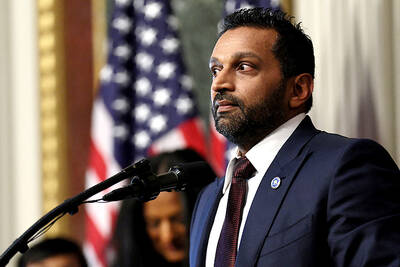
A pro-Iran hacking group claimed to breach FBI Director Kash Patel’s personal e-mail inbox and posted some of the contents online. The e-mails provided by the hacking group include travel details, correspondence with leasing agents in Washington and global entry, and loyalty account numbers. The e-mail address the hackers claim to have compromised has been previously tied to Patel’s personal details, and the leaked e-mails contain photos of Patel and others, in addition to correspondence with family members and colleagues. “The FBI is aware of malicious actors targeting Director Patel’s personal email information,” the agency said in a statement on
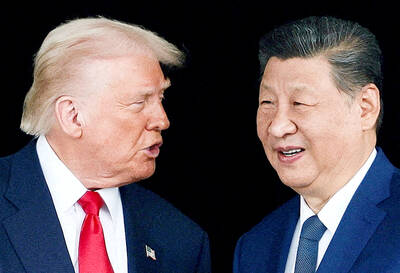
RIVALRY: ‘We know that these are merely symbolic investigations initiated by China, which is in fact the world’s most profligate disrupter of supply chains,’ a US official said China has started a pair of investigations into US trade practices, retaliating against similar probes by US President Donald Trump’s administration as the superpowers stake out positions before an expected presidential summit in May. The move, announced by the Chinese Ministry of Commerce on Friday, is a direct mirror of steps Trump took to revive his tariff agenda after the US Supreme Court last month struck down some of his duties. “China expresses its strong dissatisfaction and firm opposition to these actions,” a ministry spokesperson said in a statement, referring to the so-called Section 301 investigations initiated on March 11.


 RSS
RSS