


An atmosphere of fear pervades China's largely Muslim Xinjiang region, where strangers shy away from open discussion, and religious and civil rights are curbed.
So say residents of the 1.6 million-square-kilometer area in the far west which borders eight largely Muslim Central and South Asian nations and once made up the central portion of the Silk Road.
Since a series of bombings and protests culminated in violent and deadly riots in the city of Yining in 1997, Beijing has clamped down on all religious and cultural undertakings by the majority Uighur Muslim population.
The all pervasive "strike hard" campaign against separatism and extremism has succeeded in ending ethnic violence, but at the expense of people's rights, they say.
"The Chinese are putting far too much pressure on society," says an unemployed Uighur accountant in the regional capital of Urumqi, who only identifies herself as Rozhana.
"You cannot discuss politics publicly, you can hardly have any group meetings with friends without the Chinese suspecting that you are trying to overthrow them."
With a population of some 19 million people, including 8 million Uighur Muslims, residents say the crackdown has meant interaction between the Uighurs and the increasingly numerous Han Chinese is kept to a minimum.
"You only have to say `down with Mao Zedong [
"They are always arresting people, so everyone is afraid to say anything against the Chinese."
Zhang Xinping, a 50-year-old Chinese businessman who was born in Kashgar and who can speak the Turkish Uighur language, says he has long been despondent about the treatment of Uighurs.
But the government's efforts to oppose terrorism meant that the immigrant population of Chinese had more reason to dislike or look down upon them.
"I think that the Han Chinese coming to Kashgar should learn the Uighur language, but they are incapable of this," Zhang said.
"This is part of the problem here. If the Chinese made a little more effort to respect the Uighur culture then things would be better. The Chinese just don't have the habit of treating them better."
The crackdown became more severe after Muslim extremists carried out the Sept. 11, 2001 terrorist attacks on the US, further sharpening racial tensions amid a huge influx of Han Chinese entering the region as part of the government's effort to revitalize its west through economic development.
A 114-page report issued last week by two US rights groups highlighted the crushing campaign of religious repression being carried out against the Uighurs in the name of anti-separatism and counter-terrorism.
Penned by Human Rights Watch and Human Rights in China, it outlined how China denies Uighurs religious freedom, and by extension freedom of association, assembly, and expression.
"The worldwide campaign against terrorism has given Beijing the perfect excuse to crackdown harder than ever in Xinjiang," said Brad Adams, Asia director for Human Rights Watch.
"Other Chinese enjoy a growing freedom to worship, but the Uighurs, like the Tibetans, find that their religion is being used as a tool of control."
China denies this.
Pan Zhiping, a leading expert on racial issues at the Xinjiang Academy of Social Sciences, says the strike-hard campaign appears to be working.
"After the Sept. 11 terrorist attacks, the government very openly and clearly stated its opposition to separatism, religious extremism and terrorism," he said.
"Since then the Xinjiang people have become very clear on this policy.
"Right now Xinjiang is quiet, this has been so especially after 1997. No one wants to see chaos, no one wants to see innocent people dying on buses because of some separatist bomb."
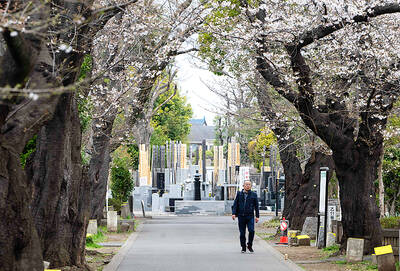
ROCKY RELATIONS: The figures on residents come as Chinese tourist numbers drop following Beijing’s warnings to avoid traveling to Japan The number of Chinese residents in Japan has continued to rise, even as ties between the two countries have become increasingly fractious, data released on Friday showed. As of the end of December last year, the number of Chinese residents had increased by 6.5 percent from the previous year to 930,428. Chinese people accounted for 22.6 percent of all foreign residents in Japan, making them by far the largest group, Japanese Ministry of Justice data showed. Beijing has criticized Tokyo in increasingly strident terms since Japanese Prime Minister Sanae Takaichi last year suggested that a military conflict around Taiwan could

Germany is considering Australia’s Ghost Bat robot fighter as it looks to select a combat drone to modernize its air force, German Minister of Defense Boris Pistorius said yesterday. Germany has said it wants to field hundreds of uncrewed fighter jets by 2029, and would make a decision soon as it considers a range of German, European and US projects developing so-called “collaborative combat aircraft.” Australia has said it will integrate the Ghost Bat, jointly developed by Boeing Australia and the Royal Australian Air Force, into its military after a successful weapons test last year. After inspecting the Ghost Bat in Queensland yesterday,
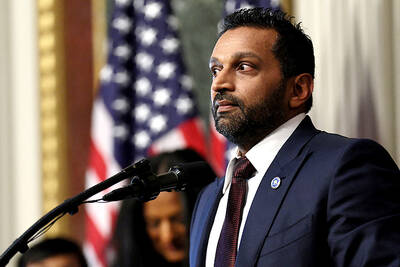
A pro-Iran hacking group claimed to breach FBI Director Kash Patel’s personal e-mail inbox and posted some of the contents online. The e-mails provided by the hacking group include travel details, correspondence with leasing agents in Washington and global entry, and loyalty account numbers. The e-mail address the hackers claim to have compromised has been previously tied to Patel’s personal details, and the leaked e-mails contain photos of Patel and others, in addition to correspondence with family members and colleagues. “The FBI is aware of malicious actors targeting Director Patel’s personal email information,” the agency said in a statement on
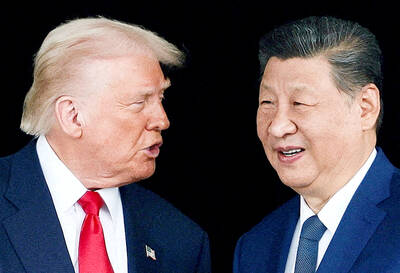
RIVALRY: ‘We know that these are merely symbolic investigations initiated by China, which is in fact the world’s most profligate disrupter of supply chains,’ a US official said China has started a pair of investigations into US trade practices, retaliating against similar probes by US President Donald Trump’s administration as the superpowers stake out positions before an expected presidential summit in May. The move, announced by the Chinese Ministry of Commerce on Friday, is a direct mirror of steps Trump took to revive his tariff agenda after the US Supreme Court last month struck down some of his duties. “China expresses its strong dissatisfaction and firm opposition to these actions,” a ministry spokesperson said in a statement, referring to the so-called Section 301 investigations initiated on March 11.


 RSS
RSS