


Accusations of involvement in kidnappings of priests in Argentina dog one papal contender. "Revelations" about Nazi links surface about another top candidate. Gossipy items about health problems raise doubts about others.
Like any political campaign, the run-up to the election of a pope has seen some dirty laundry hung out in public, and it's not the cardinals' red socks that are getting an airing.
Among the "princes of the church" being targeted was German Cardinal Joseph Ratzinger, one of Pope John Paul II's most trusted aides and a man some Vatican watchers have put in pole position in the race to be Pope.
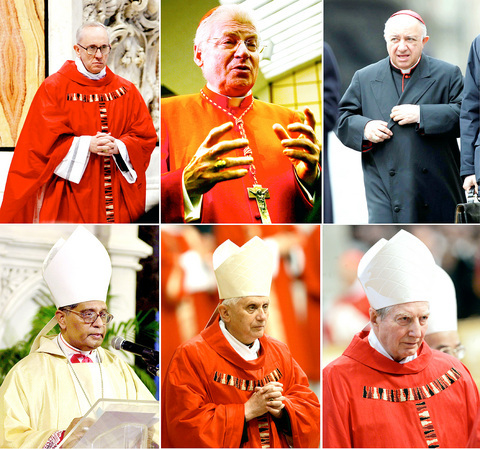
PHOTO: AP
Journalists have been poking around Ratzinger's teenage years during World War II, apparently searching for evidence of any pro-Nazi sentiment.
And on Friday, Argentine Cardinal Jorge Bergoglio was cited in a criminal complaint alleging involvement in the 1976 kidnappings of two fellow Jesuits during Argentina's dark years of military dictatorship. The cardinal's spokesman called the allegation by a human rights lawyer "old slander."
Closet doors are being yanked open in efforts to shape the fortunes of those in the conclave, which began Monday with a first, inconclusive vote.
Also being swept out in the search for dirt are purported health problems.
The Corriere della Sera's daily column on the rise and fall of pre-conclave fortunes noted the "small pieces of gossip tossed out there with apparent nonchalance but which translate into little bombs."
Among the potential bombshells was an item in the communist daily Il Manifesto that Venice Cardinal Angelo Scola's future "could be burned for health reasons" over allegations he suffers strong headaches and "nervous depression."
Cardinals and their aides closely monitor the Italian media. But now that they have been sequestered in Vatican City since Sunday night, the electors aren't allowed to follow the news under strict rules set by John Paul to discourage outside influence.
Other Italian reports said Bombay Cardinal Ivan Dias, who is seen as a long-shot candidate, has diabetes. They later reported that a priest who spoke with the 69-year-old Dias said the reports were wrong.
Several reports noted that the former archbishop of Milan, Cardinal Carlo Maria Martini, has a tremor that could be a sign of Parkinson's, the disease John Paul suffered from in his last years.
Martini has been widely mentioned as a possible "anti-candidate" to counter Ratzinger.
The German cardinal is a hero to doctrinal conservatives, while liberal camps are supposedly rooting for Martini, who is considered more open-minded.
The 78-year-old Bavarian prelate is the supposed favorite of cardinals leaning toward an elderly figure to lead the church for likely just a few years while churchmen try to absorb the legacy of John Paul's 26 years at the helm.
A Sunday Times of London profile on Ratzinger, saying his doctrinal watchdog role has earned him uncomplimentary nicknames like "God's rottweiler," reported on the cardinal's "brief membership" in the Hitler Youth movement and service, in the final stretch of World War II, in a German anti-aircraft unit.
In his memoirs, Ratzinger speaks openly of being enrolled in the Nazi youth movement against his will when he was 14 in 1941, when membership was compulsory. He says he was soon let out because of his studies for the priesthood.
Two years later he was drafted into a Nazi anti-aircraft unit as a helper, a common fate for teenage boys too young to be soldiers. Enrolled as a soldier at 18, in the last months of the war, he barely finished basic training.
Ratzinger's wartime past "may return to haunt him," the British paper wrote on the eve of the conclave's start.
Web sites, presumably propelled by Ratzinger supporters, churned out articles in his defense, including one by the Jerusalem Post seeking to knock down much of the Times' harsh description of the cardinal's background.
Also sharply attacked in recent days has been another Italian contender, Milan Cardinal Dionigi Tettamanzi, with detractors insisting he isn't the down-to-the bone conservative many see him as.
But Tettamanzi's star was already seen as falling years ago by those whose credo is the oft-cited Italian proverb: "He who enters the conclave a pope comes out a cardinal.'' That camp contends the buzz on Tettamanzi began too soon to sustain enough support for him into the conclave.

‘CROSSING THE LINE’: China’s embassy in Seoul criticized US Forces Korea Commander General Xavier Brunson, asking if his ‘hostile’ remarks were authorized by Washington South Korea and the US are in talks over recent public remarks by the commander of US Forces Korea, Seoul’s presidential office said yesterday, after the comments drew sharp criticism from China. In a recent podcast interview, US Forces Korea Commander General Xavier Brunson described South Korea as “the dagger in the heart of Asia” from China’s east coast, prompting the Chinese embassy in Seoul to say that he had “truly crossed the line.” The interview came amid growing speculation that Washington might seek to expand the role of US Forces Korea in countering the growing regional influence of China, a key

SEEKING ORDER: Rodrigo Paz said that ‘anyone who wants to destroy the nation will have to deal with this president and the full force of the constitution’ Bolivian President Rodrigo Paz on Wednesday said that the nation was at a “breaking point” after nearly a month of protests that have caused shortages of food, fuel and medicine. Paz, who took office six months ago amid the worst economic crisis there in four decades, is battling a groundswell of fury over his policies. The political capital, La Paz, has been besieged by low-income workers and members of the indigenous majority calling for his resignation. “The country needs order and is reaching breaking point,” the 58-year-old said at a public event in La Paz, renewing his appeal for dialogue. On Tuesday, the Bolivian

Through the noise of rushing papers and whirring belts at a print factory in Kyoto, two creators watch their photo essay come to life in broadsheet form — part of an effort to win new audiences in the age of artificial intelligence (AI). Despite the decline of the publishing industry, self-publication and handmade “zine” magazines are growing in popularity in Japan, reflecting the nation’s enduring love of paper in the digital era. While speaking to Agence France-Presse at the plant, his hands black with ink, one of the creators, Kazuma Obara, said: “I think [paper] is a medium that engages all five

Australian researchers have trained lab-grown brain cells on a silicon computer chip to play the 1990s shooter game Doom and said they are just scratching the surface of what the neurons could be capable of doing. It is the science-fiction work of biotech boffins at Cortical Labs, who researched and developed the technology that harnesses the workings of the brain’s networking system. Each so-called “biological computer” contains about 200,000 living human brain cells, grown from stem cells that were harvested from blood donations. Having mastered the simple computer game Pong, where a paddle is moved up and down to send a ball


 RSS
RSS