


The mafia's laws are simple: avoid killing if you can, and kill discreetly if you can't. However, laws were made to broken. And in the past few weeks they have been broken a lot.
Mob violence, once thought to be a distant bad memory in Italy, has gripped Naples, the country's grimy, crime-ridden southern city.
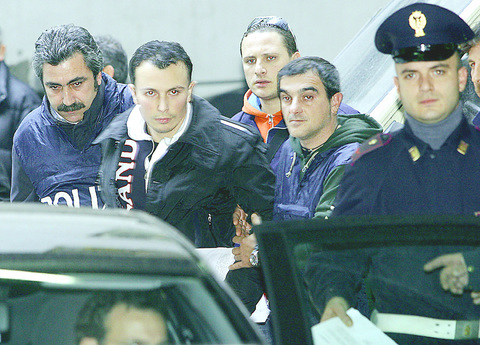
PHOTO: AFP
Last week thousands of heavily armed police -- backed by helicopters and sniffer dogs -- launched a series of raids aiming at rounding up the gunmen, extortionists and drug-runners responsible. But, despite the arrest of the supposed reigning capo di capi and 50 others, no one believes the bloodshed is over. Indeed, many fear it will spread.
More than 100 have died after factions of one of the mafia's most notorious families turned against one another earlier this year.
Bodies have been found in burnt-out cars, teenagers have been shot off their scooters, aspiring drug-pushers executed among hanging salamis in a delicatessen. In a touch worthy of The Godfather films, one alleged mafioso was shot as he ate dinner in a restaurant, dying face down in his pizza.
Now investigators fear that the battle could spread, dragging southern Italy into a welter of shootings and beatings.
The violence began in June, when a young and inexperienced boss -- a former hitman called Ciro di Lauro, who was running the city's rundown Scampia quarter on behalf of his fugitive father -- allegedly ordered the murder of two rebellious young lieutenants. With control of a US$21 billion a year drugs trade at stake, the killings rapidly escalated. In one particularly violent weekend, six gang members died.
The battle is fundamentally between clan members loyal to Paolo di Lauro, 51, who is on the run from a government arrest warrant after 20 years running Scampia, and an ambitious new generation of gangsters who want a larger cut of the drugs profits. It is unremittingly brutal. One elderly man was beaten to death for failing to reveal where his stepson was. The body of a 22-year-old woman, who had reportedly refused to reveal the whereabouts of her gang-member boyfriend, was found in her burnt-out Fiat.
There have been other signs of the strain the war is imposing on the population of Naples' northern suburbs. Children are missing school because their families are on the run. Homes and businesses are regularly torched. Even many of the Christmas lights hanging in shop windows are not merely decorations, but part of a sophisticated protection racket.
Public prosecutor Giuseppe Narducci warned one newspaper that the conflict could spread from the Di Lauro clan to involve other powerful crime families. "What is happening is the result of a fracture within a single group, a fratricidal war," he said. "One of the factions could seek outside support or alliances."
Technically, the mob in Naples is known as the camorra and has been active for centuries, surviving periodic waves of repression.
The government has sent 300 extra police and made 700 arrests since the autumn, including Vincenzo Mazzarella, 48, head of one of the families, who was detained at a hotel near EuroDisney outside Paris.
Amato Lamberti, a sociology professor at Naples University who has studied the camorra for 30 years, has no doubts about the reason for the violence: "Naples has become the most important drugs market in the Mediterranean. The war is to control the traffic."
Experts say the violence is a sign of weakness in the camorra, whose members prefer to don their double-breasted suits and get down to the business of making money. For years the gangsters have avoided bloodshed because of the attention it brings from the authorities.
Palermo, headquarters of the Sicilian mafia, has been quiet for decades after the well-organized central leadership of the cosa nostra banned killings. But the camorra -- split into more than 20 clans -- have always been more volatile.
Critics say the government's response has been inadequate. On Dec. 11, Marcello Dell'Utri, one of Prime Minister Silvio Berlusconi's closest business and political allies, was sentenced to nine years for complicity with Sicily's cosa nostra. For many on the opposition benches, that fact alone explains why Berlusconi's government is unable to lead in the war against organized crime in any convincing way.
"The real problem is the camorra's roots in Neapolitan society," Lamberti said.


Through the noise of rushing papers and whirring belts at a print factory in Kyoto, two creators watch their photo essay come to life in broadsheet form — part of an effort to win new audiences in the age of artificial intelligence (AI). Despite the decline of the publishing industry, self-publication and handmade “zine” magazines are growing in popularity in Japan, reflecting the nation’s enduring love of paper in the digital era. While speaking to Agence France-Presse at the plant, his hands black with ink, one of the creators, Kazuma Obara, said: “I think [paper] is a medium that engages all five
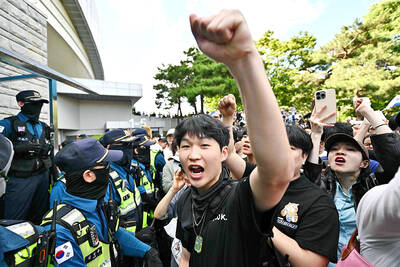
‘ABSURD MISTAKE’: The election commission said that there had been a failure to anticipate turnout after 14 polling stations ran short of ballot papers South Korean riot police yesterday cleared protesters from a Seoul polling station after a 35-hour blockade sparked by a shortage of ballot papers during local elections earlier this week. Wednesday’s election was the first nationwide vote since South Korean President Lee Jae-myung took office following the ouster of Yoon Suk-yeol over his short-lived martial law declaration. Lee’s ruling Democratic Party swept most races, but failed to flip the crucial Seoul mayoral seat. The South Korean National Election Commission apologized, blaming a failure to anticipate turnout after 14 polling stations in Seoul ran short of ballot papers. Some polling stations stayed open until 10pm to

France experienced its hottest spring on record, the French weather service said on Tuesday, after an exceptional early heat wave that also broke highs for the season in England and Wales. Meteo-France said the average nationwide temperature over March to May was 13.8°C — about 1.7°C above the norm, and surpassing records set in 2011 and 2020. “The warmest spring since records began in 1900,” it said in a bulletin. All three months were warmer than average, but the onset of an “unprecedented heatwave” late last month pushed the mercury to highs typically seen at the height of the summer. “Our country had never

A Sherpa guide was found crawling to base camp on Mount Everest a week after he went missing and was reunited with his family, who had given up hope he would return. Dawa Sherpa was last seen on Friday last week descending the mountain, but he did not reach base camp even though his client did. The pair were among the last climbers on the mountain as the climbing season came to an end and the route was dismantled. Dawa was located by a cleaning crew on Thursday morning as he was crawling down the snowy slopes around the Khumbu Icefall, just above


 RSS
RSS