


Pakistan's former prime minister Benazir Bhutto said her nation bought long-range missile technology from North Korea in the 1990s, but there was no exchange of nuclear technology in return, a leading Japanese daily reported yesterday.
Bhutto was also quoted as telling the Asahi Shimbun in an interview, conducted in London where she lives in exile, that people had proposed to the government that Pakistan sell its nuclear technology to other nations.
In February, Abdul Qadeer Khan, a scientist who is the father of Pakistan's nuclear bomb, said he had leaked nuclear secrets to North Korea, Libya and Iran but that he had acted independently.
Western diplomats have said, however, that Khan could not have acted alone and that Pakistani scientists might have sold nuclear technology to North Korea, which has been at the center of a nuclear crisis since 2002.
Asked about speculation that Pakistan had exported nuclear technology, Bhutto said it was true that while she was in office there were unspecified people who had proposed this to the government as a way of raising foreign currency, but that she persuaded them not to.
She added that Pakistan did acquire missile technology from North Korea following a visit she made there in December 1993, but that it was bought and no trade of nuclear technology was made for it.
She also denied that Pakistan exported nuclear technology from 1994 to 1995, the Asahi said.
Bhutto served as prime minister from December 1988 to August 1990 and from October 1993 to October 1996.
In February, Bhutto said Mu-sharraf's decision to pardon Khan following his apology had only fuelled suspicion the president was involved in the scandal involving the leak of nuclear secrets.

Crowds in Bangladesh are flocking to snap photographs with an unlikely social media star — an albino buffalo with flowing blond hair nicknamed “Donald Trump” that is due to be sacrificed within days. Owner Zia Uddin Mridha, 38, said his brother named the 700kg bull over its flowing helmet of hair resembling the signature look of the US president. “My younger brother picked this name because of the buffalo’s extraordinary hair,” he said at his farm in Narayanganj, just outside the capital, Dhaka. Mridha said that a constant stream of curious visitors — social media fans, onlookers and children — have come throughout

It began as a satirical online project. Now millions of young people in India are flocking to it as an outlet for their frustration. A parody political party called the Cockroach Janta Party, with the insect as its symbol, has exploded across India’s social media by turning absurdist humor into protest. Memes and short videos mocking corruption, joblessness and political dysfunction have flooded social media sites, where millions of users are embracing the cockroach — known for its ability to survive harsh conditions — as a tongue-in-cheek symbol of endurance. The online movement’s rise has been unusually rapid. The Cockroach Janta Party (CJP)

HOTTER: While Indians are accustomed to summer heat, climate change has caused northwestern India to warm faster than other parts of the country, an academic said Roads and markets have emptied during afternoons and some farmers have switched to nighttime work to avoid scorching temperatures as a heat wave grips large parts of India. The India Meteorological Department forecast maximum temperatures for yesterday of about 45°C in the capital, New Delhi, where authorities have opened temporary “cooling zones” to help people cope. The weather department warned that conditions would likely persist across several northern regions in the coming days, with temperatures staying well above seasonal averages. Authorities urged people to stay indoors during the hottest hours and take precautions against heat-related illnesses. India declares a heat wave whenever maximum temperatures
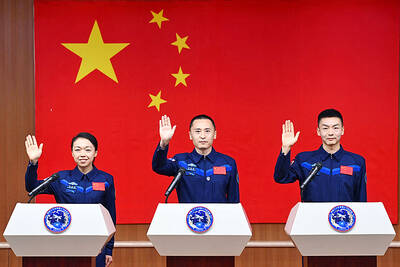
A Hong Kong astronaut is to join a Chinese space mission for the first time as part of a three-person crew launching today, as Beijing edges closer to its goal of landing people on the moon. The Tiangong space station — crewed by teams of three astronauts that are typically rotated every six months — is the crown jewel of China’s space program, boosted by billions in state investment in a bid to catch up with the US and Russia. The Shenzhou-23 mission is to blast off at 11:08pm from the Jiuquan Satellite Launch Center in northwestern China, carrying three astronauts to


 RSS
RSS