


It was a scoop to make any journalist jealous: the revelation that three Italian hostages held in Iraq until recently were only freed thanks to their sheer luck at finding themselves in the company of a Polish intelligence agent.
The agent, via a bean-sized microchip tracking device implanted in his forearm, transmitted their position to coalition special forces, who rode to the rescue.
Fantastic stuff. But true? Nobody knows.
The story did not cite any sources and did not provide any evidence to back its claim. It did not appear in any reputable daily or magazine, nor was it broadcast on any mainstream radio station or television network.
And yet, it was immediately picked up by at least two Italian news agencies and several influential dailies, including Rome's La Repubblica, Turin's La Stampa and the online edition of Milan's Il Corriere della Sera.
`Spy'
The alleged scoop was in fact first published on the Internet by Dagospia, a gossip web site that is rapidly redefining Italy's media landscape.
Dagospia is the brainchild of Roberto D'Agostino, a rumor-mill enthusiast who first made headlines in 1991 by slapping Vittorio Sgarbi, an obnoxious art critic-turned-politician, on live television.
The name of his Internet magazine, which he founded four years ago, derives from a contraction of his surname and "spia," Italian for "spy." Its design style resembles that of the Drudge Report, the Internet gossip site created by American journalist Matt Drudge.
D'Agostino openly speaks of Drudge as being the model that inspired Dagospia.
And just like Drudge played a pivotal role in unveiling the Monica Lewinsky scandal in the United States, Dagospia is rapidly establishing itself as Italy's premier source of gossip and insider information for journalists, captains of industry, politicians and media personalities, not to mention ordinary Italians, who visit the site in their millions.
Admiration
Last year, for instance, rumors that Corriere della Sera's board of directors would be replacing its chief editor because of the editor's hostility towards the government of Prime Minister Silvio Berlusconi first surfaced on Dagospia.
The change of guard at Italy's most influential daily did indeed take place several days later, earning D'Agostino widespread admiration from the country's media circles.
More recently, during a meeting with foreign journalists in Rome, a high-ranking Northern League politician cited a Dagospia article to denounce what he described as an "unnaturally cozy" relationship between the governor of the Bank of Italy and the chairman of Capitalia, one of Italy's largest banks.
Too hot
Dagospia relies on a growing network of strictly anonymous contributors to provide readers with daily servings of sex and celebrity rumors involving figures from the worlds of culture, politics, finance, sports and media.
It is equally disparaging toward everyone, whatever their status in society.
Many of the stories it prints are too hot to be published in the mainstream media -- usually because they risk offending sensitive advertisers or because they infringe upon the vested interests of very powerful individuals or corporations.
Some of Italy's best paparazzi send their irreverent snapshots to Dagospia because they are unable to find a buyer.
Voyeurism
A recent photograph of Berlusconi holding on to his private parts during a military parade, for instance, was only to be seen on Dagospia.
La Stampa columnist Filippo Ceccarelli has since suggested that its publication on the Internet site is evidence of the prime minister's decline in popularity.
Despite being financed largely by advertisements from the pornographic industry -- an aspect that may make puritans cringe -- Dagospia cannot be ignored.
By appealing to Italians' lust for voyeurism, intrigue and scandal, and by operating outside the control of the authorities, Dagospia has turned into a highly influential source of information and into an unprecedented media success story.
"I am the most ferocious gossip in the world," D'Agostino says proudly.

SPEAKING OUT: After Siranudh Scott’s allegations surfaced, celebrities and public figures took to social media to share their own experiences of sexual misconduct and abuse A high-profile alleged sexual abuse case within a wealthy Thai beer brewing family has prompted a wave of painful accounts from survivors of unconnected abuse in the conservative nation. Siranudh Scott, a member of the billionaire Thai family that founded the ubiquitous Singha beer brand, posted an emotional video this month accusing his elder brother Sunit of repeatedly abusing him when he was a teenager. Sunit, who is in his 30s, later denied the allegations in a video posted online, but Singha parent Boonrawd dismissed him from his executive role with the company on Tuesday last week. “I felt I needed to speak

SEEKING ORDER: Rodrigo Paz said that ‘anyone who wants to destroy the nation will have to deal with this president and the full force of the constitution’ Bolivian President Rodrigo Paz on Wednesday said that the nation was at a “breaking point” after nearly a month of protests that have caused shortages of food, fuel and medicine. Paz, who took office six months ago amid the worst economic crisis there in four decades, is battling a groundswell of fury over his policies. The political capital, La Paz, has been besieged by low-income workers and members of the indigenous majority calling for his resignation. “The country needs order and is reaching breaking point,” the 58-year-old said at a public event in La Paz, renewing his appeal for dialogue. On Tuesday, the Bolivian
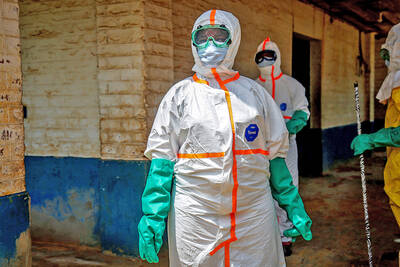
COMMUNITY CONFLICT: Concerns about disease spread from corpses has run up against friends and families’ desire to bury their dead as infection spreads in the area Angry residents of a town at the epicenter of the Ebola outbreak in the Democratic Republic of the Congo (DR Congo) attacked and burned a tent that was part of a health center where people are being treated for the virus, the staff there said Saturday. It was the second such attack in the region in a week. No one was hurt in the attack, according to reports but as patients ran out to escape the fire, 18 people with suspected Ebola infections fled the facility and are unaccounted for, a hospital director said. Angry residents arrived at the clinic in the
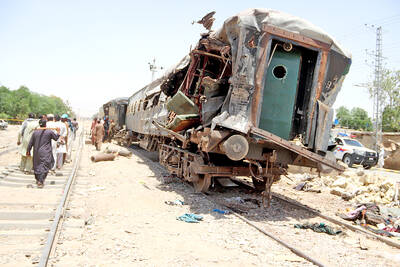
INSURGENT ACTION: A local independence movement in Balochistan, alleged by Pakistan’s government to be backed by India, claimed responsibility for the strike A suicide bomber detonated an vehicle-borne IED near a railway as a passenger train passed through the southwestern Pakistani city of Quetta yesterday, killing at least 23 people and wounding over 70, officials said. The explosion caused two of the train cars to overturn and catch fire, according to footage shared online. The attack happened in an area where security forces are usually stationed, badly damaging several nearby buildings and smashing more than a dozen vehicles parked along the road, according to witnesses and images circulating on social media. Doctors at local hospitals said they had received the wounded, with 20 in critical


 RSS
RSS