


Jose Luis Rodriguez Zapatero brought the Socialists from the political wilderness to a spectacular election victory on Sunday and will now need his cool head and calm temper to unite Spain after its worst bomb attack.
Rodriguez Zapatero, who until Thursday's bombing was considered an outsider for Spain's top job, had angered many in his own party with his lack of aggression in the months after he took the leadership in 2000 following a heavy electoral defeat.
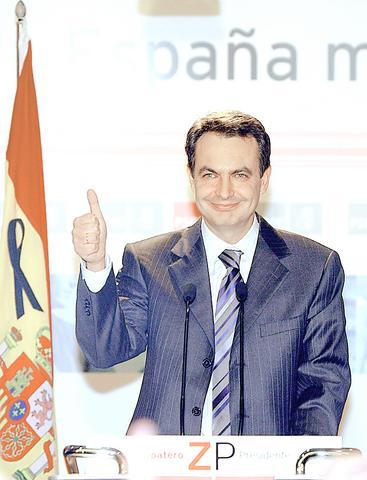
PHOTO: EPA
But his tendency to compromise may prove a valuable asset as he looks to form a government with left-wing allies or regional parties. It may also help Spain heal the scars from Thursday's train bombings which killed 200 people and injured some 1,500.
The attack appeared to have played a crucial role in a big poll swing to the Socialists, stirring anger at the ruling Popular Party's handling of the investigation and at outgoing Prime Minister Jose Maria Aznar's commitment to the US-led war in Iraq.
One of Zapatero's first acts as prime minister could be the withdrawal of 1,300 Spanish troops from Iraq. He has promised to pull them out if the UN does not take charge in Iraq by the end of June.
The unflappable Zapatero, who became Spain's youngest member of parliament at 26, then faces a tougher task as his government will need to appease powerful Catalan and Basque nationalists keen to wrestle more power from Madrid.
The 43-year-old will also need to court Spain's unions and old-style socialists and keep the loyalty of powerful barons who control the regional branches of his party.
Zapatero is often compared to Britain's "Third Way" advocate, Prime Minister Tony Blair.
The law student has stuck to a policy of "calm change" instead of rupture with old-school socialism.
"He is a 15-round fighter, the kind that gets into trouble in the first four rounds, and then gradually takes over," Manuel Garcia, his former law professor, told El Pais newspaper.
Unlike many of his fiery countrymen, Zapatero is famed for his coolness and colleagues say they have never seen him angry. Married with two children, Zapatero prides himself on his politeness but the word most used to describe him is "dull."
"He is a very serene person. He received the news of the result with a strange calm," said a senior Socialist politician of Zapatero's reaction to his election win.
In a country obsessively proud of its cuisine, Zapatero professes not to enjoy food and does not drink alcohol. He loves fishing in the rivers of his native northern province of Leon.
Zapatero realized he had politics in his blood aged 16 when he heard the will of his socialist grandfather, an army colonel executed by a fascist firing squad in the Spanish Civil War.
"My father read to my brother and I the will of my grandfather Captain Lozano who wrote a few hours before being shot in 1936, `I die innocent and I forgive,'" Zapatero wrote. "At that moment my biography begins."
When he turned 18, Zapatero joined the Socialist Party. He rose quickly through the ranks after the party won power in 1982 under its charismatic former prime minister Felipe Gonzalez -- one of Zapatero's heroes.
Ironically, Gonzalez -- who held power for 14 years until he was ousted by Aznar amid corruption scandals -- was one of Zapatero's most outspoken critics in his early days as party leader.
He stirred outrage by offering a cross-party pact with the Popular Party (PP) against the Basque terrorist group ETA, but stuck to his guns and won the day.
But critics say Zapatero lacks the killer instinct and point to his previous failure while opposition leader to capitalize on a string of unpopular moves by the PP, including a bungled labour reform, an oil spill and the war in Iraq.
More recently, the revelation that a coalition partner of the Socialists in the regional government of Catalonia held secret talks with ETA prompted the PP to question Zapatero's control over his own party.
For some, Zapatero's lack of aggression was exemplified in a recent television interview. When asked what he would do if confronted by the leader of ETA in the street, Zapatero replied: "I would not look him in the face."

SPEAKING OUT: After Siranudh Scott’s allegations surfaced, celebrities and public figures took to social media to share their own experiences of sexual misconduct and abuse A high-profile alleged sexual abuse case within a wealthy Thai beer brewing family has prompted a wave of painful accounts from survivors of unconnected abuse in the conservative nation. Siranudh Scott, a member of the billionaire Thai family that founded the ubiquitous Singha beer brand, posted an emotional video this month accusing his elder brother Sunit of repeatedly abusing him when he was a teenager. Sunit, who is in his 30s, later denied the allegations in a video posted online, but Singha parent Boonrawd dismissed him from his executive role with the company on Tuesday last week. “I felt I needed to speak

SEEKING ORDER: Rodrigo Paz said that ‘anyone who wants to destroy the nation will have to deal with this president and the full force of the constitution’ Bolivian President Rodrigo Paz on Wednesday said that the nation was at a “breaking point” after nearly a month of protests that have caused shortages of food, fuel and medicine. Paz, who took office six months ago amid the worst economic crisis there in four decades, is battling a groundswell of fury over his policies. The political capital, La Paz, has been besieged by low-income workers and members of the indigenous majority calling for his resignation. “The country needs order and is reaching breaking point,” the 58-year-old said at a public event in La Paz, renewing his appeal for dialogue. On Tuesday, the Bolivian
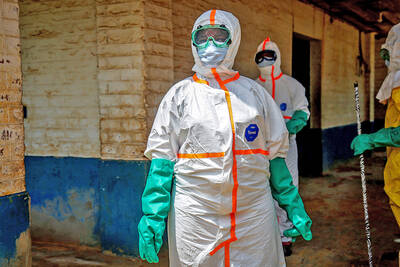
COMMUNITY CONFLICT: Concerns about disease spread from corpses has run up against friends and families’ desire to bury their dead as infection spreads in the area Angry residents of a town at the epicenter of the Ebola outbreak in the Democratic Republic of the Congo (DR Congo) attacked and burned a tent that was part of a health center where people are being treated for the virus, the staff there said Saturday. It was the second such attack in the region in a week. No one was hurt in the attack, according to reports but as patients ran out to escape the fire, 18 people with suspected Ebola infections fled the facility and are unaccounted for, a hospital director said. Angry residents arrived at the clinic in the
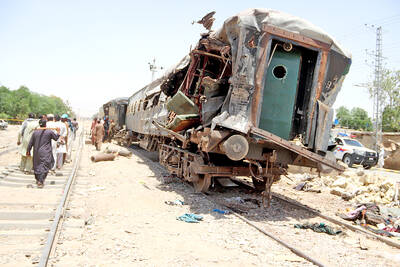
INSURGENT ACTION: A local independence movement in Balochistan, alleged by Pakistan’s government to be backed by India, claimed responsibility for the strike A suicide bomber detonated an vehicle-borne IED near a railway as a passenger train passed through the southwestern Pakistani city of Quetta yesterday, killing at least 23 people and wounding over 70, officials said. The explosion caused two of the train cars to overturn and catch fire, according to footage shared online. The attack happened in an area where security forces are usually stationed, badly damaging several nearby buildings and smashing more than a dozen vehicles parked along the road, according to witnesses and images circulating on social media. Doctors at local hospitals said they had received the wounded, with 20 in critical


 RSS
RSS