


Although the annual hajj is a time of erasing past sins, some pilgrims are finding it hard to forgive Islamic militants -- including suicide bombers -- for blackening their religion's image.
The pilgrimage comes as some militants and clerics in the Arab world have renounced their extremist stands in recent months. They embraced moderation in the wake of international and domestic pressure, especially since the Sept. 11, 2001, terrorist attacks in the US.
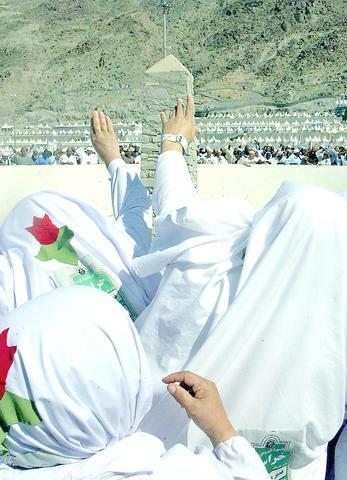
PHOTO: AP
While some pilgrims in this holy city said militants don't deserve forgiveness, many others maintained that forgiveness, like repentance, is crucial to eliminating extremism.
"We must not create an enmity with them," Saudi pilgrim Abdullah al-Ghamdi, 27, said of the militants.
"We have to open a dialogue with them so that they are fully convinced," he said.
Syrian merchant and first-time pilgrim Seif Eddin Shalabi disagreed.
"By God, we can never forgive them for what they have done," Shalabi said on Tuesday.
"They have caused strife between Muslims themselves and between Muslims and the West. Also what about the numerous victims? Who's to be held accountable for that?"
Shalabi said militants have caused resistance to be confused with terrorism, "which has undermined our causes in Palestine and Iraq."
Shoeib Adamou, from Nigeria, said terrorists cannot even be considered real Muslims.
"The whole Muslim community has repeatedly denounced them, so forgiveness is not even an issue here," he said, as waves of pilgrims poured into Mecca for the last rites of a pilgrimage marred by the trampling deaths of 251 people on Sunday.
Condemnations of extremism and terrorism have been central to speeches and sermons delivered at this year's hajj, where fears of a terror attack kept security high.
In a Saturday sermon on Mount Arafat, top Saudi cleric Abdel Aziz Al al-Sheik said terrorists have helped "the enemies of Islam" in attacking the religion.
At the feast prayers a day later in the Grand Mosque, cleric Abdel Rahman bin Abdel Aziz al-Sudeis denounced extremism and stressed that Islam is a religion of moderation.
The same ideas were highlighted by the Saudi king and crown prince, who described terrorists as "people with sick thought" in their address to the pilgrims Monday.
Following the Sept. 11 attacks, Saudi Arabia -- home to 15 of the 19 suicide hijackers -- and other Muslim countries came under intense pressure to combat religious extremism.
After suicide bombings struck the Saudi capital of Riyadh last year, the government cracked down heavily on Islamic militants and terror suspects.
In the past few months, three Muslim clerics detained in terror sweeps and charged with advocating violence in sermons appeared on Saudi state-run television to call on militants to disarm and renounce extremism. A group of arrested militants also apologized on television, saying they had been brainwashed.
In Egypt, the imprisoned leaders of the country's largest militant group, al-Gamaa al-Islamiya, have published books renouncing their earlier violence and have denounced last year's suicide attacks in Saudi Arabia.
And in Yemen, where at least 170 repentant al-Qaeda militants were released after vowing to respect Yemen's laws, authorities have opened a dialogue with militants who haven't been involved in terrorist acts.
"The door to repentance is open," said Egyptian salesman Mohammed al-Sayed, who was performing his third hajj. "The important thing is that they are sincere."
Usama Mustafa, an American of Lebanese origin, praised militants who repented, but accused the US and Arab regimes of "pushing the militants to the extreme" -- America through its perceived bias toward Israel, and Arab governments by oppressing their own citizens.
"What do they expect from these people? That they smile back at them? The injustice is so clear," said the hospital administrator from Alexandria, Virginia.
"We cannot blame them [militants] too much, and we cannot defend them too much," he said.
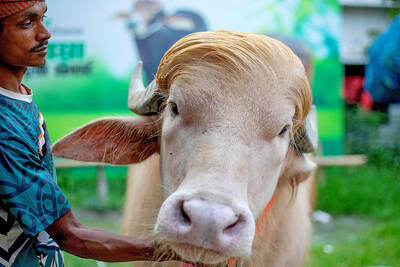
Crowds in Bangladesh are flocking to snap photographs with an unlikely social media star — an albino buffalo with flowing blond hair nicknamed “Donald Trump” that is due to be sacrificed within days. Owner Zia Uddin Mridha, 38, said his brother named the 700kg bull over its flowing helmet of hair resembling the signature look of the US president. “My younger brother picked this name because of the buffalo’s extraordinary hair,” he said at his farm in Narayanganj, just outside the capital, Dhaka. Mridha said that a constant stream of curious visitors — social media fans, onlookers and children — have come throughout

It began as a satirical online project. Now millions of young people in India are flocking to it as an outlet for their frustration. A parody political party called the Cockroach Janta Party, with the insect as its symbol, has exploded across India’s social media by turning absurdist humor into protest. Memes and short videos mocking corruption, joblessness and political dysfunction have flooded social media sites, where millions of users are embracing the cockroach — known for its ability to survive harsh conditions — as a tongue-in-cheek symbol of endurance. The online movement’s rise has been unusually rapid. The Cockroach Janta Party (CJP)
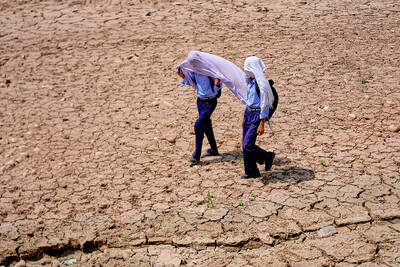
HOTTER: While Indians are accustomed to summer heat, climate change has caused northwestern India to warm faster than other parts of the country, an academic said Roads and markets have emptied during afternoons and some farmers have switched to nighttime work to avoid scorching temperatures as a heat wave grips large parts of India. The India Meteorological Department forecast maximum temperatures for yesterday of about 45°C in the capital, New Delhi, where authorities have opened temporary “cooling zones” to help people cope. The weather department warned that conditions would likely persist across several northern regions in the coming days, with temperatures staying well above seasonal averages. Authorities urged people to stay indoors during the hottest hours and take precautions against heat-related illnesses. India declares a heat wave whenever maximum temperatures

A Hong Kong astronaut is to join a Chinese space mission for the first time as part of a three-person crew launching today, as Beijing edges closer to its goal of landing people on the moon. The Tiangong space station — crewed by teams of three astronauts that are typically rotated every six months — is the crown jewel of China’s space program, boosted by billions in state investment in a bid to catch up with the US and Russia. The Shenzhou-23 mission is to blast off at 11:08pm from the Jiuquan Satellite Launch Center in northwestern China, carrying three astronauts to


 RSS
RSS