


Posters are up, images are being polished and the dirty tricks have started well before candidates are allowed to barrage voters in the Philippines.
Officially, campaigning cannot begin until Feb. 10, but in the media and on the luncheon speech circuit, President Gloria Macapagal Arroyo and her five rivals have been revving up their personalities and platforms for general elections in May.
Even critical business such as passing this year's national budget is mired in politics as lawmakers haggle about the size of the pork barrel for vote-winning public works projects.
The state election commission can disqualify candidates for premature campaigning, but it has problems of its own after the Supreme Court cancelled a deal for electronic ballot-counters due to bidding irregularities.
Votes for 17,000 elected officials -- from president and senator through to regional governor and town councillor -- must again be tallied by hand after the polls close on May 10.
In the past, it has taken weeks for final results to trickle in from a nation of 7,100 islands and nearly 40 million voters.
Elections in the Philippines are always raucous events, with the dead casting ballots, voters registering in multiple wards and politicians forming fluid alliances.
But there are signs this campaign could be particularly nasty -- from questions about the citizenship of front-running film star Fernando Poe Jr to rumors of a plot against Arroyo's government that sent the peso plunging last week.
"I am afraid that we will witness one of the most violent elections in our history," said political analyst Earl Parreno.
Some of Arroyo's critics cast doubt on the legitimacy of her mandate, saying her rise from vice president in early 2001 after a popular revolt toppled Joseph Estrada was a coup by the ruling elite against a leader with vast backing from the poor.
Stephen Wilford, the Singapore-based Southeast Asia analyst for the Control Risks Group, said he was concerned the election could be postponed by lack of preparation for a manual count or fail altogether because of widespread doubt about the outcome.
"If some kind of poll goes ahead, the most dangerous time for the Philippines could be after the elections are over from the point of view that the result will not have the respect it needs to give any new president any kind of mandate," Wilford said.
"Then your military challenges and your machinations among the oligarchs are really going to ratchet up."
The influence of generals and unhappiness in the ranks cannot be ignored after the military backed street protests and middle-class anger that ousted dictator Ferdinand Marcos in 1986 and Estrada three years ago.
Six months after Arroyo peacefully put down a mutiny by about 300 soldiers, several young captains demanded the resignation of Defence Secretary Eduardo Ermita last week, accusing him of ordering troops to spy on the president's challengers.
Police have filed minor flag-desecration charges against five junior officers and two civilians, as analysts saw dirty tricks rather than a serious threat of sedition behind the allegations.
Still, the willingness of either the government or the opposition to use tactics that ultimately hurt the country's image underscores the ruthlessness of the fight for power.
The battle can be even rougher at the local level, where town officials deliver blocks of support in return for a cut of neighborhood infrastructure projects. Power and influence often pass through certain families election after election.
"We really don't have a culture of public service," Parreno said. "We have a well-entrenched patron-client relationship that we have inherited from three centuries of Spanish colonization."
With the Philippines facing rampant corruption, huge national debts, pervasive poverty, rebel threats and an economy falling behind a global rebound, candidates have been talking up a storm without delving too deeply into specifics.
Poe leads Arroyo in opinion polls, capitalizing on his fame among the lower classes as the fist-swinging hero of few words in action movies since the 1950s.
But questions hang over his close friendship with Estrada, himself a former actor, and his ability to deal with the nation's problems without a high school diploma or political track record.
Arroyo, an economist, is playing up her achievements among only partly successful fiscal and anti-graft reforms.
Raul Roco, a former education secretary popular with students and professionals, is running in third place as an independent candidate but some analysts suspect his campaign may run out of gas without the support of a party machine.
Senator Panfilo Lacson, who accuses Arroyo's husband of salting away contributions from her 1998 campaign, enjoys support from the tiny but influential ethnic Chinese community for his no-nonsense stance on crime when he was national police chief.
But he has effectively pulled some of the opposition vote away from Poe by refusing to yield to the popular film star.
Eduardo Villanueva, a television evangelist known as "Brother Eddie," and businessman Eddie Gil also made the cut to run for president but languish at the bottom of voter surveys.
In a sign of early efforts to woo voters, Arroyo's running mate Noli de Castro, a senator and former newsreader, recently joined the president for her weekly radio address.
Personalities, not policies, tend to bring in the votes here.
But another maxim of Philippine politics -- there are no losers, only winners and those who were cheated -- is a reminder that victory must be achieved at almost any cost.
"Because things are quite close, the money is going to be running freely," Wilford said. "The problem is the Philippines has never had a political elite that has governed in the interests of the Philippines."
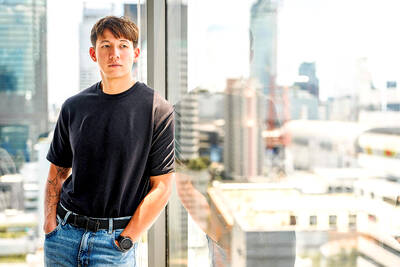
SPEAKING OUT: After Siranudh Scott’s allegations surfaced, celebrities and public figures took to social media to share their own experiences of sexual misconduct and abuse A high-profile alleged sexual abuse case within a wealthy Thai beer brewing family has prompted a wave of painful accounts from survivors of unconnected abuse in the conservative nation. Siranudh Scott, a member of the billionaire Thai family that founded the ubiquitous Singha beer brand, posted an emotional video this month accusing his elder brother Sunit of repeatedly abusing him when he was a teenager. Sunit, who is in his 30s, later denied the allegations in a video posted online, but Singha parent Boonrawd dismissed him from his executive role with the company on Tuesday last week. “I felt I needed to speak

SEEKING ORDER: Rodrigo Paz said that ‘anyone who wants to destroy the nation will have to deal with this president and the full force of the constitution’ Bolivian President Rodrigo Paz on Wednesday said that the nation was at a “breaking point” after nearly a month of protests that have caused shortages of food, fuel and medicine. Paz, who took office six months ago amid the worst economic crisis there in four decades, is battling a groundswell of fury over his policies. The political capital, La Paz, has been besieged by low-income workers and members of the indigenous majority calling for his resignation. “The country needs order and is reaching breaking point,” the 58-year-old said at a public event in La Paz, renewing his appeal for dialogue. On Tuesday, the Bolivian

A Hong Kong astronaut is to join a Chinese space mission for the first time as part of a three-person crew launching today, as Beijing edges closer to its goal of landing people on the moon. The Tiangong space station — crewed by teams of three astronauts that are typically rotated every six months — is the crown jewel of China’s space program, boosted by billions in state investment in a bid to catch up with the US and Russia. The Shenzhou-23 mission is to blast off at 11:08pm from the Jiuquan Satellite Launch Center in northwestern China, carrying three astronauts to
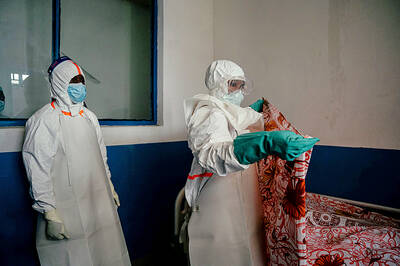
UPGRADED ALERT: The risk inside DR Congo is now considered ‘very high,’ while neighboring countries face a ‘high’ threat as the outbreak continues, the WHO said Ebola is spreading faster than responders can track it in eastern Congo, where health workers managed to follow up with barely one in five identified contacts in a single day. Authorities in the Democratic Republic of the Congo (DR Congo) reported 83 confirmed infections, 746 suspected cases and 1,603 identified contacts as of Thursday, but health workers were able to follow up on only 342 contacts that day — about 21 percent of the total under monitoring — data released by the DR Congo Ministry of Public Health on Friday showed. The figures suggest the response is falling behind the outbreak itself,


 RSS
RSS