


Under the slogan, "You are taking away our future," tens of thousands of students held demonstrations in three German cities on Saturday, protesting planned cuts to the state-funded university system that would mean charging annual tuition fees or closing departments.
Waving banners, blowing whistles and blaring loud music as they marched through the streets of Berlin, Frankfurt and Leipzig, several thousand students sought to draw attention to government policies to cut millions of euros of education funding at dozens of secondary institutions, and attempts to charge annual tuition fees at some universities.
More than 20,000 students braved wet, cold weather in Berlin to march through the streets carrying banners that read, "Berlin without education is like a motor without gas" and "Don't leave education out in the rain." Medical students pushed hospital beds through the demonstration, while another was pushing himself in a wheelchair with a sign hung around his neck reading "Educational cripple."
"The distribution of money is always a political decision. The state coffers aren't empty because of students or the jobless, but because of the government's faulty income and commercial tax policies," Klemens Himpele, the head of a local student activist group participating in the demonstrations, told a rally attended by thousands in Frankfurt.
"There's enough money there, but it's in the wrong pockets," said Himpele.
German law guarantees all qualifying students the right to an education and it is illegal to charge fees. Students currently pay a fee per semester. That covers administrative fees and in many cases, a pass for public transportation.
But several states controlled by the conservative opposition, including Bavaria and Baden-Wuerttemburg, are challenging the law in court, in hopes of winning the right to charge annual tuition fees, which students say would make it even harder for them to complete their studies. The average German student usually spends about six years at university.
Already students complain that lecture halls are overcrowded and seminars that should hold a maximum of 20 students are stuffed with more than 50, making discussions and access to professors virtually impossible.
Andre Schlecht-Pese, an architecture student in the eastern city of Dessau, said students are already digging into their own pockets to purchase materials to build models.
Enrico Schoenberg, 22, a computer science student at Berlin's Technical University, said he fears the planned Berlin cuts will result in fewer professors and the closing of several departments, although he couldn't say which ones. Already overcrowding means students often have to wait an extra semester to fulfill all of their course requirements, delaying graduation. But he's also against charging fees to study.
"I don't know if I could afford to study" if there were fees to pay, Schoenberg said. "It would mean I would have to work and study at the same time and I don't know if I could hack it."

When a hiker fell from a 55m waterfall in wild New Zealand bush, rescuers were forced to evacuate the badly hurt woman without her dog, which could not be found. After strangers raised thousands of dollars for a search, border collie Molly was flown to safety by a helicopter pilot who was determined to reunite the pet and the owner. A week earlier, an emergency rescue helicopter found the woman with bruises and lacerations after a fall at a rocky spot at the waterfall on the South Island’s West Coast. She was airlifted on March 24, but they were forced to
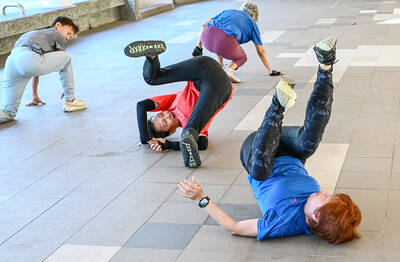
CONFIDENCE BOOSTER: ’After parkour ... you dare to do a lot of things that you think only young people can do,’ a 67-year-old parkour enthusiast said In a corner of suburban Singapore, Betty Boon vaults a guardrail, crawls underneath a slide, executes forward shoulder rolls and scales a steep slope, finishing the course to applause. “Good job,” the 69-year-old’s coach cheers. This is “geriatric parkour,” where about 20 retirees learned to tackle a series of relatively demanding exercises, building their agility and enjoying a sense of camaraderie. Boon, an upbeat grandmother, said learning parkour has aided her confidence and independence as she ages. “When you’re weak, you will be dependent on someone,” she said after sweating it out with her parkour classmates in suburban Toa Payoh,

HIGH HOPES: The power source is expected to have a future, as it is not dependent on the weather or light, and could be useful for places with large desalination facilities A Japanese water plant is harnessing the natural process of osmosis to generate renewable energy that could one day become a common power source. The possibility of generating power from osmosis — when water molecules pass from a less salty solution to a more salty one — has long been known. However, actually generating energy from that has proved more complicated, in part due the difficulty of designing the membrane through which the molecules pass. Engineers in Fukuoka, Japan, and their private partners think they might have cracked it, and have opened what is only the world’s second osmotic power plant. It generates

Chinese dissident artist Gao Zhen (高兟), famous for making provocative satirical sculptures of former Chinese leader Mao Zedong (毛澤東), was tried on Monday over accusations of “defaming national heroes and martyrs,” his wife and a rights group said. Gao, 69, who was detained in 2024 during a visit from the US, faces a maximum three-year prison sentence, said his wife, Zhao Yaliang (趙雅良), and Shane Yi, a researcher at the Chinese Human Rights Defenders group which operates outside the nation. The closed-door, one-day trial took place at Sanhe City People’s Court in Hebei Province neighboring the capital, Beijing, and ended without a


 RSS
RSS