


Black-clad business leaders, foreign ambassadors and relatives gathered yesterday at a funeral ceremony for Chung Mong-hun, a top executive of the Hyundai conglomerate who committed suicide earlier this week.
Up to 2,000 people attended the ceremony for Chung, whose death on Monday cast doubt on the future of economic projects that he was promoting in North Korea. The projects are a key element of South Korea's efforts to reconcile with its isolated, communist neighbor.
Later, a hearse carried Chung's casket to a family burial ground southeast of Seoul. His widow, Hyun Jeong-un, and family members took turns shoveling dirt onto his casket. Family members wept, while most of those attending stood in somber silence.
At the funeral ceremony at a Seoul hospital, mourners bowed deeply before a large, framed photograph of Chung on an outdoor altar decorated with white chrysanthemums.
"Why did you have to leave when there is much more to do and a long road ahead?" said a tearful Sohn Kil-seung, chief of the Federation of Korean Industries, a business leaders' group.
"Who will fill your empty space?" Sohn said in his memorial address.
Chung, 54, jumped to his death from his office window in downtown Seoul. His company, Hyundai-Asan, had been losing heavily on investments in North Korea, and he was embroiled in a scandal over a 2000 summit between the two Koreas.
"Chairman Chung pushed North Korean projects with special effort and affection as there were voices of concern from some," said Kim Yoon-kyu, president of Hyundai-Asan. Chung's late father and Hyundai founder, Chung Ju-yung, had initiated business ventures in the North, his birthplace.
Earlier this week, North Korea expressed condolences and said it was temporarily suspending a joint tourism project with South Korea. The tours to Diamond Mountain on the North's east coast were a financial disaster for Hyundai-Asan, but a symbol of cooperation on the divided Korean Peninsula.
Yesterday, Rodong Sinmun, a North Korean newspaper, said Chung's death was a "political murder" committed by conservative South Korean politicians who were "displeased with the development of the inter-Korean relations."
In a suicide note, Chung had asked that his ashes be scattered over Diamond Mountain. But family members decided to bury him close to Seoul, allowing them to visit his grave regularly.

When a hiker fell from a 55m waterfall in wild New Zealand bush, rescuers were forced to evacuate the badly hurt woman without her dog, which could not be found. After strangers raised thousands of dollars for a search, border collie Molly was flown to safety by a helicopter pilot who was determined to reunite the pet and the owner. A week earlier, an emergency rescue helicopter found the woman with bruises and lacerations after a fall at a rocky spot at the waterfall on the South Island’s West Coast. She was airlifted on March 24, but they were forced to

CONFIDENCE BOOSTER: ’After parkour ... you dare to do a lot of things that you think only young people can do,’ a 67-year-old parkour enthusiast said In a corner of suburban Singapore, Betty Boon vaults a guardrail, crawls underneath a slide, executes forward shoulder rolls and scales a steep slope, finishing the course to applause. “Good job,” the 69-year-old’s coach cheers. This is “geriatric parkour,” where about 20 retirees learned to tackle a series of relatively demanding exercises, building their agility and enjoying a sense of camaraderie. Boon, an upbeat grandmother, said learning parkour has aided her confidence and independence as she ages. “When you’re weak, you will be dependent on someone,” she said after sweating it out with her parkour classmates in suburban Toa Payoh,
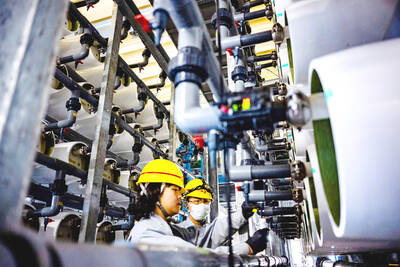
HIGH HOPES: The power source is expected to have a future, as it is not dependent on the weather or light, and could be useful for places with large desalination facilities A Japanese water plant is harnessing the natural process of osmosis to generate renewable energy that could one day become a common power source. The possibility of generating power from osmosis — when water molecules pass from a less salty solution to a more salty one — has long been known. However, actually generating energy from that has proved more complicated, in part due the difficulty of designing the membrane through which the molecules pass. Engineers in Fukuoka, Japan, and their private partners think they might have cracked it, and have opened what is only the world’s second osmotic power plant. It generates
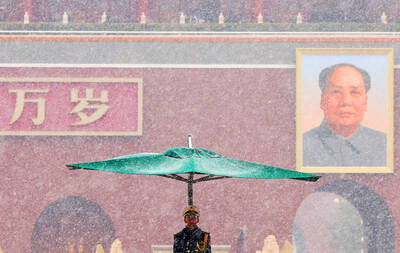
Chinese dissident artist Gao Zhen (高兟), famous for making provocative satirical sculptures of former Chinese leader Mao Zedong (毛澤東), was tried on Monday over accusations of “defaming national heroes and martyrs,” his wife and a rights group said. Gao, 69, who was detained in 2024 during a visit from the US, faces a maximum three-year prison sentence, said his wife, Zhao Yaliang (趙雅良), and Shane Yi, a researcher at the Chinese Human Rights Defenders group which operates outside the nation. The closed-door, one-day trial took place at Sanhe City People’s Court in Hebei Province neighboring the capital, Beijing, and ended without a


 RSS
RSS