


Biowell Technology Inc (
The company fuses organic DNA into the ink on labels and sells them to manufacturers to place on genuine products. Included in the kits are cotton swabs which mix with a chemical on the labels and can immediately tell investigators or consumers whether the product is real or fake.
"Obviously companies must control the labels," said David Silver, special assistant at Biowell.
The company claims the labels are copy proof due to the DNA combined with the ink used in printing. Executives at the company say it would be nearly impossible to extract the DNA strand and figure out its make up since the company developed its own primer to hold the DNA and keep it "alive" and the DNA itself is in such a small concentration it would be extremely difficult to find.
"Even if someone were able to locate the DNA, they would not be able to extract it because they don't know what kind of primer was used. Without the correct primer, the DNA would `die,'" said U.K. Singha, a researcher at Biowell.
Counterfeit goods come in many forms beyond music and video CDs. In their most deadly form, fake aircraft parts and pharmaceuticals have found their way onto world markets.
"Although very stringent controls exist for the supply of spare aircraft parts, there have been a number of incidents of aeroplane crashes caused by fake components. ... The Far East is commonly pinpointed by the US aviation industry as the problem area," according to a report published by the Organization for Economic Cooperation and Development.
Last week, US authorities confiscated thousands of bogus airplane parts from Panaviation, an Italian company accused of selling up to 10,000 counterfeit parts to companies in the US, MSNBC reported on its Web site.
"We are looking at parts that are very critical to flight safety -- hydraulic fittings, brakes, flaps, cockpit instruments and landing gear," MSNBC quoted aviation journalist Tim Van Beveren as saying.
"People formerly involved in the drug business have changed over to be brokers for aviation parts. The margins of profit are the same," he added.
In the case of bogus pharmaceuticals, some patients pay for bogus drugs that are completely ineffective in treating their diseases and sometimes contain chemicals hazardous to health. The World Health Organization says people die every day from using counterfeit drugs.
The Biowell labels look like price tag labels commonly found on goods in a department store, but have six levels of security, including the DNA, florescent markings and micro-printing used to make the labels difficult to reproduce in appearance. If all other safety features fail, the DNA will still offer an easy source of detection for someone seeking to separate genuine products from fakes, according to Biowell.
The company has so far been able to mix its DNA and primer in 20 different materials, including ink, paper, paint, ceramics and plastic, and other materials might work, but "you have to test and see," according to Johnson Chen (詹淳勝), another researcher at Biowell. The firm is willing to work with companies on developing new ways to use its DNA protection process.
So far, Biowell's customers include firms from the software, information technology and components industries, as well as the spirits industry, since copying bottles and packaging on expensive wines and whiskeys has become big business around the world.
Biowell plans to find agents to help it develop markets around the world for its products, as it wishes to remain a pure research organization, according to company chairman Sheu Jen-jei (
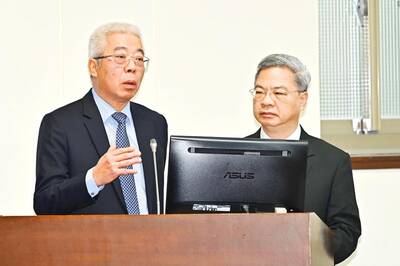
Taiwan has arranged for about 8 million barrels of crude oil, or about one-third of its monthly needs, to be shipped from the Red Sea this month to bypass the Strait of Hormuz and ease domestic supply pressures, CPC Corp, Taiwan (CPC, 台灣中油) said yesterday. The state-run oil company has worked with Middle Eastern suppliers to secure routes other than the Strait of Hormuz, through which about 20 percent of the world’s oil and liquefied natural gas typically passes, CPC chairman Fang Jeng-zen (方振仁) said at a meeting of the legislature’s Economics Committee in Taipei. Suppliers in Saudi Arabia have indicated they
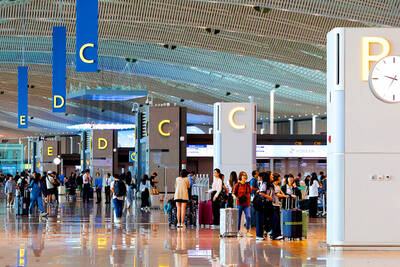
South Korea has adjusted its electronic arrival card system to no longer list Taiwan as a part of China, a move that the Ministry of Foreign Affairs said would help facilitate exchanges between the two sides. South Korea previously listed “Taiwan” as “Taiwan (China)” in the drop-down menus of its online arrival card system, where people had to fill out where they came from and their next destination. The ministry had requested South Korea make a revision and said it would change South Korea’s name on Taiwan’s online immigration system from “Republic of Korea” to “Korea (South),” should the issue not be
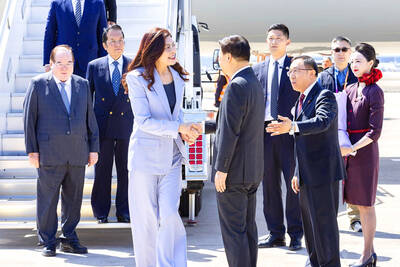
CCP ‘PAWN’? Beijing could use the KMT chairwoman’s visit to signal to the world that many people in Taiwan support the ‘one China’ principle, an academic said Chinese Nationalist Party (KMT) Chairwoman Cheng Li-wun (鄭麗文) yesterday arrived in China for a “peace” mission and potential meeting with Chinese President Xi Jinping (習近平), while a Taiwanese minister detailed the number of Chinese warships currently deployed around the nation. Cheng is visiting at a time of increased Chinese military pressure on Taiwan, as the opposition-dominated Legislative Yuan stalls a government plan for US$40 billion in extra defense spending. Speaking to reporters before going to the airport, Cheng said she was going on a “historic journey for peace,” but added that some people felt uneasy about her trip. “If you truly love Taiwan,

Tainan, Taipei and New Taipei City recorded the highest fines nationwide for illegal accommodations in the first quarter of this year, with fines issued in the three cities each exceeding NT$7 million (US$220,639), Tourism Administration data showed. Among them, Taipei had the highest number of illegal short-term rental units, with 410. There were 3,280 legally registered hotels nationwide in the first quarter, down by 14 properties, or 0.43 percent, from a year earlier, likely indicating operators exiting the market, the agency said. However, the number of unregistered properties rose to 1,174, including 314 illegal hotels and 860 illegal short-term rental


 RSS
RSS