

The Forward Alliance today announced a long-term partnership with Samaritan International to promote exchanges between Taiwan and Europe on resilience, with European Economic and Trade Office head Lutz Gullner stressing the importance of such cooperation.
The alliance, a national security and civil defense think tank, today held a ceremony at National Chengchi University to announce the partnership, attended by Gullner, Deputy Minister of the Interior Ma Shih-yuan (馬士元), National Fire Agency Director-General Hsiao Huan-chang (蕭煥章), Samaritan International EU office director Paul Wardenga and alliance founder Enoch Wu (吳怡農).
Taiwan has demonstrated the capacity of civil society organizations to coordinate and work together, which is key to building a resilient society, Wu said at the ceremony, citing how hundreds of thousands of people across Taiwan mobilized when disaster struck Guangfu Township (光復) in Hualien last year.
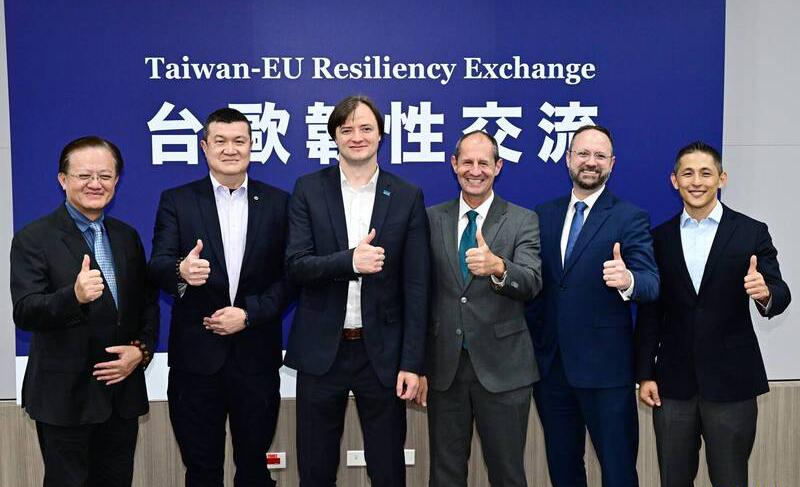
Photo: Chen Yi-kuan, Taipei Times
Samaritan International brings together civil society groups from more than 20 European countries, and its volunteers include social workers, first-aid responders and search-and-rescue personnel, much like in Taiwan, Wardenga said.
The partnership would be a valuable platform for volunteer training and coordination to enhance whole-of-society resilience, he said.
Amid today’s geopolitical uncertainty, the EU considers resilience and preparedness crucial for all societies facing natural and human-related disasters, Gullner said.
Taiwan has valuable experience and robust systems for responding to natural disasters, while the EU has more experience in wildfire response and cooperation, he said.
Taiwan and Europe can learn and develop together to build a culture of resilience not only between governments, but also within civil society, he added.
Resilience means maintaining society’s essential functions, as well as responding, recovering and preparing for disasters, Gullner said, adding that cooperation is crucial to improving resilience on both sides.
The Ministry of the Interior aims to train 3.5 percent of Taiwan’s population, or about 800,000 people, to be volunteers and civil defense personnel, Ma said.
It also aims for 25 percent of the population, or about 6 million people, to serve in national defense, including military and ministry personnel, medical workers, civil servants and volunteers, he said.
The government is still seeking ways to meet these targets and integrate resources, he said, adding that determining how the government and civil society should work together is a key challenge.
Additional reporting by Chen Chih-cheng
Taiwan’s growing defense preparations might be sending a stronger signal to the US than to Beijing, highlighting the need for Taipei to tailor its deterrence efforts to different audiences, a US security academic said yesterday. Stanford University Freeman Spogli Institute for International Studies fellow Oriana Skylar Mastro made the comment during a Taipei Security Dialogue panel examining lessons Taiwan could draw from the wars in Ukraine and the Middle East. Mastro said she was impressed by Taiwan’s increased defense spending, emphasis on asymmetric capabilities and efforts to prepare society for conflict, but questioned whom those initiatives were influencing. She said when she asked

A total of 400 foreign “high- level” professionals have been naturalized as Republic of China (Taiwan) citizens over the past decade as the government has eased nationality rules to attract talent from a wider range of fields, the Ministry of the Interior said yesterday. The 400th high-level professional, who works in the electronics industry, was approved for ROC citizenship on Aug. 26, the MOI said. The MOI quoted the newly naturalized citizen as saying that Taiwan is a leader in fields such as semiconductors, electronics manufacturing, artificial intelligence development and energy technology. He also said
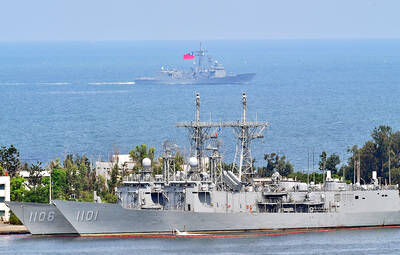
SIZE MATTERS: Large ships are politically attractive as visible symbols of national defense, but small surface combatants are more likely to survive an initial strike Taiwan needs to restructure its naval fleet from focusing on large warships, which are “sitting ducks” for China’s advanced tracking technology, to smaller, stealthy corvettes that are harder to detect but retain sufficient firepower to deter a Chinese invasion, a Taiwanese academic and a former US military commander said in an article published on Friday in the journal Foreign Affairs. Taiwan does not need a fleet capable of competing with the Chinese navy for traditional control of the Taiwan Strait, but rather “sea denial” capabilities that would prevent China from freely using the waterway, Taiwanese aerospace and security expert Holmes Liao
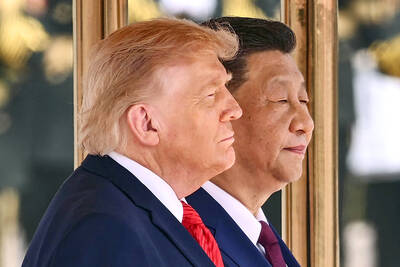
China has warned that it could cancel a planned US-China leaders’ summit if Washington approves new arms sales to Taiwan, a Japanese media outlet quoted sources as saying yesterday. US President Donald Trump, “apparently eager to showcase some diplomatic achievements ahead of November’s midterm congressional elections, places great importance on holding the summit with Chinese President Xi Jinping (習近平),” Japan’s Kyodo News reported. “While preparing for Xi’s upcoming trip, China has restated its position that the Taiwan issue is a ‘red line’ in bilateral relations,” the report said. The report said that when Xi met with Trump in Beijing in May, Xi said


 RSS
RSS