

Taiwan’s growing defense preparations might be sending a stronger signal to the US than to Beijing, highlighting the need for Taipei to tailor its deterrence efforts to different audiences, a US security academic said yesterday.
Stanford University Freeman Spogli Institute for International Studies fellow Oriana Skylar Mastro made the comment during a Taipei Security Dialogue panel examining lessons Taiwan could draw from the wars in Ukraine and the Middle East.
Mastro said she was impressed by Taiwan’s increased defense spending, emphasis on asymmetric capabilities and efforts to prepare society for conflict, but questioned whom those initiatives were influencing.
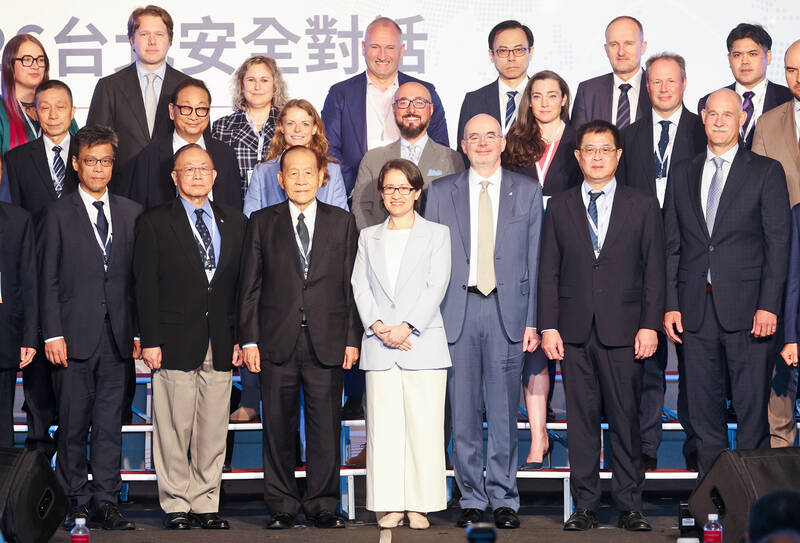
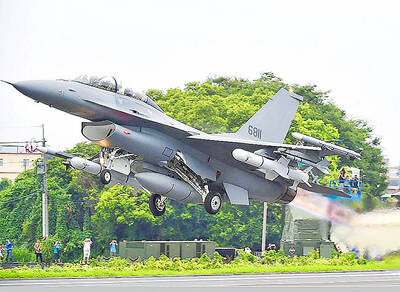
Photo: CNA
She said when she asked senior Chinese figures and analysts whether Taiwan’s improving capabilities were making Beijing more cautious, their responses generally amounted to: “We don’t really know. We’re not paying attention to that. That’s not the point.”
Although Taiwan’s efforts contributed to improved deterrence, “the audience is the US,” she said.
Taiwan’s message that it is doing more for its defense, particularly its ability to defend itself without outside intervention, is largely directed at Washington, Mastro said.
That is an appropriate strategy, because it reassured Washington of Taiwan’s determination to defend itself, she said, but added that Taipei needed a separate approach to ensure that its capabilities also affected Beijing’s calculations.
“There’s no situation under which Taiwan can defend itself without direct US military intervention,” Mastro said.
Taiwan should communicate its newly acquired capabilities more effectively to Beijing so that its defense investments can deepen relations with the US and deter China, she added.
National Chengchi University Department of Diplomacy professor Chen Ping-Kuei (陳秉逵) agreed with Mastro, saying: “I think the public believes that we have sent an effective signal to the US, but we haven’t sent a very effective deterrent signal to Beijing.”
US arms sales to Taiwan is an important signal of Washington’s commitment, he said, adding that their political significance could be more important than the size of individual packages.
If Washington were to begin discussing proposed arms sales packages for Taiwan with Beijing, it would send “a very, very bad signal” to Taipei, Chen said.
He was referring to concerns raised after US President Donald Trump confirmed he had spoken to Chinese President Xi Jinping (習近平) about arms sales to Taiwan when they met in Beijing in mid-May.
That violated a key tenet of the “six assurances” — that the US would not consult China on arms sales to Taiwan.
Trump seemed to brush aside such a pledge.
“What am I going to say? I don’t want to talk to you about it because I have an agreement that was signed in 1982?” he said after the meeting.
Beyond military capabilities and signaling, Taiwan must prepare to remain functional if China seeks to isolate it, German Institute for Defence and Strategic Studies senior research fellow Wolfgang Muller said.
Isolation would not necessarily require a formal blockade, because heightened risk alone could alter the behavior of shipping companies, insurers, suppliers and maintenance providers, Muller said.
“Do not ask only how China would invade Taiwan. Ask also how China could make an invasion unnecessary,” he said.
Rather than pursuing complete self-sufficiency, Taiwan should measure how long essential services could continue if external supplies were interrupted, Muller said.
He also urged Taiwan to identify bottlenecks linking infrastructure systems and pre-position critical items that could be difficult to obtain during a crisis, including transformers, medicine, chemicals, communications equipment and machine parts.
“Taiwan cannot make its critical infrastructure invulnerable, but it can make failure more temporary,” Muller said. “Recovery capacity is combat power.”
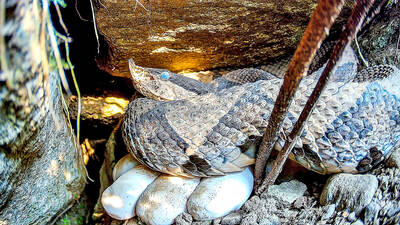
NATURE TAKES ITS COURSE: The agency’s head said he felt a sense of loss watching red-banded snakes eat the babies, as they had decided on non-intervention The Forestry and Nature Conservation Agency yesterday released a documentary on a hundred-pace viper that had incubated 16 eggs, all of which hatched, but only a baby viper escaped after they were attacked by red-banded snakes. The agency’s Taichung branch last year launched the viper reproduction monitoring project soon after forest rangers Lin Chun-yu (林俊佑) and Chou Chia-cheng (周家成) spotted a pregnant hundred-pace viper in a grass-covered burrow near a parking lot in Tbulan Village (松鶴部落). The Atayal village, in Taichung’s Heping District (和平), is headed by Ecyang Yapu, who was positive about the project and assisted in access control and power
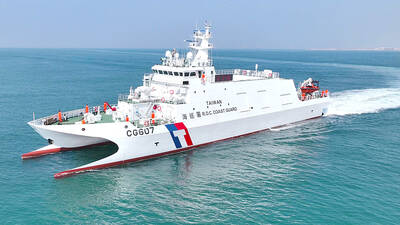
The Coast Guard Administration (CGA) yesterday said that it had deployed vessels to “monitor” Chinese ships operating in waters off the east coast. The CGA said it dispatched vessels in response to a China Coast Guard announcement that it had carried out another “routine law-enforcement patrol” in waters off the east coast. “The CGA firmly rejects China’s cognitive warfare campaign of ‘law enforcement in name, jurisdictional expansion in practice,’” it said on X. As of 11am yesterday, two China Coast Guard ships were “loitering and drifting” about 105 nautical miles (195km) and 74 nautical miles east of Green Island (綠島) respectively, it said. It
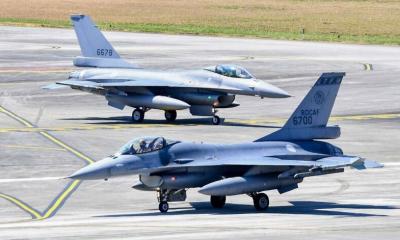
The first two F-16V Block 70 jets Taiwan purchased from the US were spotted unexpectedly turning back after departing from Hawaii yesterday, potentially further delaying delivery of the aircraft. Taiwan has purchased 66 of the F-16 C/D Block 70 jets to be deployed at Chihhang Air Base (志航基地) in Taitung County and operated by the air force's 7th Tactical Fighter Wing to defend Taiwan’s eastern region. Two single-seat jets, bearing serial No. 6727 and 6728, were spotted taking off from Hickam Field in Hawaii yesterday, observers said. Based on the precedent set during the delivery of Taiwan's older F-16 Block 20s, the new
A sharp rise in compensation to be paid by air force officers who leave before completing their required service could indicate an increase in pilots leaving the military early, an analyst said on Friday, warning that the trend could worsen a shortage of experienced personnel. Chieh Chung (揭仲), a researcher at the Association for Strategic Foresight, issued the warning even though the number of volunteer military personnel is expected to increase next year. The planned headcount for volunteer military personnel, covering officers, noncommissioned officers (NCO) and enlisted soldiers, is 158,223 for next year, up 4,258 from 153,965 this year, Chieh said. The increase


 RSS
RSS