

Taiwan needs to restructure its naval fleet from focusing on large warships, which are “sitting ducks” for China’s advanced tracking technology, to smaller, stealthy corvettes that are harder to detect but retain sufficient firepower to deter a Chinese invasion, a Taiwanese academic and a former US military commander said in an article published on Friday in the journal Foreign Affairs.
Taiwan does not need a fleet capable of competing with the Chinese navy for traditional control of the Taiwan Strait, but rather “sea denial” capabilities that would prevent China from freely using the waterway, Taiwanese aerospace and security expert Holmes Liao (廖宏祥) and former US Navy admiral Dennis Blair wrote the article, titled “How Taiwan can win the Strait: A nimbler navy can deny China.”
The focus of “sea denial” is “preventing China from using the waterway freely enough to carry out an invasion” by deterring its forces with smaller vessels, as well as shore-based mobile launchers, aircraft armed with anti-ship missiles and submarines, they said.
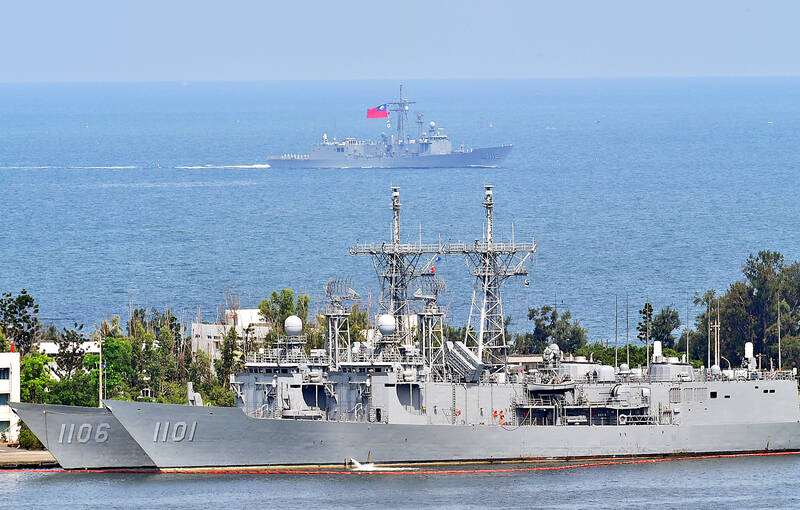
Photo: Taipei Times
“Taiwan has traditionally favored large ships such as destroyers and frigates to form the core of its fleet,” they said, adding that Taiwan’s current naval plans include replacing an aging surface fleet with large, expensive new ships.
However, China has invested in cutting-edge surveillance, intelligence and reconnaissance, as well as electronic warfare systems, drones and missiles, making Taiwan’s large surface ships “a liability,” they said.
“These same technologies make China’s large amphibious ships more vulnerable in restricted waters, and those ships cannot be replaced by smaller, stealthier alternatives” as they would be necessary for an assault on Taiwan, the article said.
Taipei could take advantage of that asymmetry by replacing large destroyers and frigates with numerous small surface combatants that are more likely to survive an initial Chinese strike and remain capable of deterring an invasion fleet, the authors said.
The smaller ships could “operate independently while sharing information and coordinating their attacks,” they said.
Liao and Blair, who was commander in chief of the US Pacific Command from 1999 to 2002, said that Ukraine’s Black Sea campaign — which “combined land-based anti-ship cruise missiles, swarms of uncrewed surface vessels, aerial drones and external intelligence” — showed that a weaker power could constrain a stronger opponent in contested waters.
Taiwan’s continued commissioning of “lightweight but heavily armed” missile patrol ships are helping the nation restructure its fleet, they wrote.
Sustained production of the ships would lower costs and new weapons, sensors and uncrewed systems could be incorporated into successive batches of the vessels, which cost less than US$200 million, compared with an estimated US$2 billion for a single 7,000 tonne warship, they said.
“The obstacles to the transformation of Taiwan’s navy are more institutional than technical,” as large ships are attractive to politicians because they are a highly visible symbols of national defense that bring shipyard contracts and “a sense of national achievement.”
“Rather than continue to upgrade these obsolescent, if not obsolete, ships, Taiwan should progressively decommission them and redirect scarce resources toward the lighter surface ships it needs,” Liao and Blair wrote.
“The country needs a dispersed, agile and lethal force structure to defeat China in the Taiwan Strait,” they said. “Such a navy will not look as impressive during a fleet review, but it will be a more effective deterrent against a potential Chinese invasion.”
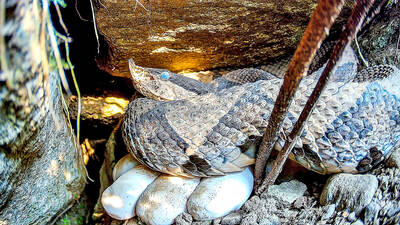
NATURE TAKES ITS COURSE: The agency’s head said he felt a sense of loss watching red-banded snakes eat the babies, as they had decided on non-intervention The Forestry and Nature Conservation Agency yesterday released a documentary on a hundred-pace viper that had incubated 16 eggs, all of which hatched, but only a baby viper escaped after they were attacked by red-banded snakes. The agency’s Taichung branch last year launched the viper reproduction monitoring project soon after forest rangers Lin Chun-yu (林俊佑) and Chou Chia-cheng (周家成) spotted a pregnant hundred-pace viper in a grass-covered burrow near a parking lot in Tbulan Village (松鶴部落). The Atayal village, in Taichung’s Heping District (和平), is headed by Ecyang Yapu, who was positive about the project and assisted in access control and power
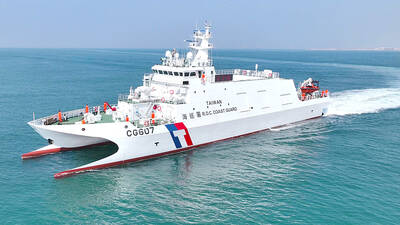
The Coast Guard Administration (CGA) yesterday said that it had deployed vessels to “monitor” Chinese ships operating in waters off the east coast. The CGA said it dispatched vessels in response to a China Coast Guard announcement that it had carried out another “routine law-enforcement patrol” in waters off the east coast. “The CGA firmly rejects China’s cognitive warfare campaign of ‘law enforcement in name, jurisdictional expansion in practice,’” it said on X. As of 11am yesterday, two China Coast Guard ships were “loitering and drifting” about 105 nautical miles (195km) and 74 nautical miles east of Green Island (綠島) respectively, it said. It
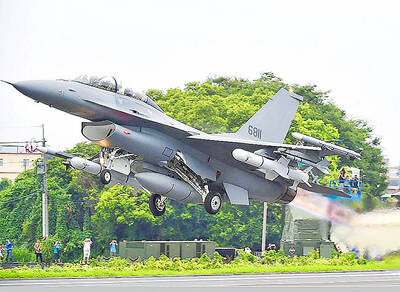
A sharp rise in compensation to be paid by air force officers who leave before completing their required service could indicate an increase in pilots leaving the military early, an analyst said on Friday, warning that the trend could worsen a shortage of experienced personnel. Chieh Chung (揭仲), a researcher at the Association for Strategic Foresight, issued the warning even though the number of volunteer military personnel is expected to increase next year. The planned headcount for volunteer military personnel, covering officers, noncommissioned officers (NCO) and enlisted soldiers, is 158,223 for next year, up 4,258 from 153,965 this year, Chieh said. The increase
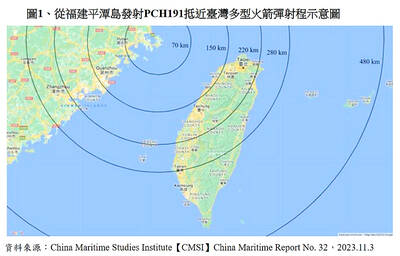
Potential improvements to munitions used by China’s long-range rocket-artillery units could extend their range to cover the entire Miyako Strait, which might give the Chinese People’s Liberation Army (PLA) the ability to secure the strategic waterway, the Mainland Affairs Council (MAC) said in a report. The PLA’s long-range rocket-artillery units deployed along the Taiwan Strait are concentrated along the coast of Fujian Province, including Changle, Pingtan and Shishi, the quarterly report on China said. The artillery brigades of the PLA’s 71st, 72nd and 73rd group armies have been deployed, with preparations for potential battlefield operations under way since August 2022, the report


 RSS
RSS