

A total of 400 foreign “high- level” professionals have been naturalized as Republic of China (Taiwan) citizens over the past decade as the government has eased nationality rules to attract talent from a wider range of fields, the Ministry of the Interior said yesterday.
The 400th high-level professional, who works in the electronics industry, was approved for ROC citizenship on Aug. 26, the MOI said.
The MOI quoted the newly naturalized citizen as saying that Taiwan is a leader in fields such as semiconductors, electronics manufacturing, artificial intelligence development and energy technology.
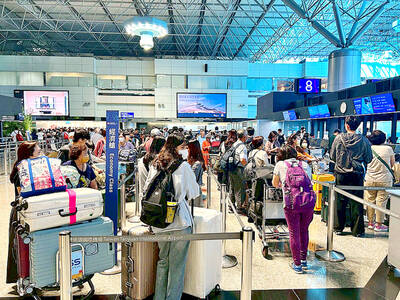
Photo: Huang Hsin-po, Taipei Times
He also said Taiwan has built a comprehensive high-tech ecosystem that allows top professionals like him to develop their careers, while the country’s high quality of life also attracted him to become a member of Taiwanese society.
The MOI did not disclose the new ROC citizen’s original nationality.
According to the MOI, high-level professionals are experts in various fields, including technology, economics, education and academic research, culture and the arts, and sports, whose naturalization is expected to “serve the interests of the ROC.”
Over the past 10 years, 170 of the high-level professionals naturalized as ROC citizens were from other Asian countries, 128 from the Americas, 76 from Europe, 13 from Oceania and 13 from Africa, the MOI said.
Among the 400 high-level professionals, 149 came from the fields of education and academic research, making it the largest group, followed by 85 in economics, 61 in technology, and 50 in culture and the arts, the MOI said.
The data showed that the naturalized professionals came from a wide range of backgrounds and areas of expertise, the ministry said.
The latest high-level professional to become an ROC citizen is the 400th to benefit from Taiwan’s efforts to ease restrictions under the Nationality Act.
In December 2016, the act was amended to allow high- level foreign professionals to retain their original nationalities after obtaining ROC citizenship.
In May 2024, the act was again amended to reduce the residency requirement for high-level professionals applying for naturalization from five years to two.
The MOI said Taiwan has various channels through which foreign talent can apply for naturalization. High-level professionals who already hold a Plum Blossom Card, for example, can apply for ROC citizenship after a review and do not need to renounce their original citizenship after naturalization.
As many countries compete for talent, Taiwan is determined to create a friendly legal and living environment to attract more outstanding foreign professionals to develop their careers and settle in the country, the MOI said.
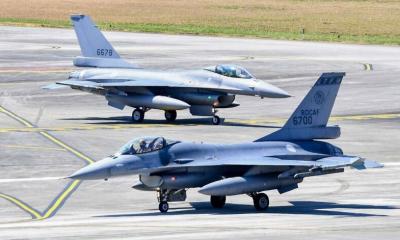
The first two F-16V Block 70 jets Taiwan purchased from the US were spotted unexpectedly turning back after departing from Hawaii yesterday, potentially further delaying delivery of the aircraft. Taiwan has purchased 66 of the F-16 C/D Block 70 jets to be deployed at Chihhang Air Base (志航基地) in Taitung County and operated by the air force's 7th Tactical Fighter Wing to defend Taiwan’s eastern region. Two single-seat jets, bearing serial No. 6727 and 6728, were spotted taking off from Hickam Field in Hawaii yesterday, observers said. Based on the precedent set during the delivery of Taiwan's older F-16 Block 20s, the new
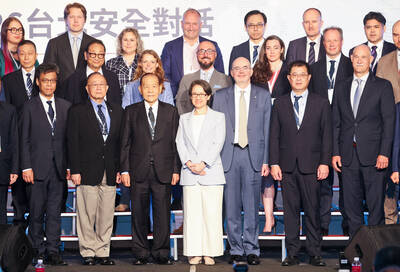
Taiwan’s growing defense preparations might be sending a stronger signal to the US than to Beijing, highlighting the need for Taipei to tailor its deterrence efforts to different audiences, a US security academic said yesterday. Stanford University Freeman Spogli Institute for International Studies fellow Oriana Skylar Mastro made the comment during a Taipei Security Dialogue panel examining lessons Taiwan could draw from the wars in Ukraine and the Middle East. Mastro said she was impressed by Taiwan’s increased defense spending, emphasis on asymmetric capabilities and efforts to prepare society for conflict, but questioned whom those initiatives were influencing. She said when she asked
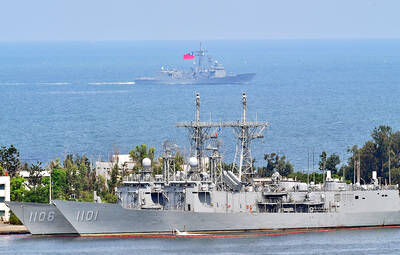
SIZE MATTERS: Large ships are politically attractive as visible symbols of national defense, but small surface combatants are more likely to survive an initial strike Taiwan needs to restructure its naval fleet from focusing on large warships, which are “sitting ducks” for China’s advanced tracking technology, to smaller, stealthy corvettes that are harder to detect but retain sufficient firepower to deter a Chinese invasion, a Taiwanese academic and a former US military commander said in an article published on Friday in the journal Foreign Affairs. Taiwan does not need a fleet capable of competing with the Chinese navy for traditional control of the Taiwan Strait, but rather “sea denial” capabilities that would prevent China from freely using the waterway, Taiwanese aerospace and security expert Holmes Liao
EVA Airways Corp is to raise excess baggage fees and revise other international baggage charges beginning on Sept. 29, citing higher fuel prices and rising global operating costs amid economic and geopolitical pressures. The changes would apply to international flights with travel dates on or after Sept. 29, the Taiwanese carrier said in a statement on its Web site. The revised baggage policy covers excess baggage, prepaid excess baggage, overweight and oversized baggage fees. It also covers updated pricing rules, and fees for transporting pets and sports equipment. Under the new rates, excess baggage fees would increase by between US$20 and US$90 per


 RSS
RSS