

Premier Cho Jung-tai (卓榮泰) yesterday encouraged newlyweds to have children while attending a mass wedding held by Chunghwa Telecom in Taipei, where 72 couples were married.
Cho, who served as a witness at the ceremony at the Grand Hotel, thanked the newlyweds for taking a step that could help Taiwan “address its demographic challenges,” referring to the country’s low birthrate.
Ministry of the Interior data showed that Taiwan’s fertility rate fell to 0.695 last year — one of the lowest in the world — while the number of births dropped for a 10th consecutive year to a record-low 107,812.
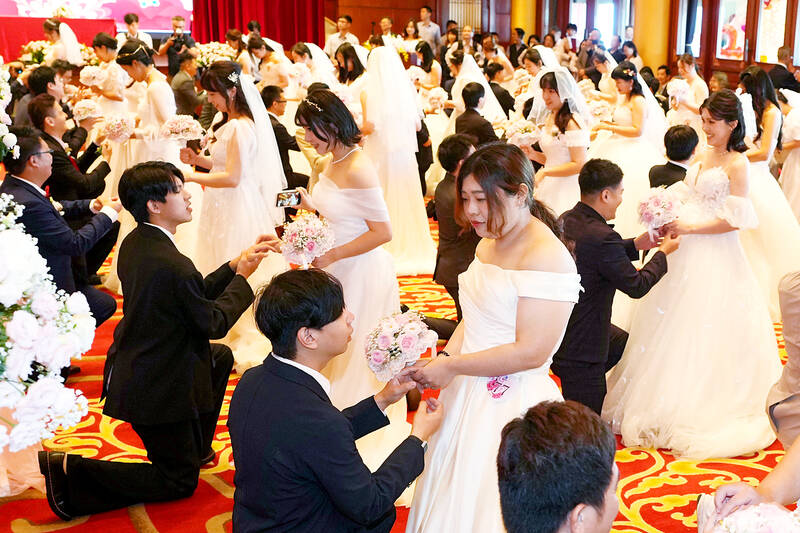
Photo: CNA
While encouraging the couples to have children, Cho added that childbirth remains a personal choice.
“Marriage is everyone’s right, and having children is everyone’s choice. It is definitely not a responsibility or obligation,” he said.
Cho urged couples planning to start families to use government support, highlighting plans for a NT$5,000 monthly child-rearing allowance starting next year, expanded childcare services and measures aimed at easing housing and education costs.
Cho said he hoped state-owned enterprises would organize more large-scale mass weddings, adding that Taiwan Power Co is planning to hold one as well.
At least one person in each of the 72 newlywed couples works for Chunghwa Telecom, and in five cases, both spouses were employees of Taiwan’s largest telecom.
Chunghwa Telecom chairman Alex Chien (簡志誠) said the company began holding mass weddings in 1963 and has held them almost every year since, with about 800 couples taking part since 2010.
Chien said he hoped the couples would “have children soon.”
He highlighted company measures to support employees starting families, including an NT$80,000 childbirth subsidy, a seven-hour workday with eight hours’ pay for employees with children younger than six, and 18 workplace childcare facilities nationwide.
Among the newlyweds was 44-year-old senior engineer Lin Kuan-nan (林冠男), who said he and his wife plan to have a child.
A 19-year Chunghwa Telecom employee, Lin said the planned NT$5,000 monthly allowance had “some appeal,” but added that the amount would “definitely not be enough” amid rising living costs.
“Of course, the more the better,” he said, adding that he hoped the government could provide additional subsidies.
Dino Chen, a senior engineer who has worked at Chunghwa Telecom for five years, said he and his wife plan to have a child in a year or two, but added that while the government’s available support showed “sincerity,” it remained insufficient.
“Once you take on a mortgage, you might have to pay NT$20,000 to NT$30,000 a month,” the 30-year-old said, identifying housing as their “main” concern.
While Chen said that “there is definitely pressure,” he said his wife works too and that they share the mortgage payments, easing the financial burden.
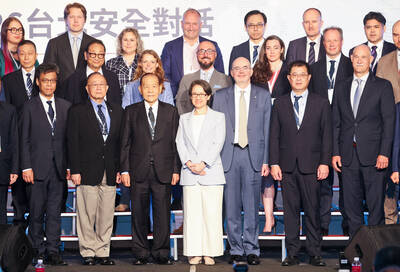
Taiwan’s growing defense preparations might be sending a stronger signal to the US than to Beijing, highlighting the need for Taipei to tailor its deterrence efforts to different audiences, a US security academic said yesterday. Stanford University Freeman Spogli Institute for International Studies fellow Oriana Skylar Mastro made the comment during a Taipei Security Dialogue panel examining lessons Taiwan could draw from the wars in Ukraine and the Middle East. Mastro said she was impressed by Taiwan’s increased defense spending, emphasis on asymmetric capabilities and efforts to prepare society for conflict, but questioned whom those initiatives were influencing. She said when she asked
A total of 400 foreign “high- level” professionals have been naturalized as Republic of China (Taiwan) citizens over the past decade as the government has eased nationality rules to attract talent from a wider range of fields, the Ministry of the Interior said yesterday. The 400th high-level professional, who works in the electronics industry, was approved for ROC citizenship on Aug. 26, the MOI said. The MOI quoted the newly naturalized citizen as saying that Taiwan is a leader in fields such as semiconductors, electronics manufacturing, artificial intelligence development and energy technology. He also said
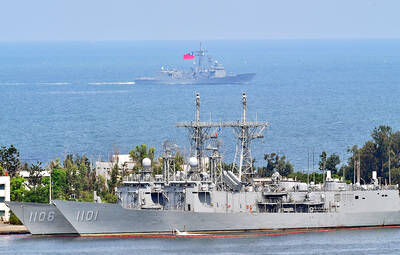
SIZE MATTERS: Large ships are politically attractive as visible symbols of national defense, but small surface combatants are more likely to survive an initial strike Taiwan needs to restructure its naval fleet from focusing on large warships, which are “sitting ducks” for China’s advanced tracking technology, to smaller, stealthy corvettes that are harder to detect but retain sufficient firepower to deter a Chinese invasion, a Taiwanese academic and a former US military commander said in an article published on Friday in the journal Foreign Affairs. Taiwan does not need a fleet capable of competing with the Chinese navy for traditional control of the Taiwan Strait, but rather “sea denial” capabilities that would prevent China from freely using the waterway, Taiwanese aerospace and security expert Holmes Liao
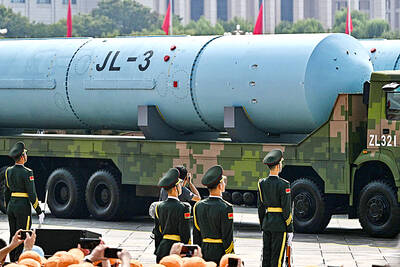
SUB-LAUNCHED SUBOPTIMAL: The JL-3, an upgraded version of the missile test-fired earlier in the summer, would have the range to strike at much of the country Refits to Chinese nuclear submarines to carry JL-3 intercontinental ballistic missiles would put much of the US in striking distance, Taiwanese defense analysts said in a report commissioned by the Mainland Affairs Council. Researchers from National Defense University’s Graduate Institute of China Military Affairs Studies said that the Chinese People’s Liberation Army Navy (PLAN) in July test-fired a missile with a training warhead. Chinese state media reported without elaborating that a PLAN nuclear-powered ballistic missile submarine (SSBN) launched a missile with a training warhead, which accurately hit the designated target area in the Pacific, the report said. The launch was a rare display


 RSS
RSS