

Taiwan cannot be overlooked in building a drone supply chain independent of China, US-based Shield AI’s Taiwan representative Chen Yi-ju (陳奕儒) said in an interview.
Two years ago, less than 1 percent of the materials used in Shield AI products came from Taiwan, Chen said. That figure had risen to 16 percent in May and June this year, and the company expects that Taiwanese suppliers could soon account for as much as 25 percent of the value of an individual drone.
Founded in 2015, Shield AI develops artificial intelligence (AI)-powered autonomous systems and military uncrewed vehicles. Its core products include the Hivemind AI pilot and V-BAT uncrewed aircraft, which enable military platforms to fly autonomously, operate cooperatively and carry out missions in environments subject to electronic interference.
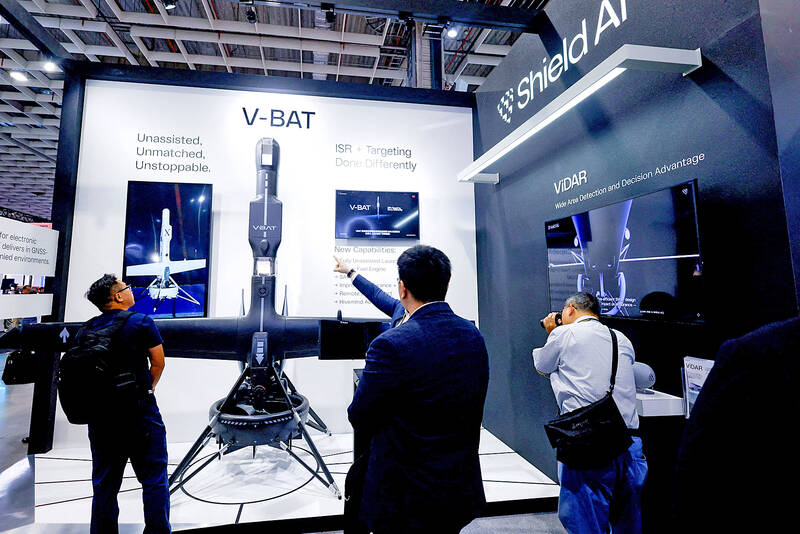
Photo: Ann Wang, Reuters
In an interview with the Liberty Times (sister paper of the Taipei Times), Chen said that Shield AI’s presence in Taiwan was a long-term investment, citing the nation’s mature drone, electronics, software and hardware industries.
Taiwan has considerable potential to contribute to physical AI, including through academic researchers involved in AI model training, while its hardware industry has strengths in making drones lighter, extending flight times and improving heat dissipation, he said.
Beyond procuring components, Shield AI wants to develop more capabilities locally. Chen said the company hopes to establish local capabilities in logistics, maintenance, training and some assembly, so products introduced to Taiwan would not have to be sent to the US for support during special or wartime circumstances.
The widespread use of uncrewed vehicles in the Russia-Ukraine war has highlighted their military importance, but Taiwan’s operational environment differs significantly from Europe’s, Chen said.
A key challenge for Taiwan is withstanding severe electronic warfare interference, he said, adding that Hivemind enables uncrewed vehicles to continue carrying out missions under intense interference.
Shield AI has learned from Ukraine that it must be physically present in a country to fully understand customers’ needs, Chen said. The company works with Taiwanese users and policymakers to understand military requirements and help partners develop sovereign AI capabilities tailored to Taiwan.
Shield AI also hopes to provide software development kits that allow Taiwanese engineers to design software models and mission functions themselves, rather than simply importing a fixed foreign system, he said.
Shield AI cofounder and president Brandon Tseng said in a written statement that the company is firmly committed to expanding its presence in Taiwan. It has established an office at Taipei 101 and plans to double its local staff next year.
The company is building a cooperation ecosystem with Taiwanese partners, including the National Chungshan Institute of Science and Technology, Aerospace Industrial Development Corp (漢翔航空工業) and Thunder Tiger Group (雷虎科技), he said.
Tseng, a former US Navy SEAL, said his frontline experience showed him the gap between advanced military equipment and technological integration, prompting him to pursue autonomous technology.
“Victory without war is the greatest victory,” he said, explaining that Shield AI aims to develop technology that gives military forces the ability to deter conflict before it breaks out.
The US Air Force has awarded Shield AI a contract for autonomous mission system software for Collaborative Combat Aircraft. Tseng said the program is designed to enable AI-piloted wingmen to operate alongside human pilots, reducing the risk to personnel.
Shield AI has integrated Hivemind into Anduril’s YFQ-44A Fury uncrewed aircraft. Following flight tests, it demonstrated that two different mission autonomy systems could alternate during a single mission, achieve the same objective and safely return to base.
Hivemind has been used on more than 40 different platforms, Tseng said, demonstrating its flexibility for use with other collaborative combat aircraft.
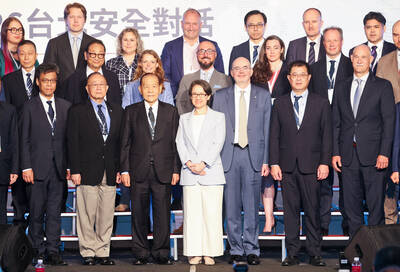
Taiwan’s growing defense preparations might be sending a stronger signal to the US than to Beijing, highlighting the need for Taipei to tailor its deterrence efforts to different audiences, a US security academic said yesterday. Stanford University Freeman Spogli Institute for International Studies fellow Oriana Skylar Mastro made the comment during a Taipei Security Dialogue panel examining lessons Taiwan could draw from the wars in Ukraine and the Middle East. Mastro said she was impressed by Taiwan’s increased defense spending, emphasis on asymmetric capabilities and efforts to prepare society for conflict, but questioned whom those initiatives were influencing. She said when she asked
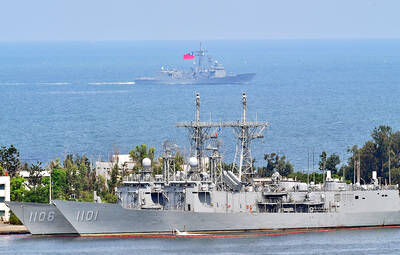
SIZE MATTERS: Large ships are politically attractive as visible symbols of national defense, but small surface combatants are more likely to survive an initial strike Taiwan needs to restructure its naval fleet from focusing on large warships, which are “sitting ducks” for China’s advanced tracking technology, to smaller, stealthy corvettes that are harder to detect but retain sufficient firepower to deter a Chinese invasion, a Taiwanese academic and a former US military commander said in an article published on Friday in the journal Foreign Affairs. Taiwan does not need a fleet capable of competing with the Chinese navy for traditional control of the Taiwan Strait, but rather “sea denial” capabilities that would prevent China from freely using the waterway, Taiwanese aerospace and security expert Holmes Liao
A total of 400 foreign “high- level” professionals have been naturalized as Republic of China (Taiwan) citizens over the past decade as the government has eased nationality rules to attract talent from a wider range of fields, the Ministry of the Interior said yesterday. The 400th high-level professional, who works in the electronics industry, was approved for ROC citizenship on Aug. 26, the MOI said. The MOI quoted the newly naturalized citizen as saying that Taiwan is a leader in fields such as semiconductors, electronics manufacturing, artificial intelligence development and energy technology. He also said
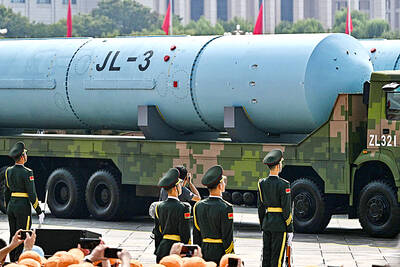
SUB-LAUNCHED SUBOPTIMAL: The JL-3, an upgraded version of the missile test-fired earlier in the summer, would have the range to strike at much of the country Refits to Chinese nuclear submarines to carry JL-3 intercontinental ballistic missiles would put much of the US in striking distance, Taiwanese defense analysts said in a report commissioned by the Mainland Affairs Council. Researchers from National Defense University’s Graduate Institute of China Military Affairs Studies said that the Chinese People’s Liberation Army Navy (PLAN) in July test-fired a missile with a training warhead. Chinese state media reported without elaborating that a PLAN nuclear-powered ballistic missile submarine (SSBN) launched a missile with a training warhead, which accurately hit the designated target area in the Pacific, the report said. The launch was a rare display


 RSS
RSS