

A Taiwanese academic yesterday slammed Chinese drama Emperor Jiaqing and the Journey to Taiwan (嘉慶君遊臺灣), saying it distorted history and promoted a cross-strait unification narrative.
The microdrama is funded and presented by Jingcai Taiwan, a Chinese state-run media platform of the Beijing Municipal Taiwan Affairs Office, with its premiere held in Beijing on Friday last week.
The Taiwanese academic, specializing in Qing and Taiwan history, said on condition of anonymity that historical records clearly show that during the more than 200 years of Qing rule over Taiwan, no Qing emperor, including Emperor Jiaqing (嘉慶), ever set foot in the nation.
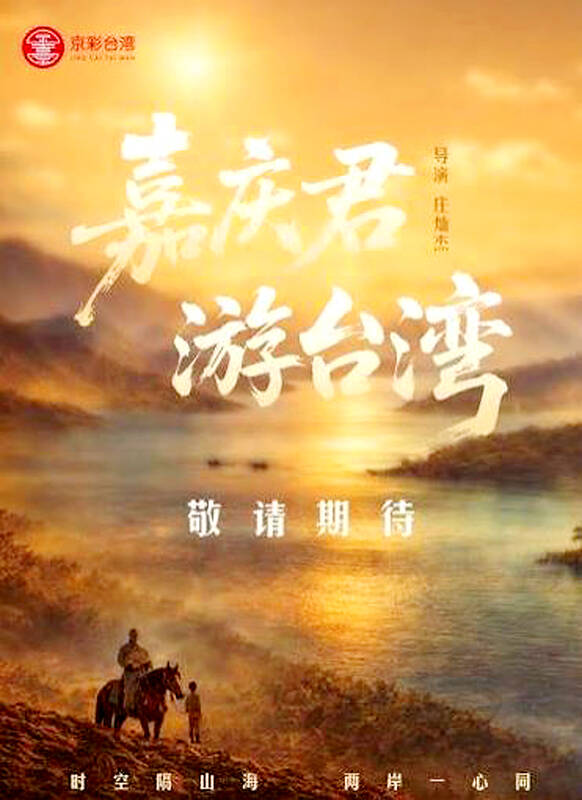
Photo: Screen grab from Pekingimage’s X account
The folktale, which circulated in Taiwan in the 19th century, was similar to Chinese legends such as “Emperor Zhengde’s Tour of Jiangnan” (正德皇帝遊江南) and “Qianlong’s Tour of Jiangnan” (乾隆下江南). At their core, the stories were fictional fantasies and a form of psychological compensation born out of authoritarian rule, repression and the frustrations of the era, they said.
Taiwanese in the 19th century created the story of Emperor Jiaqing traveling secretly to Taiwan mainly because the Beijing-based Qing Dynasty adopted a repressive policy that prioritized guarding against Taiwan over governing Taiwan, the academic said.
At the time, the Qing court regarded Taiwan as a hotspot of rebellion and strictly restricted cross-strait travel with a ban on bringing family to Taiwan, as the nation was primarily populated by remnants of the previous dynasty, they said.
That resulted in severe gender imbalance and many displaced people, the academic said.
The situation was compounded by exorbitant taxation for Taiwan, exclusion of Taiwanese from official positions and the deployment of garrison forces using only troops from China’s Fujian or Guangdong provinces, they said.
The populace had no choice but to pin their hopes on the imaginary arrival of a savior monarch, they said, adding that the folktale was not only a psychological compensation during years of hardships, but a silent indictment and satire of the local officials’ tyranny.
It is not a story that sings the glory of the ruler, they said.
The Chinese Communist Party (CCP) misrepresented the folktale out of the historical context and framed it as “Taiwanese longing for the grace of the Chinese emperor,” the academic said.
That reflects China’s feudal patriarchal mindset and “celestial empire” arrogance, they added.
The CCP is naive to believe that such a soap opera would evoke the feeling of “shared ancestry” among Taiwanese, the academic said.
China’s attempt to use the micro drama to bring the two sides of the Strait closer would only backfire, the scholar said.
The political stunt not only reopens the wounds of discriminatory treatment and unequal policies imposed on Taiwan by China’s central authorities throughout history, but also demonstrates to the international community and the Taiwanese public that Beijing neither understands Taiwan’s history nor the mindset and democratic values of modern Taiwanese society, they said.
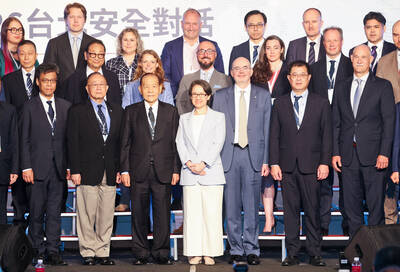
Taiwan’s growing defense preparations might be sending a stronger signal to the US than to Beijing, highlighting the need for Taipei to tailor its deterrence efforts to different audiences, a US security academic said yesterday. Stanford University Freeman Spogli Institute for International Studies fellow Oriana Skylar Mastro made the comment during a Taipei Security Dialogue panel examining lessons Taiwan could draw from the wars in Ukraine and the Middle East. Mastro said she was impressed by Taiwan’s increased defense spending, emphasis on asymmetric capabilities and efforts to prepare society for conflict, but questioned whom those initiatives were influencing. She said when she asked
A total of 400 foreign “high- level” professionals have been naturalized as Republic of China (Taiwan) citizens over the past decade as the government has eased nationality rules to attract talent from a wider range of fields, the Ministry of the Interior said yesterday. The 400th high-level professional, who works in the electronics industry, was approved for ROC citizenship on Aug. 26, the MOI said. The MOI quoted the newly naturalized citizen as saying that Taiwan is a leader in fields such as semiconductors, electronics manufacturing, artificial intelligence development and energy technology. He also said
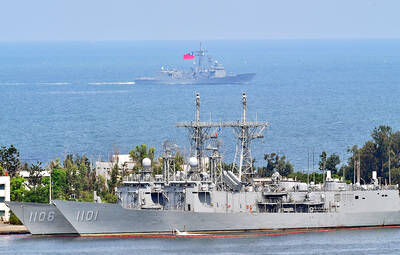
SIZE MATTERS: Large ships are politically attractive as visible symbols of national defense, but small surface combatants are more likely to survive an initial strike Taiwan needs to restructure its naval fleet from focusing on large warships, which are “sitting ducks” for China’s advanced tracking technology, to smaller, stealthy corvettes that are harder to detect but retain sufficient firepower to deter a Chinese invasion, a Taiwanese academic and a former US military commander said in an article published on Friday in the journal Foreign Affairs. Taiwan does not need a fleet capable of competing with the Chinese navy for traditional control of the Taiwan Strait, but rather “sea denial” capabilities that would prevent China from freely using the waterway, Taiwanese aerospace and security expert Holmes Liao
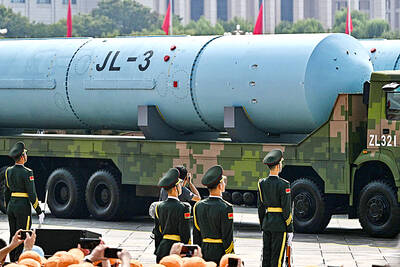
SUB-LAUNCHED SUBOPTIMAL: The JL-3, an upgraded version of the missile test-fired earlier in the summer, would have the range to strike at much of the country Refits to Chinese nuclear submarines to carry JL-3 intercontinental ballistic missiles would put much of the US in striking distance, Taiwanese defense analysts said in a report commissioned by the Mainland Affairs Council. Researchers from National Defense University’s Graduate Institute of China Military Affairs Studies said that the Chinese People’s Liberation Army Navy (PLAN) in July test-fired a missile with a training warhead. Chinese state media reported without elaborating that a PLAN nuclear-powered ballistic missile submarine (SSBN) launched a missile with a training warhead, which accurately hit the designated target area in the Pacific, the report said. The launch was a rare display


 RSS
RSS