

Recent Chinese diplomatic and military moves are aimed at creating pressure ahead of a planned meeting between Chinese President Xi Jinping (習近平) and US President Donald Trump, National Security Council adviser Huang Chung-yen (黃重諺) said.
Trump when visiting China in May extended an invitation to Xi to visit Washington on Sept. 24.
China is yet to officially announce plans for Xi’s visit to the US.
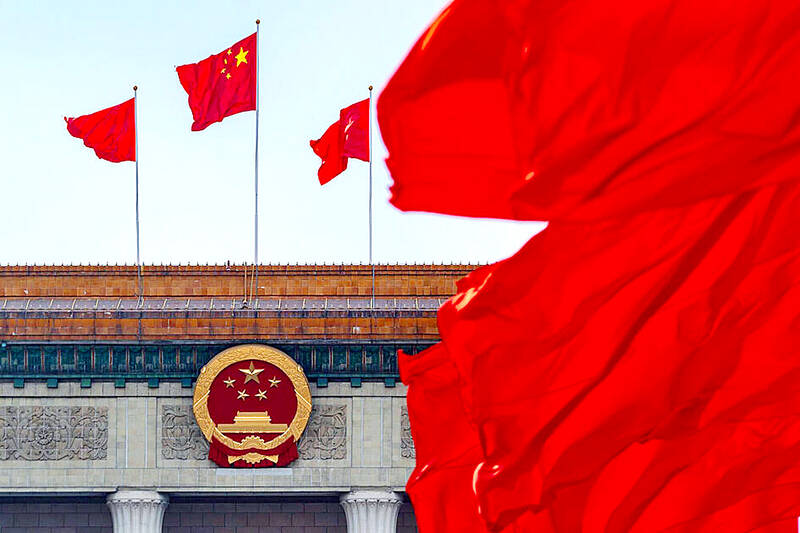
Photo: Bloomberg
In an interview with the Liberty Times (sister paper of the Taipei Times) on Thursday, Huang said Xi’s overseas visits, China’s “gray zone” activities along the First Island Chain and efforts to expand its trade surplus with the US through low-priced exports are intended to create “final pressure” ahead of the meeting.
The moves are aimed at securing leverage in negotiations abroad while creating the impression at home that China is doing well despite its economic downturn, Huang said.
Xi began a series of overseas visits late last month, including attending a Shanghai Cooperation Organization meeting in Kyrgyzstan, where he met Russian President Vladimir Putin, visiting Egypt, the first country to join the Belt and Road Initiative, and attending the BRICS summit in India, Huang said.
China has also stepped up “gray zone” incursions in the East China Sea, South China Sea and waters around Taiwan, particularly in Taiwan’s eastern waters and waters near Japan and the Philippines, using increased geopolitical pressure as a bargaining chip, he said.
Economically, China’s overcapacity and low-priced exports have spilled over into G20 and other countries. Beijing is seeking to use its growing trade surplus with the US as leverage to negotiate increased purchases, Huang said.
The issues are growing concerns for other countries, which must protect domestic industries from low-priced Chinese exports and address geopolitical pressure from Beijing.
The US must protect its trade interests while ensuring regional security, he said.
Regarding a possible US-China dialogue on artificial intelligence (AI) security before the summit, Huang said AI encompasses computing capacity, energy infrastructure, chips and semiconductors, and downstream applications, making it extremely resource intensive.
Countries must establish security safeguards while maintaining technological competition, preventing authoritarian countries from gaining control of critical technologies, he said.
Huang said that during the administrations of former president Tsai Ing-wen (蔡英文) and President William Lai (賴清德), Taiwan’s core objective has been to remain “indispensable” to the geopolitical landscape and global supply chains.
Taiwan’s indispensability is also reflected in the US National Security Strategy and National Defense Strategy, which establish Taiwan as a core element of security along the First Island Chain and in global supply chains, Huang said.
Separately, regarding a Kyodo News report on Saturday saying that China has asked the US not to approve new arms sales to Taiwan before the summit and that Xi could consider canceling his visit if Washington approves such sales, Hung Pu-chao (洪浦釗), an assistant professor at the University of Taipei’s Center for General Education, said yesterday that even an agreement between the US and China would be unlikely to alter their strategic competition.
The meeting would involve negotiations over major strategic interests, and Taiwan must understand how Washington and Beijing handle the Taiwan issue to prevent its interests from being affected by their negotiations, Hung said.
If the two sides reach partial agreements, the key question would be whether US-China relations enter a period of short-term easing or merely adjust the way they compete, he said.
The outcome would affect security in the Taiwan Strait, the US-Japan alliance and the broader Indo-Pacific region’s security framework, Hung said.
Additional reporting by Chen Yu-fu
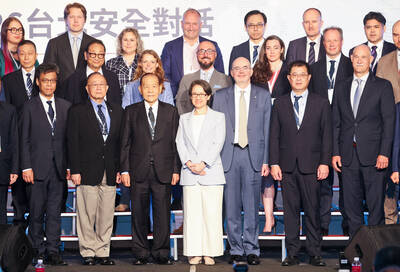
Taiwan’s growing defense preparations might be sending a stronger signal to the US than to Beijing, highlighting the need for Taipei to tailor its deterrence efforts to different audiences, a US security academic said yesterday. Stanford University Freeman Spogli Institute for International Studies fellow Oriana Skylar Mastro made the comment during a Taipei Security Dialogue panel examining lessons Taiwan could draw from the wars in Ukraine and the Middle East. Mastro said she was impressed by Taiwan’s increased defense spending, emphasis on asymmetric capabilities and efforts to prepare society for conflict, but questioned whom those initiatives were influencing. She said when she asked
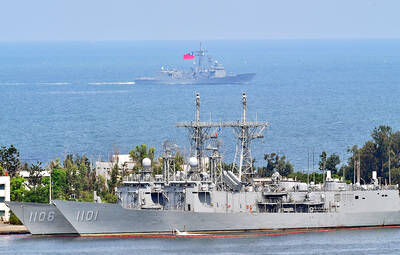
SIZE MATTERS: Large ships are politically attractive as visible symbols of national defense, but small surface combatants are more likely to survive an initial strike Taiwan needs to restructure its naval fleet from focusing on large warships, which are “sitting ducks” for China’s advanced tracking technology, to smaller, stealthy corvettes that are harder to detect but retain sufficient firepower to deter a Chinese invasion, a Taiwanese academic and a former US military commander said in an article published on Friday in the journal Foreign Affairs. Taiwan does not need a fleet capable of competing with the Chinese navy for traditional control of the Taiwan Strait, but rather “sea denial” capabilities that would prevent China from freely using the waterway, Taiwanese aerospace and security expert Holmes Liao
A total of 400 foreign “high- level” professionals have been naturalized as Republic of China (Taiwan) citizens over the past decade as the government has eased nationality rules to attract talent from a wider range of fields, the Ministry of the Interior said yesterday. The 400th high-level professional, who works in the electronics industry, was approved for ROC citizenship on Aug. 26, the MOI said. The MOI quoted the newly naturalized citizen as saying that Taiwan is a leader in fields such as semiconductors, electronics manufacturing, artificial intelligence development and energy technology. He also said
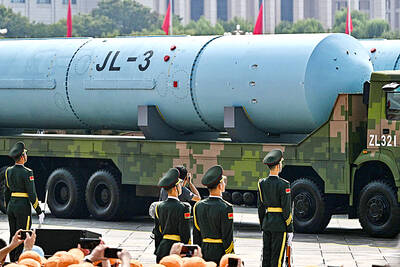
SUB-LAUNCHED SUBOPTIMAL: The JL-3, an upgraded version of the missile test-fired earlier in the summer, would have the range to strike at much of the country Refits to Chinese nuclear submarines to carry JL-3 intercontinental ballistic missiles would put much of the US in striking distance, Taiwanese defense analysts said in a report commissioned by the Mainland Affairs Council. Researchers from National Defense University’s Graduate Institute of China Military Affairs Studies said that the Chinese People’s Liberation Army Navy (PLAN) in July test-fired a missile with a training warhead. Chinese state media reported without elaborating that a PLAN nuclear-powered ballistic missile submarine (SSBN) launched a missile with a training warhead, which accurately hit the designated target area in the Pacific, the report said. The launch was a rare display


 RSS
RSS