


The Centers for Disease Control (CDC) yesterday raised the travel advisory for the Democratic Republic of the Congo (DRC) and Uganda to “Level 3: Warning” due to an Ebola outbreak, requiring returning travelers to undergo 21 days of self-health management.
Early symptoms of Ebola include fever, diarrhea, headache and abnormal bleeding, the CDC said, adding that anyone experiencing these symptoms after returning to Taiwan should report their conditions to the CDC’s “1922” hotline and seek medical attention immediately.
The WHO on May 17 declared that the Ebola outbreak caused by the Bundibugyo virus in the DRC constitutes public health emergency of international concern.
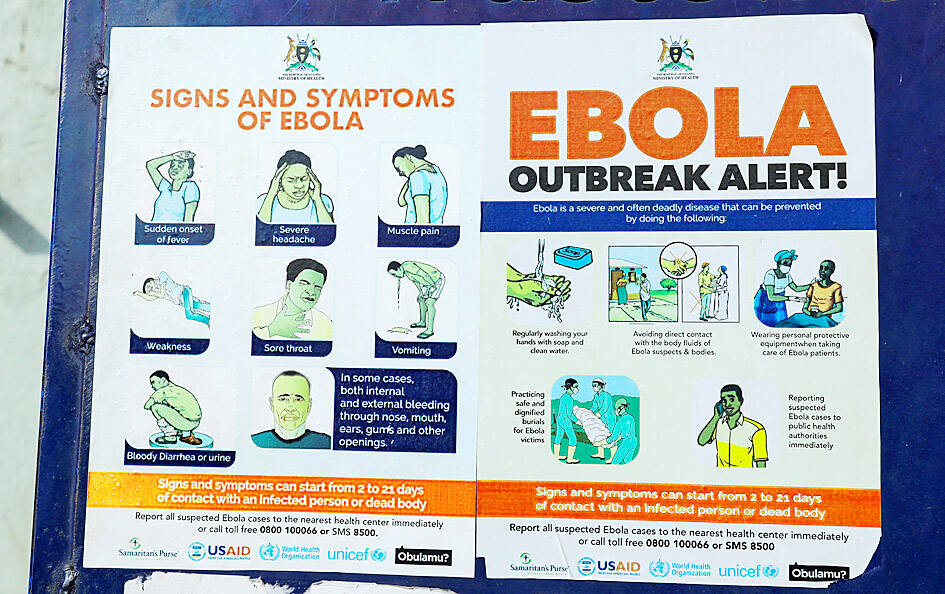
Photo: Reuters
CDC Deputy Director-General and spokeswoman Tseng Shu-hui (曾淑慧) yesterday said that the Ebola epidemic is spreading rapidly in the two countries, and while Ituri Province in the DRC is the primary hotspot, cases have also emerged in North Kivu Province and South Kivu Province, as well as and the neighboring country Uganda.
The Level 3 advisory means people should avoid nonessential travel to these areas, she said.
People who have visited the two countries within the past 21 days are required to practice self-health management for 21 days after entering Taiwan, which includes measuring their body temperature daily and reporting their health condition through an online self-reporting system, Tseng said.
They should report their conditions as soon as they exhibit suspected symptoms and have the local health department refer them to a hospital for treatment, she added.
As of Sunday, the DRC had accumulated 112 confirmed cases, including 11 deaths, along with 906 suspected cases and 223 suspected deaths, she said.
Uganda had seven confirmed cases and one death, Tseng said, adding that a US citizen tested positive after coming into contact with the virus at a local medical facility, indicating continued risk of the outbreak spreading.
Tseng said the Ebola virus is primarily transmitted through contact with the blood, body fluids, secretion, or contaminated objects of infected individuals.
Initial symptoms include fever, headache, muscle aches, nausea, abdominal pain, diarrhea and vomiting; and in severe cases, it can lead to bleeding, multiple organ failure or even death, she said.
There is currently no approved vaccine or antiviral drug for this particular strain, and combined with local political instability and frequent population movement, disease prevention and control have become even more challenging, she added.
To reduce the risk of imported cases, the CDC has enhanced cross-departmental border control measures, including reminding travelers through airport electronic displays, news tickers and in-flight announcements, and airport quarantine personnel intensifying “TOCC” — travel history, occupation, contact history and cluster history — assessments and health evaluations, she said.
While the outbreak is currently limited to two countries in Africa and the overall risk to Taiwan remains low, the possibility of imported cases cannot be ruled out due to frequent global travel, Tseng said, adding that people should avoid traveling to affected areas unless absolutely necessary.
Those who must travel there should practice protective measures, such as washing their hands frequently, wearing masks, and avoiding contact with wildlife and patients’ bodily fluids, she added.

FUKUOKA SITUATION: Japanese media reported that the pathogen is expected to be identified by the summer, while the CDC downplayed the idea that it was hMPV A “mysterious cold-like illness” reported in Japan’s Fukuoka Prefecture does not seem to be a new disease, but Japanese authorities have been asked about the situation, the Centers for Disease Control (CDC) said yesterday. The Fukuoka Prefectural Medical Association on Wednesday told a news conference that a “mystery cold” that has become a hot topic on social media is “highly likely to be caused by some kind of viral infection,” Japan’s KBC News reported. “Many people are experiencing symptoms starting with a sore throat, followed by a runny nose, phlegm and a severe cough,” KBC News reported, citing association officials. Health authorities are

Nvidia Corp CEO Jensen Huang (黃仁勳) arrived in Taiwan yesterday ahead of upcoming AI and technology events, saying he plans to meet with clients and Taiwan Semiconductor Manufacturing Co Chairman C.C. Wei (魏哲家) during his visit. After landing at Taipei Songshan Airport, Huang posed for photos with fans and handed out Yakult drinks to reporters and supporters waiting at the scene, saying he has “a lot to do” during the trip. Asked about reports that Nvidia’s planned headquarters site in Taipei’s Beitou Shilin Technology Park could break ground on May 27, Huang said that if the company holds an event, he would

The Ministry of Finance this afternoon announced the winning numbers for the March-April uniform invoice lottery. The winning number for the NT$10 million (US$318,060) special prize is 19531471, and the winning number for the NT$2 million grand prize is 85941329. Three numbers were drawn for the NT$200,000 first prize: 07225810, 20231230 and 83518781. Those with receipts matching the last seven digits of any of the first-prize numbers will win the NT$40,000 second prize, while those matching the last six digits will win the NT$10,000 third prize. Those whose receipts match the last five digits of the first-prize numbers can claim the NT$4,000 fourth prize,
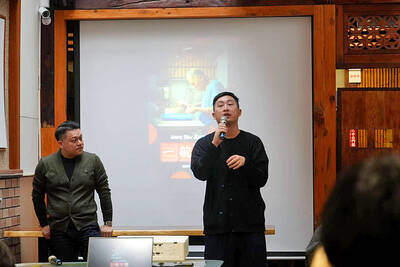
Taiwan Travelogue (臺灣漫遊錄), which earlier this week became the first Taiwanese novel to win the International Booker Prize, is to be adapted into a television series through a Taiwan-Japan coproduction, producer Chang Chen-yu (張辰漁) said yesterday. Chang, a producer at World Softest Production Film Co, wrote on Facebook that the company had been searching for projects with international appeal that retain a strong Taiwanese identity after colleagues and Japanese partners strongly recommended the novel. After reading the book, Chang said he immediately decided to pursue the screen rights. “A great story has the power to transcend time and borders, and connect countless people,”


 RSS
RSS