


Democracy in Taiwan is more than just a political system; it is a way of life and an identity that Taiwanese have fought for, Minister of Foreign Affairs Lin Chia-lung (林佳龍) said during the opening of a Forum 2000 Foundation event in Taipei yesterday.
It marked the first time the Forum for Democratic Cooperation, hosted by the Forum 2000 Foundation, was held in the Indo-Pacific region.
Situated on the First Island Chain, Taiwan is a critical front line that bolsters global democratic resilience, Lin said.
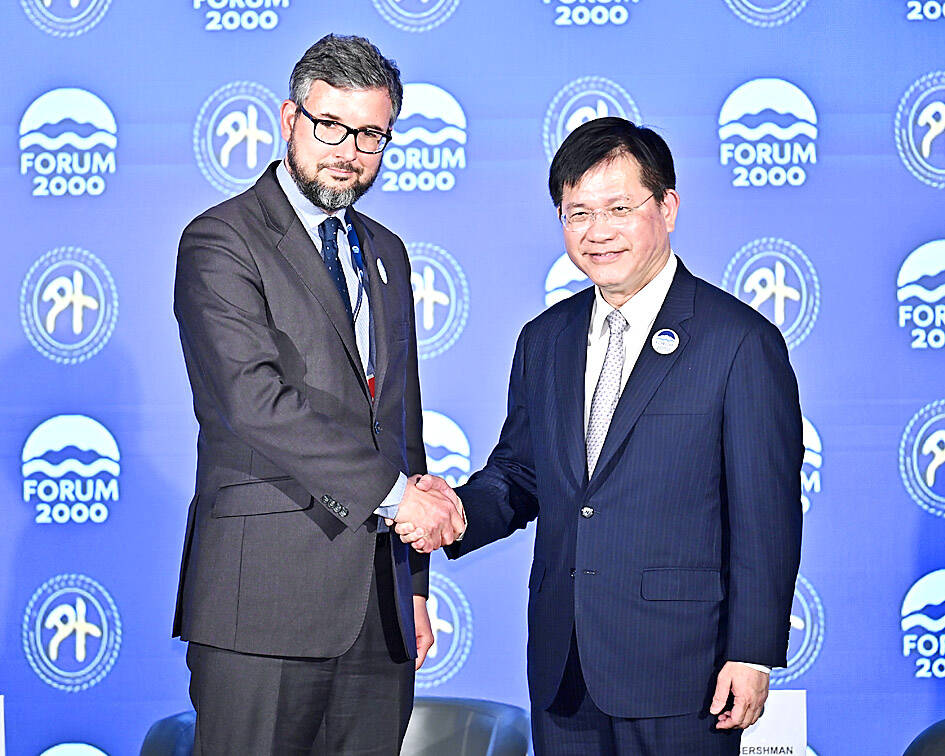
Photo: Tu Chien-jung, Taipei Times
Taiwanese have lived under constant military threat, as well as enduring international diplomatic isolation and cognitive warfare tactics, Lin said, adding that, despite this, Taiwan has not cowed and is still an open, democratic, innovative and resilient country.
Taiwan’s story is a testament to democratic values, Lin said, adding that if one’s democracy proves resilient to external pressure, the people’s participation in public affairs increases, and with the support of international partners, democracy cannot be subverted
A free and liberal community is the most adaptive and innovative, Lin said.
Taiwan is an integral node connecting the Indo-Pacific, Europe and North American democracies, and is not a passive regional observer, but a major force actively upholding regional peace and stability.
The Taiwan Strait issue is not confined to Taiwan’s internal politics; it is a global challenge, especially in an era when supply chain resilience is considered a matter of national security, Lin said.
Quoting President William Lai (賴清德), Lin said that a credible technological ecosystem and a resilient supply chain free of Chinese influence form the pillar of support for global democracy, adding that Taiwan is prepared to work with its international partners to ensure that emerging technology is used to empower freedom, and not to expand authoritarianism.
Foundation executive director Jakub Klepal said the foundation was founded by late Czech president Vaclav Havel, who had decades-long strong ties with Taiwan.
Czech-Taiwan ties are long-standing and founded on collaborations in technology, education, Internet safety and parliamentary interactions, Klepal said, adding that he was proud to say that the Czech Republic is one of Taiwan’s closest friends in Europe.
Meanwhile, commenting on the coalition government’s refusal to provide a government aircraft for Czech Senate President Milos Vystrcil’s planned visit to Taiwan next month, as it seeks closer business ties with China, former Czech minister of foreign affairs Tomas Petricek said on the sidelines of the forum that the Czech government is in the midst of discussing a rebalancing of relations with Taiwan and China.
The new government in Prague remains interested in Czech-Taiwan collaborations, but might adopt more practical, opportunistic diplomatic rhetoric, he added.
Petricek said he did not feel that the Czech government’s actions would bring about expected results, adding that the Czech-China trade deficit was so large that investments in China would benefit China more than it would benefit the Czech Republic.
Additional reporting by Huang Ching-hsuan

FUKUOKA SITUATION: Japanese media reported that the pathogen is expected to be identified by the summer, while the CDC downplayed the idea that it was hMPV A “mysterious cold-like illness” reported in Japan’s Fukuoka Prefecture does not seem to be a new disease, but Japanese authorities have been asked about the situation, the Centers for Disease Control (CDC) said yesterday. The Fukuoka Prefectural Medical Association on Wednesday told a news conference that a “mystery cold” that has become a hot topic on social media is “highly likely to be caused by some kind of viral infection,” Japan’s KBC News reported. “Many people are experiencing symptoms starting with a sore throat, followed by a runny nose, phlegm and a severe cough,” KBC News reported, citing association officials. Health authorities are

Nvidia Corp CEO Jensen Huang (黃仁勳) arrived in Taiwan yesterday ahead of upcoming AI and technology events, saying he plans to meet with clients and Taiwan Semiconductor Manufacturing Co Chairman C.C. Wei (魏哲家) during his visit. After landing at Taipei Songshan Airport, Huang posed for photos with fans and handed out Yakult drinks to reporters and supporters waiting at the scene, saying he has “a lot to do” during the trip. Asked about reports that Nvidia’s planned headquarters site in Taipei’s Beitou Shilin Technology Park could break ground on May 27, Huang said that if the company holds an event, he would

The Ministry of Finance this afternoon announced the winning numbers for the March-April uniform invoice lottery. The winning number for the NT$10 million (US$318,060) special prize is 19531471, and the winning number for the NT$2 million grand prize is 85941329. Three numbers were drawn for the NT$200,000 first prize: 07225810, 20231230 and 83518781. Those with receipts matching the last seven digits of any of the first-prize numbers will win the NT$40,000 second prize, while those matching the last six digits will win the NT$10,000 third prize. Those whose receipts match the last five digits of the first-prize numbers can claim the NT$4,000 fourth prize,
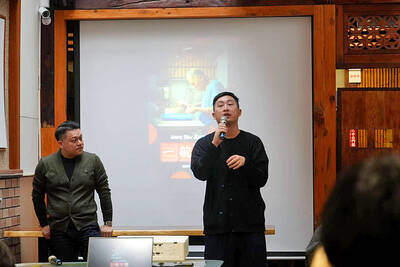
Taiwan Travelogue (臺灣漫遊錄), which earlier this week became the first Taiwanese novel to win the International Booker Prize, is to be adapted into a television series through a Taiwan-Japan coproduction, producer Chang Chen-yu (張辰漁) said yesterday. Chang, a producer at World Softest Production Film Co, wrote on Facebook that the company had been searching for projects with international appeal that retain a strong Taiwanese identity after colleagues and Japanese partners strongly recommended the novel. After reading the book, Chang said he immediately decided to pursue the screen rights. “A great story has the power to transcend time and borders, and connect countless people,”


 RSS
RSS