


Lawmakers today agreed to cut NT$2 million (US$63,647) of a proposed NT$8.81 billion arms procurement package for this year, paving the way for the budget to be passed as soon as Friday.
The Legislative Yuan’s Foreign Affairs and National Defense Committee and Finance Committee this morning completed an initial review of the Executive Yuan’s proposed procurement budget to “safeguard national security and strengthen asymmetric combat capabilities.”
The special budget was intensely debated, but ultimately the committees passed a multi-year NT$780 billion budget framework centered on arms purchases, Democratic Progressive Party (DPP) Legislator Chen Kuan-ting (陳冠廷) said after the meeting.
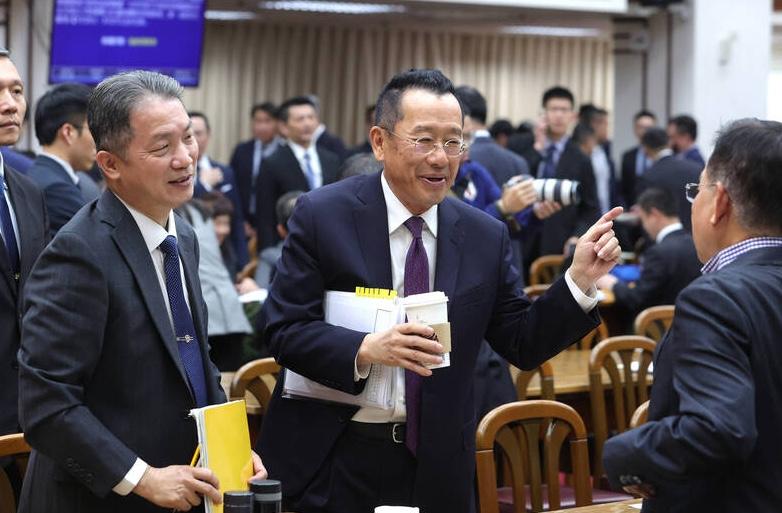
Photo: Wang Yi-sung, Taipei Times
The review of this year’s NT$8.81 billion special budget is based on that foundation, and ruling and opposition parties have reached a strong understanding, making the review process very smooth, Chen said.
Chinese Nationalist Party (KMT) lawmakers had originally proposed multiple budget cuts, including more than NT$20 million for the construction and operation of garages, training facilities and maintenance plants for M109A7 self-propelled howitzers and the High Mobility Artillery Rocket System (HIMARS).
If the preliminary planning budget was cut amid rising labor and material costs, it could lead to failed bids, which would subsequently affect project management, construction and equipment delivery schedules, the Ministry of National Defense (MND) said during the review.
After negotiations, these were consolidated into a single across-the-board reduction of NT$2 million, Chen said.
The MND said it would make the necessary internal adjustments based on these cuts, which should be fully manageable.
During the review, lawmakers raised concerns about how uncrewed systems could be affected in the future and proposed related suggestions, Chen said.
He said he would work with DPP Legislator Chung Chia-pin (鍾佳濱) to push a drone industry development bill, with the Ministry of Economic Affairs and MND collaborating to fill regulatory gaps.
The completion of the budget’s initial review marks the end of one phase, with drone legislation set to be the next key focus, he added.
Since there is already cross-party consensus on the budget, it can be submitted directly to the plenary session without cross-party negotiations, Chen said.
The bill would be added to the schedule as early as Friday, although this would depend on the final agenda, he said.
Following a six-month process to finalize the special defense act’s preliminary review, Minister of National Defense Wellington Koo (顧立雄) told reporters after the meeting that the ministry would continue to negotiate with lawmakers to build consensus.
Asked if the NT$2 million cut to operational expenses would have an impact, Koo said the ministry could manage it through line item adjustments, adding: “I think we can handle it.”
The MND also confirmed during the meeting that the Executive Yuan approved the use of reserve funds on Monday to cover the first payment for the HIMARS, which is due by Sunday.
This ensures there would be no breach of contract or cancelation, the ministry added.
Additional reporting by Fang Wei-li

FUKUOKA SITUATION: Japanese media reported that the pathogen is expected to be identified by the summer, while the CDC downplayed the idea that it was hMPV A “mysterious cold-like illness” reported in Japan’s Fukuoka Prefecture does not seem to be a new disease, but Japanese authorities have been asked about the situation, the Centers for Disease Control (CDC) said yesterday. The Fukuoka Prefectural Medical Association on Wednesday told a news conference that a “mystery cold” that has become a hot topic on social media is “highly likely to be caused by some kind of viral infection,” Japan’s KBC News reported. “Many people are experiencing symptoms starting with a sore throat, followed by a runny nose, phlegm and a severe cough,” KBC News reported, citing association officials. Health authorities are

Nvidia Corp CEO Jensen Huang (黃仁勳) arrived in Taiwan yesterday ahead of upcoming AI and technology events, saying he plans to meet with clients and Taiwan Semiconductor Manufacturing Co Chairman C.C. Wei (魏哲家) during his visit. After landing at Taipei Songshan Airport, Huang posed for photos with fans and handed out Yakult drinks to reporters and supporters waiting at the scene, saying he has “a lot to do” during the trip. Asked about reports that Nvidia’s planned headquarters site in Taipei’s Beitou Shilin Technology Park could break ground on May 27, Huang said that if the company holds an event, he would

The Ministry of Finance this afternoon announced the winning numbers for the March-April uniform invoice lottery. The winning number for the NT$10 million (US$318,060) special prize is 19531471, and the winning number for the NT$2 million grand prize is 85941329. Three numbers were drawn for the NT$200,000 first prize: 07225810, 20231230 and 83518781. Those with receipts matching the last seven digits of any of the first-prize numbers will win the NT$40,000 second prize, while those matching the last six digits will win the NT$10,000 third prize. Those whose receipts match the last five digits of the first-prize numbers can claim the NT$4,000 fourth prize,
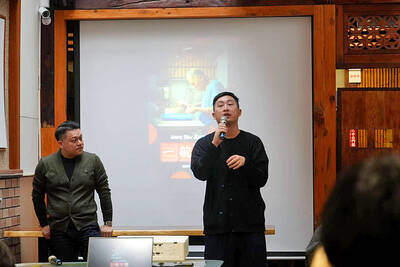
Taiwan Travelogue (臺灣漫遊錄), which earlier this week became the first Taiwanese novel to win the International Booker Prize, is to be adapted into a television series through a Taiwan-Japan coproduction, producer Chang Chen-yu (張辰漁) said yesterday. Chang, a producer at World Softest Production Film Co, wrote on Facebook that the company had been searching for projects with international appeal that retain a strong Taiwanese identity after colleagues and Japanese partners strongly recommended the novel. After reading the book, Chang said he immediately decided to pursue the screen rights. “A great story has the power to transcend time and borders, and connect countless people,”


 RSS
RSS