


A woman in her 60s from central Taiwan who died of meningococcal meningitis one day after the onset of symptoms is the first person in Taiwan to die of the disease this year, the Centers for Disease Control (CDC) said yesterday.
The woman, who had a history of hypertension, began experiencing acute symptoms on May 7 and sought emergency medical treatment the next day, CDC Epidemic Intelligence Center Deputy Director Lee Chia-lin (李佳琳) said.
The woman’s symptoms included a fever, chills, dizziness, vomiting, diarrhea and general weakness, CDC physician Lin Yung-ching (林詠青) said.
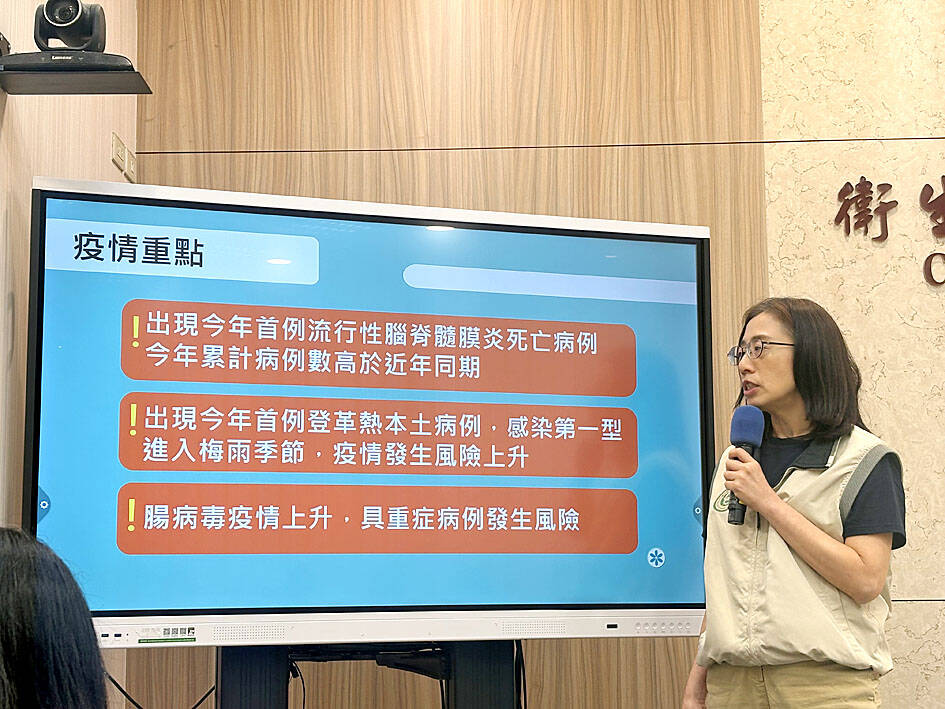
Photo: Hou Chia-yu, Taipei Times
When she sought treatment at an emergency room, she showed signs of cyanosis, a bluish or purplish discoloration of the skin and mucous membranes caused by a lack of oxygen in the blood, Lin said.
She was immediately intubated, and despite a medical team performing cardiopulmonary resuscitation on her, she died of respiratory failure and disseminated intravascular coagulation, he said.
A blood culture confirmed the presence of meningococcal bacteria, and further qualitative analysis identified the strain as Group B meningococcus, Lin said.
The woman’s close contacts, including family members who lived with her and healthcare workers who treated her, did not show suspected symptoms of the disease, he said, adding that 20 of them received post-exposure prophylaxis and their health conditions were monitored until Monday last week, and no new cases were identified.
Meningococcal meningitis is transmitted between humans mainly through close, direct contact with respiratory and throat secretions from an infected person or carrier, he said.
The disease is not as contagious as the flu, as it usually requires longer and closer direct contact for effective transmission, he added.
The bacteria commonly live in the back of the nose and throat of healthy people, among an estimated 5 to 10 percent of the population, without causing illness, Lin said.
However, in some cases, infection can develop into serious illness, with infants younger than one year old, schoolchildren, those living in close communal settings, and immunocompromised individuals at higher risk, he said.
Symptoms of the disease, which has an incubation period of two to 10 days, can appear suddenly, and include fever, headache, neck stiffness, nausea, vomiting and hemorrhagic rash, Lin said, adding that the fatality rate can be up to 40 percent if left untreated, as the illness can progress rapidly.
The disease can be prevented by practicing hand and respiratory hygiene, and people at higher risk of severe illness should avoid crowded and poorly ventilated spaces or consider vaccination, especially when traveling to areas where it is spreading, he said.
Meanwhile, CDC Deputy Director-General Tseng Shu-hui (曾淑慧) said that this year’s first local case of dengue fever, reported on Saturday, was “a little bit early” compared with last year’s first local cases, which were announced on Aug. 25.
However, as the doctor who treated the case was cautious and immediately performed a dengue rapid test to confirm infection, the CDC believes the case might have only a limited impact, Tseng said.
The CDC also issued a notice to healthcare facilities, urging doctors to be extra vigilant in reporting suspected cases, to effectively reduce the risk of dengue transmission, she added.

FUKUOKA SITUATION: Japanese media reported that the pathogen is expected to be identified by the summer, while the CDC downplayed the idea that it was hMPV A “mysterious cold-like illness” reported in Japan’s Fukuoka Prefecture does not seem to be a new disease, but Japanese authorities have been asked about the situation, the Centers for Disease Control (CDC) said yesterday. The Fukuoka Prefectural Medical Association on Wednesday told a news conference that a “mystery cold” that has become a hot topic on social media is “highly likely to be caused by some kind of viral infection,” Japan’s KBC News reported. “Many people are experiencing symptoms starting with a sore throat, followed by a runny nose, phlegm and a severe cough,” KBC News reported, citing association officials. Health authorities are

Nvidia Corp CEO Jensen Huang (黃仁勳) arrived in Taiwan yesterday ahead of upcoming AI and technology events, saying he plans to meet with clients and Taiwan Semiconductor Manufacturing Co Chairman C.C. Wei (魏哲家) during his visit. After landing at Taipei Songshan Airport, Huang posed for photos with fans and handed out Yakult drinks to reporters and supporters waiting at the scene, saying he has “a lot to do” during the trip. Asked about reports that Nvidia’s planned headquarters site in Taipei’s Beitou Shilin Technology Park could break ground on May 27, Huang said that if the company holds an event, he would

The Ministry of Finance this afternoon announced the winning numbers for the March-April uniform invoice lottery. The winning number for the NT$10 million (US$318,060) special prize is 19531471, and the winning number for the NT$2 million grand prize is 85941329. Three numbers were drawn for the NT$200,000 first prize: 07225810, 20231230 and 83518781. Those with receipts matching the last seven digits of any of the first-prize numbers will win the NT$40,000 second prize, while those matching the last six digits will win the NT$10,000 third prize. Those whose receipts match the last five digits of the first-prize numbers can claim the NT$4,000 fourth prize,
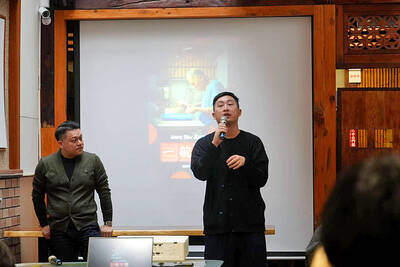
Taiwan Travelogue (臺灣漫遊錄), which earlier this week became the first Taiwanese novel to win the International Booker Prize, is to be adapted into a television series through a Taiwan-Japan coproduction, producer Chang Chen-yu (張辰漁) said yesterday. Chang, a producer at World Softest Production Film Co, wrote on Facebook that the company had been searching for projects with international appeal that retain a strong Taiwanese identity after colleagues and Japanese partners strongly recommended the novel. After reading the book, Chang said he immediately decided to pursue the screen rights. “A great story has the power to transcend time and borders, and connect countless people,”


 RSS
RSS