


The Food and Drug Administration (FDA) earlier this week released new compliance guidelines for food advertising, warning businesses and influencers that using images, metaphors or testimonials to imply medical benefits could breach regulations and result in fines of up to NT$5 million (US$158,388).
Cheng Wei-chih (鄭維智), head of the FDA’s planning and technology management division, yesterday told reporters that the FDA wished to address the issue at the source rather than continue issuing fines, as food adverts constitute the majority of regulatory violations.
The guide, unveiled on Tuesday, clarified the FDA’s principles on what constitutes illegal advertising, along with examples and the exact procedures it would use to determine whether cases meet the criteria.

Photo: CNA
The FDA said that the guide should help food industry owners and businesses inspect adverts placed with advertising companies.
Promotion of a product through the media or other means, whether by hiring influencers or having others talk about their experiences, that would result in the product owner benefiting financially would be classified as an advert, Cheng said.
The content should not be exaggerated, easily misunderstood, or claim to have medical or healing effects, Cheng said.
The FDA would consider the advert in its entirety and judge whether its intent violates regulations, Cheng added.
Reviewers would not be scanning for the inclusion, or omission, of certain key words, Cheng said, citing common terms such as the three “hypers,” referring to hypertension, hyperlipidemia and hyperglycemia, or blood viscosity and fiery liver as examples.
While these terms do not state the symptom names outright, if paired with imagery such as blood vessels being cleared, they would imply that the product would help achieve such effects, Cheng said.
As such, use of homonyms, metaphors, implied interpretation of certain words or intentionally using wrong terminology to convey certain linguistic effects would all fall under the category of intentionally alluding to products having medicinal properties and could be deemed in violation, Cheng said.
Food adverts that are deemed by the FDA or other health-related bodies to have violated Paragraph 1, Article 28 of the Act Governing Food Safety and Sanitation (食品安全衛生管理法) could be fined NT$40,000 to NT$4 million, the FDA said.
Violations of Paragraph 2, Article 28 could be fined between NT$600,000 and NT$5 million, which could be imposed consecutively, and could result in the vendor or producer being ordered to temporarily suspend operations, forcibly closed down, or have their license revoked.
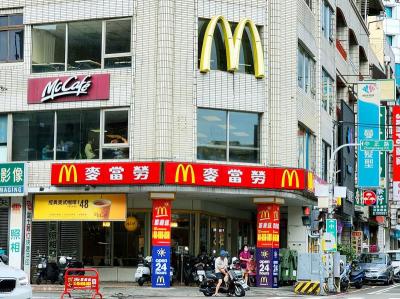
Fast food chain McDonald's is to raise prices by up to NT$5 on some products at its restaurants across Taiwan, starting on Wednesday next week, the company announced today. The prices of all extra value meals and sharing boxes are to increase by NT$5, while breakfast combos and creamy corn soup would go up by NT$3, the company said in a statement. The price of the main items of those meals, if ordered individually, would remain the same. Meanwhile, the price of a medium-sized lemon iced tea and hot cappuccino would rise by NT$3, extra dipping sauces for chicken nuggets would go up
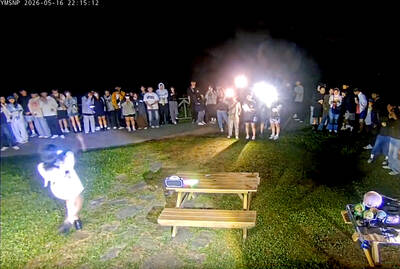
Yangmingshan National Park’s Qingtiangang (擎天崗) nature area has gone viral after a park livestream camera observed a couple in the throes of intimate congress, which was broadcast live on YouTube, drawing large late-night crowds and sparking a backlash over noise, bright lights and disruption to wildlife habitat. The area’s livestream footage appeared to show a couple engaging in sexual activity on a picnic table in the park on Friday last week, with the uncensored footage streamed publicly online. The footage quickly spread across social media, prompting a tide of visitors to travel to the site to “check in” and recreate the

Minister of Digital Affairs Lin Yi-ching (林宜敬) yesterday cited regulatory issues and national security concerns as an expert said that Taiwan is among the few Asian regions without Starlink. Lin made the remarks on Facebook after funP Innovation Group chief executive officer Nathan Chiu (邱繼弘) on Friday said Taiwan and four other countries in Asia — China, North Korea, Afghanistan and Syria — have no access to Starlink. Starlink has become available in 166 countries worldwide, including Ukraine, Malaysia, the Philippines and Vietnam, in the six years since it became commercial, he said. While China and North Korea block Starlink, Syria is not
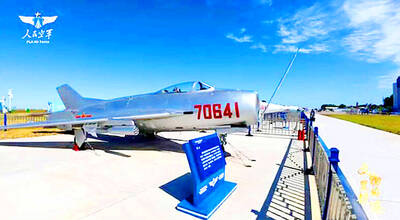
GROUNDED: A KMT lawmaker proposed eliminating drone development programs and freezing funding for counterdrone systems, despite China’s adoption of the technology China has deployed attack drones at air bases near the Taiwan Strait in a strategy aimed at overwhelming Taiwan’s air defense systems through saturation attacks, the Mainland Affairs Council (MAC) said. The council’s latest quarterly report on China said that satellite imagery and open-source intelligence indicate that the Chinese People’s Liberation Army (PLA) had converted retired J-6 fighter jets into J-6W drones, which the PLA has stationed at six air bases near Taiwan, five in China’s Fujian Province and one in Guangdong Province. The report cited J. Michael Dahm, a senior fellow at the US-based Mitchell Institute, as saying that China has


 RSS
RSS