


China's military buildup and threats toward Taiwan are real and Taipei would continue to enhance its defenses with US support, Representative to the US Alexander Yui said today in an interview with Newsmax’s Greta van Susteren.
Beijing has spent decades trying to pressure Taiwan into submission despite never having ruled the nation, Yui said.
"They've always been ever since trying to, you know, huffing and puffing and trying to bring our house down by taking Taiwan as their own," he said. "They never ruled Taiwan and they never administered Taiwan."
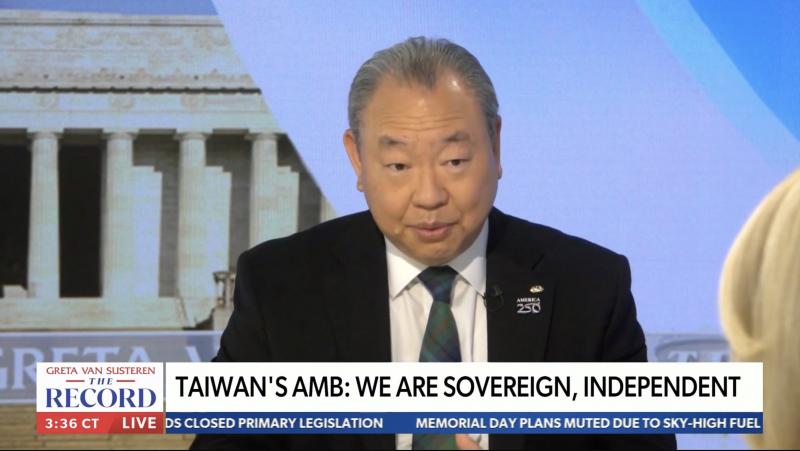
Photo: Screen grab from Newsmax’s YouTube channel
Taiwan's democratic system poses a challenge to the Chinese Communist Party because it offers "a very good alternative to the autocratic way of government in China," he said.
While Taiwan worries about the possibility of an invasion, it is determined to resist, Yui said.
"We are, we want to keep our way of life as is, and we will not budge," he said.
While Taiwan sits close to China, an invasion would be difficult because of the geographic barriers and Taiwan's military preparations, Yui said.
China has been doing “the biggest military buildup in peacetime history,” he said, adding that Beijing's ambitions extend beyond Taiwan and into the broader Indo-Pacific region.
He also praised US military support for Taiwan, saying that US President Donald Trump has overseen billions of US dollars in arms sales to Taipei.
"We believe in peace through strength," Yui said. "A stronger Taiwan actually lessens the chances for the Chinese to be able to attack Taiwan."
Taiwan is modernizing its military with a focus on asymmetric warfare and uncrewed systems, lessons drawn from the war in Ukraine, he said.
Yui also welcomed recent talks between Trump and Chinese President Xi Jinping (習近平).
Communication between the two leaders could help avoid misunderstandings, he said, adding that the US’ position on Taiwan remains unchanged.

Yangmingshan National Park authorities yesterday urged visitors to respect public spaces and obey the law after a couple was caught on a camera livestream having sex at the park’s Qingtiangang (擎天崗) earlier in the day. The Shilin Police Precinct in Taipei said it has identified a suspect and his vehicle registration number, and would summon him for questioning. The case would be handled in accordance with public indecency charges, it added. The couple entered the park at about 11pm on Thursday and began fooling around by 1am yesterday, the police said, adding that the two were unaware of the park’s all-day live

Fast food chain McDonald's is to raise prices by up to NT$5 on some products at its restaurants across Taiwan, starting on Wednesday next week, the company announced today. The prices of all extra value meals and sharing boxes are to increase by NT$5, while breakfast combos and creamy corn soup would go up by NT$3, the company said in a statement. The price of the main items of those meals, if ordered individually, would remain the same. Meanwhile, the price of a medium-sized lemon iced tea and hot cappuccino would rise by NT$3, extra dipping sauces for chicken nuggets would go up

Yangmingshan National Park’s Qingtiangang (擎天崗) nature area has gone viral after a park livestream camera observed a couple in the throes of intimate congress, which was broadcast live on YouTube, drawing large late-night crowds and sparking a backlash over noise, bright lights and disruption to wildlife habitat. The area’s livestream footage appeared to show a couple engaging in sexual activity on a picnic table in the park on Friday last week, with the uncensored footage streamed publicly online. The footage quickly spread across social media, prompting a tide of visitors to travel to the site to “check in” and recreate the

Minister of Digital Affairs Lin Yi-ching (林宜敬) yesterday cited regulatory issues and national security concerns as an expert said that Taiwan is among the few Asian regions without Starlink. Lin made the remarks on Facebook after funP Innovation Group chief executive officer Nathan Chiu (邱繼弘) on Friday said Taiwan and four other countries in Asia — China, North Korea, Afghanistan and Syria — have no access to Starlink. Starlink has become available in 166 countries worldwide, including Ukraine, Malaysia, the Philippines and Vietnam, in the six years since it became commercial, he said. While China and North Korea block Starlink, Syria is not


 RSS
RSS