


Prosecutors yesterday said they are seeking to detain three people for forging documents to export Nvidia Corp artificial intelligence (AI) chips to China, in Taiwan’s first crackdown on semiconductor smuggling.
The trio is accused of making fraudulent declarations about sales of AI servers manufactured by US-headquartered Super Micro Computer Inc so that they could ship them to China, Hong Kong and Macau, in contravention of US trade rules.
Super Micro assembles AI chips from the likes of Nvidia into systems that are installed in data centers, and used to train and run models such as OpenAI’s ChatGPT.

Photo: Ann Wang, Reuters
Washington has restricted sales of the hardware to China since 2022.
The defendants “fully knew” that sales of the servers are “strictly regulated” by the US, the Keelung District Prosecutors’ Office said.
They “conspired to purchase the servers in Taiwan and export them using fraudulent documentation. They are consequently suspected of offenses including forgery of documents under the Criminal Code,” it said.
The office executed search warrants at 12 locations on Wednesday, including the defendants’ residences, the office said, adding that the trio, along with related witnesses, were apprehended and interviewed.
Super Micro’s servers are also the subject of the biggest chip smuggling prosecution in the US, where authorities arrested the firm’s cofounder — who has pled not guilty — for allegedly diverting billions of dollars worth of Nvidia chips to China.
That case reverberated from Silicon Valley to Southeast Asia, a sign that Washington is getting serious about addressing chip smuggling.
The challenge is industrywide. Hardware made by companies including Dell Technologies Inc and Hewlett Packard Enterprise Co has also appeared in alleged illicit chip trade rings detailed by prosecutors in the US and Singapore.
At no point have authorities publicly accused the various server makers of wrongdoing across the cases, of which there are now at least seven, including the Taiwan one.
The crackdown marks a significant step for Taipei, which for years stood on the sidelines of AI chip export debates.
Under President William Lai (賴清德), Taiwan has been increasingly assertive in protecting its technological edge, including by prosecuting trade secret leakage and imposing unprecedented export restrictions on two major Chinese chip champions.
Lai also promised last year to address unspecified US concerns regarding export controls, which have been Washington’s primary tool for constraining China’s AI ambitions.
The move does not mean that Taiwan is matching US curbs on processors from Nvidia and Advanced Micro Devices Inc.
The US’ rules require companies to seek Washington’s permission for virtually all AI chip exports to China, and Taipei — like other Asian capitals — has long been reluctant to take such an aggressive step.

Yangmingshan National Park authorities yesterday urged visitors to respect public spaces and obey the law after a couple was caught on a camera livestream having sex at the park’s Qingtiangang (擎天崗) earlier in the day. The Shilin Police Precinct in Taipei said it has identified a suspect and his vehicle registration number, and would summon him for questioning. The case would be handled in accordance with public indecency charges, it added. The couple entered the park at about 11pm on Thursday and began fooling around by 1am yesterday, the police said, adding that the two were unaware of the park’s all-day live

Fast food chain McDonald's is to raise prices by up to NT$5 on some products at its restaurants across Taiwan, starting on Wednesday next week, the company announced today. The prices of all extra value meals and sharing boxes are to increase by NT$5, while breakfast combos and creamy corn soup would go up by NT$3, the company said in a statement. The price of the main items of those meals, if ordered individually, would remain the same. Meanwhile, the price of a medium-sized lemon iced tea and hot cappuccino would rise by NT$3, extra dipping sauces for chicken nuggets would go up
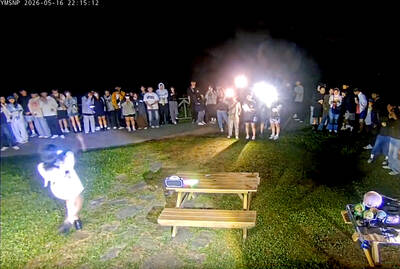
Yangmingshan National Park’s Qingtiangang (擎天崗) nature area has gone viral after a park livestream camera observed a couple in the throes of intimate congress, which was broadcast live on YouTube, drawing large late-night crowds and sparking a backlash over noise, bright lights and disruption to wildlife habitat. The area’s livestream footage appeared to show a couple engaging in sexual activity on a picnic table in the park on Friday last week, with the uncensored footage streamed publicly online. The footage quickly spread across social media, prompting a tide of visitors to travel to the site to “check in” and recreate the

Minister of Digital Affairs Lin Yi-ching (林宜敬) yesterday cited regulatory issues and national security concerns as an expert said that Taiwan is among the few Asian regions without Starlink. Lin made the remarks on Facebook after funP Innovation Group chief executive officer Nathan Chiu (邱繼弘) on Friday said Taiwan and four other countries in Asia — China, North Korea, Afghanistan and Syria — have no access to Starlink. Starlink has become available in 166 countries worldwide, including Ukraine, Malaysia, the Philippines and Vietnam, in the six years since it became commercial, he said. While China and North Korea block Starlink, Syria is not


 RSS
RSS