


Chinese Nationalist Party (KMT) Legislator Weng Hsiao-ling (翁曉玲) and Presidential Office Secretary-General Pan Men-an (潘孟安) traded barbs yesterday over prolonged vacancies on the Constitutional Court that have left the body severely understaffed for more than 18 months.
The dispute took place during a legislative committee session reviewing this year’s budget and work plans for the Presidential Office and the National Security Council.
During the hearing, Weng accused President William Lai (賴清德) of failing to fulfill his constitutional obligations by not submitting a new list of nominees to address the ongoing shortage.
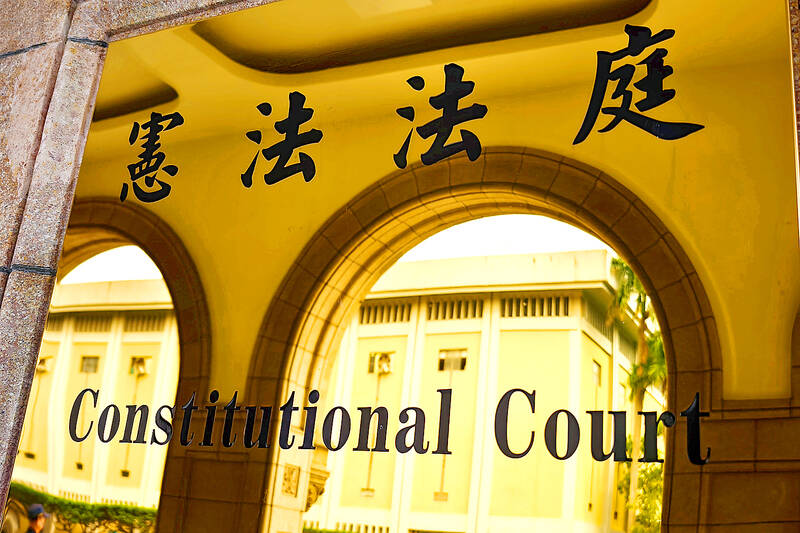
Photo: Wang Yi-sung, Taipei Times
There have been vacancies on the Constitutional Court since Oct. 31, 2024, when seven of the court’s 15 grand justices, including the chief justice and deputy chief justice, retired at the end of their eight-year terms.
Since then, Hsieh Ming-yang (謝銘洋) has served as acting president of the Judicial Yuan and acting chief justice of the Constitutional Court, while the vacancies remain unfilled.
Weng acknowledged that Lai had previously submitted two nomination lists, both of which were rejected by the legislature, where opposition parties hold a majority of seats, on Dec. 24, 2024, and July 25 last year.
However, she said that the president remains constitutionally obligated to continue nominating candidates until the vacancies are filled.
She questioned how long Hsieh would continue serving in an interim capacity, adding that Taiwan’s legal community includes far more qualified candidates than the 14 nominees already proposed.
Pan defended the administration’s handling of the issue, saying Lai had already nominated 14 legal experts in two separate rounds, all of whom were rejected by lawmakers.
“Should we keep submitting nominees only for them to be rejected again?” Pan asked, accusing legislators of subjecting respected legal experts to political attacks and humiliation during the confirmation process.
Weng countered that the Constitution requires the president to continue making nominations despite previous rejections.
Following the committee session, Pan clarified his remarks to reporters, walking back any implication that the administration would completely halt the nomination process.
He said that whether to submit new nominees is a decision for the president and not within the scope of his authority.
Pan said that his remarks were intended only to explain the process and rebut claims that the administration had failed to act.
“I was only stating the facts,” Pan said. “Whether or not to submit another list is the president’s authority.”
The political deadlock has significantly disrupted the court’s operations.
In late 2024, the legislature passed amendments to the Constitutional Court Procedure Act (憲法訴訟法) raising the minimum quorum for deliberations to 10 justices and requiring at least nine votes to declare a law unconstitutional, effectively paralyzing the court from operating with only eight grand justices.
However, the court resumed limited operations after contentiously striking down the amendments on Dec. 19 last year.
In that ruling, five of the remaining justices found the stricter quorum requirements unconstitutional, arguing that the reduced bench could continue hearing cases and issuing judgements.
Lawmakers from the opposition KMT and Taiwan People’s Party denounced the ruling, subsequently filing criminal malfeasance and abuse of power charges against the five justices.
The decision also exposed deep divisions within the judiciary, as three dissenting justices, all appointed by the ruling Democratic Progressive Party, said the ruling was invalid as the court lacked the 10-member threshold required at the time to issue such a constitutional judgement.
Under the Constitution, the Constitutional Court is composed of 15 grand justices, including the president and vice president of the Judicial Yuan.
All grand justices are nominated by the president and must receive confirmation from the Legislative Yuan before taking office.

Yangmingshan National Park authorities yesterday urged visitors to respect public spaces and obey the law after a couple was caught on a camera livestream having sex at the park’s Qingtiangang (擎天崗) earlier in the day. The Shilin Police Precinct in Taipei said it has identified a suspect and his vehicle registration number, and would summon him for questioning. The case would be handled in accordance with public indecency charges, it added. The couple entered the park at about 11pm on Thursday and began fooling around by 1am yesterday, the police said, adding that the two were unaware of the park’s all-day live

Fast food chain McDonald's is to raise prices by up to NT$5 on some products at its restaurants across Taiwan, starting on Wednesday next week, the company announced today. The prices of all extra value meals and sharing boxes are to increase by NT$5, while breakfast combos and creamy corn soup would go up by NT$3, the company said in a statement. The price of the main items of those meals, if ordered individually, would remain the same. Meanwhile, the price of a medium-sized lemon iced tea and hot cappuccino would rise by NT$3, extra dipping sauces for chicken nuggets would go up

Yangmingshan National Park’s Qingtiangang (擎天崗) nature area has gone viral after a park livestream camera observed a couple in the throes of intimate congress, which was broadcast live on YouTube, drawing large late-night crowds and sparking a backlash over noise, bright lights and disruption to wildlife habitat. The area’s livestream footage appeared to show a couple engaging in sexual activity on a picnic table in the park on Friday last week, with the uncensored footage streamed publicly online. The footage quickly spread across social media, prompting a tide of visitors to travel to the site to “check in” and recreate the

Minister of Digital Affairs Lin Yi-ching (林宜敬) yesterday cited regulatory issues and national security concerns as an expert said that Taiwan is among the few Asian regions without Starlink. Lin made the remarks on Facebook after funP Innovation Group chief executive officer Nathan Chiu (邱繼弘) on Friday said Taiwan and four other countries in Asia — China, North Korea, Afghanistan and Syria — have no access to Starlink. Starlink has become available in 166 countries worldwide, including Ukraine, Malaysia, the Philippines and Vietnam, in the six years since it became commercial, he said. While China and North Korea block Starlink, Syria is not


 RSS
RSS