


The Cabinet yesterday said that the nation’s semiconductor industry is “the result of long and painstaking independent development by local companies,” rejecting claims of theft by US President Donald Trump.
“They stole our chip industry... We lost our chip industry,” Trump said again in an interview with Fox News after his visit to Beijing last week.
He also blamed the decline of the US semiconductor industry on his predecessors’ failure to impose tariffs of as much as 200 percent on semiconductors manufactured in Taiwan.
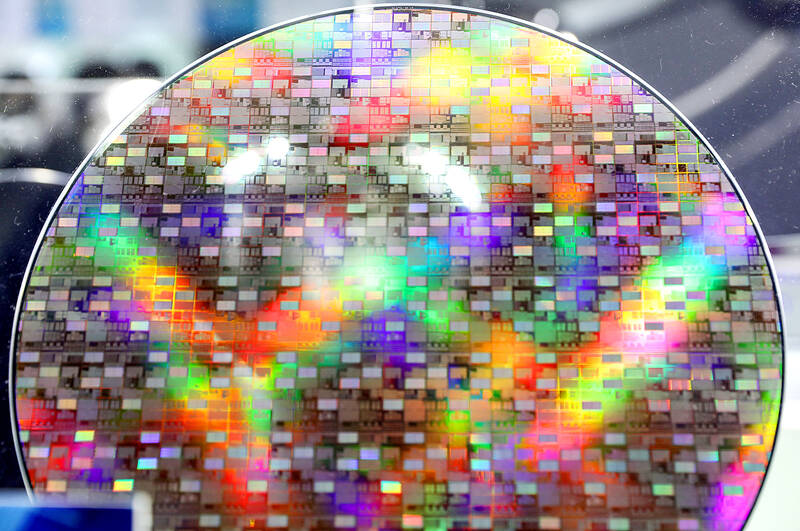
Photo: Cheng I-hwa, AFP
Executive Yuan spokeswoman Michelle Lee (李慧芝) rejected Trump’s comments at a weekly news conference, saying: “Taiwan supplies semiconductors to countries around the world.”
“It would not have achieved this level of competitiveness if it had relied on illegitimate means,” she said.
Lee added that Vice Premier Cheng Li-chiun (鄭麗君) explained to US negotiators during tariff talks that Taiwan’s semiconductor industry was the product of decades of development.
Separately yesterday, Executive Yuan Secretary-General Xavier Chang (張惇涵) said that Taiwan “did not steal chips from the world. It supplies them to the world,” when questioned by Chinese Nationalist Party (KMT) Legislator Hung Mong-kai (洪孟楷) at the legislature in Taipei.
Chang said the technologies developed by Taiwan Semiconductor Manufacturing Co (TSMC) were the result of three decades of refinement following a technology transfer agreement between Taiwan and Radio Corp of America (RCA).
The remarks by the Cabinet officials came a day after Taiwanese tech mogul Robert Tsao (曹興誠), founder of United Microelectronics Corp, urged the government to respond to Trump’s claims.
Tsao said Trump’s accusations could have serious implications, as they constituted a diplomatically hostile gesture and were being used to justify efforts to pressure Taiwanese chipmakers to establish production facilities in the US.
He urged the Executive Yuan, the Industrial Technology Research Institute (ITRI) and TSMC to hold a news conference detailing the origins of Taiwan’s semiconductor technology, and the decades of investment and research and development that had gone into building the industry to “set the record straight.”
Tsao on social media said that Taiwan’s chipmaking expertise originated from a US$3.5 million technology transfer deal with RCA in 1976, under which ITRI acquired 7-micrometer complementary metal-oxide-semiconductor manufacturing technology.

Yangmingshan National Park authorities yesterday urged visitors to respect public spaces and obey the law after a couple was caught on a camera livestream having sex at the park’s Qingtiangang (擎天崗) earlier in the day. The Shilin Police Precinct in Taipei said it has identified a suspect and his vehicle registration number, and would summon him for questioning. The case would be handled in accordance with public indecency charges, it added. The couple entered the park at about 11pm on Thursday and began fooling around by 1am yesterday, the police said, adding that the two were unaware of the park’s all-day live

Fast food chain McDonald's is to raise prices by up to NT$5 on some products at its restaurants across Taiwan, starting on Wednesday next week, the company announced today. The prices of all extra value meals and sharing boxes are to increase by NT$5, while breakfast combos and creamy corn soup would go up by NT$3, the company said in a statement. The price of the main items of those meals, if ordered individually, would remain the same. Meanwhile, the price of a medium-sized lemon iced tea and hot cappuccino would rise by NT$3, extra dipping sauces for chicken nuggets would go up

Yangmingshan National Park’s Qingtiangang (擎天崗) nature area has gone viral after a park livestream camera observed a couple in the throes of intimate congress, which was broadcast live on YouTube, drawing large late-night crowds and sparking a backlash over noise, bright lights and disruption to wildlife habitat. The area’s livestream footage appeared to show a couple engaging in sexual activity on a picnic table in the park on Friday last week, with the uncensored footage streamed publicly online. The footage quickly spread across social media, prompting a tide of visitors to travel to the site to “check in” and recreate the

Minister of Digital Affairs Lin Yi-ching (林宜敬) yesterday cited regulatory issues and national security concerns as an expert said that Taiwan is among the few Asian regions without Starlink. Lin made the remarks on Facebook after funP Innovation Group chief executive officer Nathan Chiu (邱繼弘) on Friday said Taiwan and four other countries in Asia — China, North Korea, Afghanistan and Syria — have no access to Starlink. Starlink has become available in 166 countries worldwide, including Ukraine, Malaysia, the Philippines and Vietnam, in the six years since it became commercial, he said. While China and North Korea block Starlink, Syria is not


 RSS
RSS