


Two Polish men have been accused of attempting to smuggle heroin into Taiwan by swallowing capsules of the drug wrapped in multiple layers of latex, the Coast Guard Administration’s (CGA) Investigation Branch said.
The two men, aged 39 and 30, were intercepted at customs and each excreted nearly 100 capsules of heroin, at a total weight of 1kg, the branch said.
The latex-wrapped pellets weighed about 10g each, and could remain in the stomach for one to two weeks, making them highly discreet and difficult to detect, investigators said.
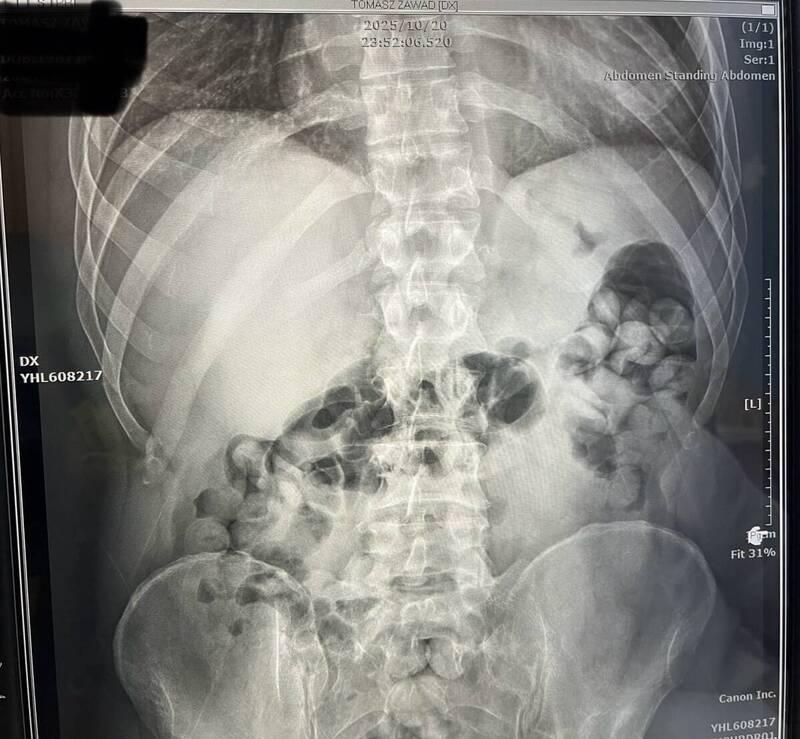
Photo copied by Cheng Ching-yi, Taipei Times
Body-packers — drug mules who ingest contraband — typically carry no more than about 1kg of narcotics, police said, adding that such cases are difficult to investigate, as authorities often cannot confirm their suspicions without reliable intelligence and sufficient evidence to obtain warrants from prosecutors.
The practice poses serious health risks to couriers, as the capsules can become lodged in the intestines or rupture inside the body, potentially resulting in death without emergency surgery, they said.
In addition to body-packing, some smugglers hide drugs in false compartments of checked luggage to evade X-ray machines, they said.
International drug syndicates typically source heroin from the Golden Triangle in Thailand and recruit people from European nations who are struggling financially with promises of high payouts, directing them to enter Taiwan on tourist visas, the branch said.
Working closely with US Homeland Security Investigations, the branch has cracked 14 cross-border airport drug trafficking cases since October last year, arresting 22 suspects, it said.
Of the 14 cases, 11 involved body-packing and three involved hidden luggage compartments, with all successful interceptions relying heavily on real-time international intelligence sharing, police said.
The joint operation seized a total of 23.3kg of heroin, or the equivalent of 62 heroin bricks, at an estimated street value of more than NT$80 million (US$2.53 million), which could have supplied as many as 770,000 doses, authorities said.
Of the 22 suspects arrested, six were Polish, five were Taiwanese, three were Thai, three were Hungarians, two were from the US, two were Latvians and one was French, they said, adding that some have been indicted.

Yangmingshan National Park authorities yesterday urged visitors to respect public spaces and obey the law after a couple was caught on a camera livestream having sex at the park’s Qingtiangang (擎天崗) earlier in the day. The Shilin Police Precinct in Taipei said it has identified a suspect and his vehicle registration number, and would summon him for questioning. The case would be handled in accordance with public indecency charges, it added. The couple entered the park at about 11pm on Thursday and began fooling around by 1am yesterday, the police said, adding that the two were unaware of the park’s all-day live

Fast food chain McDonald's is to raise prices by up to NT$5 on some products at its restaurants across Taiwan, starting on Wednesday next week, the company announced today. The prices of all extra value meals and sharing boxes are to increase by NT$5, while breakfast combos and creamy corn soup would go up by NT$3, the company said in a statement. The price of the main items of those meals, if ordered individually, would remain the same. Meanwhile, the price of a medium-sized lemon iced tea and hot cappuccino would rise by NT$3, extra dipping sauces for chicken nuggets would go up
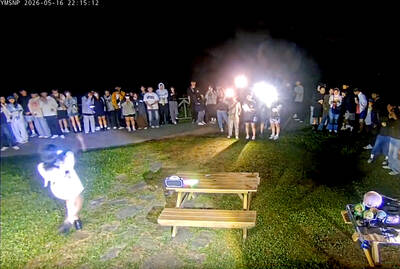
Yangmingshan National Park’s Qingtiangang (擎天崗) nature area has gone viral after a park livestream camera observed a couple in the throes of intimate congress, which was broadcast live on YouTube, drawing large late-night crowds and sparking a backlash over noise, bright lights and disruption to wildlife habitat. The area’s livestream footage appeared to show a couple engaging in sexual activity on a picnic table in the park on Friday last week, with the uncensored footage streamed publicly online. The footage quickly spread across social media, prompting a tide of visitors to travel to the site to “check in” and recreate the

Minister of Digital Affairs Lin Yi-ching (林宜敬) yesterday cited regulatory issues and national security concerns as an expert said that Taiwan is among the few Asian regions without Starlink. Lin made the remarks on Facebook after funP Innovation Group chief executive officer Nathan Chiu (邱繼弘) on Friday said Taiwan and four other countries in Asia — China, North Korea, Afghanistan and Syria — have no access to Starlink. Starlink has become available in 166 countries worldwide, including Ukraine, Malaysia, the Philippines and Vietnam, in the six years since it became commercial, he said. While China and North Korea block Starlink, Syria is not


 RSS
RSS